Blog
1 September، 2026
How to Choose the Right Arabic Calligraphy Designer
Choosing the right Arabic Calligraphy Designer is about much more than finding someone who can write beautiful Arabic letters. A strong designer understands proportion, letter structure, composition, cultural context, visual balance, and the purpose behind the artwork. The right professional should also be able to translate your idea into a finished piece that feels authentic, readable, and visually appropriate for its intended setting.
Whether you need artwork for your home, a creative project, a brand identity, an exhibition, or Arabic Wedding Invitations, it helps to evaluate a designer's artistic approach, experience, portfolio, communication, and ability to meet your requirements.
For people searching for an Arabic Calligraphy Artist in the United States, this guide explains what to look for, which questions to ask, how the design process usually works, and how to make a confident decision without choosing based on appearance alone.
Read More
Key Takeaways
- The best Arabic Calligraphy Designer for a project should understand both the artistic and linguistic aspects of Arabic lettering.
- A portfolio should show consistency, authentic calligraphic structure, different compositions, and work relevant to your intended project.
- Traditional Arabic Calligraphy and contemporary styles serve different visual purposes, so identify the style you want before commissioning artwork.
- A professional Arabic Calligraphy Service should clearly explain the creative process, revisions, deliverables, timelines, and usage rights.
- Digital tools such as an Arabic Calligraphy Generator can be useful for experimentation, but they do not necessarily provide the artistic judgment, custom composition, and human craftsmanship of a specialist.
- Clear communication about the Arabic text, intended use, dimensions, preferred style, and budget can significantly improve the final result.
What Does an Arabic Calligraphy Designer Do?
An Arabic Calligraphy Designer creates visually refined Arabic lettering for artistic, cultural, decorative, commercial, or personal purposes. Their work can involve handwritten calligraphy, digital compositions, custom lettering, logo-style artwork, wall pieces, invitations, manuscripts, or mixed-media designs. The role combines several disciplines. A designer needs knowledge of Arabic letterforms and calligraphic rules while also understanding composition, spacing, hierarchy, contrast, and visual presentation. Arabic calligraphy is particularly sensitive to proportion. Small changes in the relationship between letters, dots, spacing, and line structure can affect both readability and aesthetics. A skilled designer therefore considers the Arabic text as a complete visual composition rather than simply converting words into decorative lettering. Depending on the project, the designer may work in established styles such as Thuluth, Naskh, Diwani, Kufic, or Ruq'ah, or develop a more contemporary interpretation inspired by traditional principles.Why Choosing the Right Designer Matters
Arabic calligraphy carries linguistic, artistic, and cultural meaning. The appearance of a finished design can influence how the words are understood and experienced. A visually attractive design may still be unsuitable if the Arabic text has been altered incorrectly, the composition makes reading difficult, or the selected style does not fit the purpose. For example, artwork intended for a formal cultural setting may benefit from a disciplined traditional approach, while a modern interior design project might call for Contemporary Arabic Calligraphy with a cleaner composition. The designer's role is to balance meaning and aesthetics. This becomes particularly important for religious phrases, names, poetry, quotations, and personalized artwork. The source text should be verified carefully before the design process begins.Start by Defining Your Project
Before contacting an Arabic calligraphy professional, define what you actually need. This makes it easier to identify a designer whose skills match your project. Consider the following questions: What Arabic text do you want to use? Where will the artwork be displayed or published? Do you prefer Traditional Arabic Calligraphy, contemporary lettering, or a combination of traditional principles with a modern visual treatment? What size should the final artwork be? Will it be printed, framed, engraved, embroidered, displayed digitally, or used online? Do you need a specific color palette? Do you require a particular file format? Will the artwork be used personally or commercially? The more information you can provide, the easier it becomes for the designer to understand your expectations.Examine the Arabic Calligraphy Portfolio
A portfolio is one of the most useful ways to assess an Arabic Calligraphy Artist. Do not judge a portfolio only by asking whether the artwork looks attractive. Examine the details. Look for consistency in letter proportions, spacing, composition, line flow, and overall balance. Check whether the designer can work with different compositions rather than repeatedly producing nearly identical designs. A strong portfolio may include examples of traditional pieces, modern compositions, personalized artwork, decorative projects, or digital applications. Pay particular attention to projects similar to yours. If you need a wedding design, look for relevant invitation or event work. If you need wall artwork, examine large-format compositions. If you need a digital identity, review examples that demonstrate clean digital execution. A portfolio should help you answer one important question: Can this designer achieve the visual language my project requires?Understand Traditional Arabic Calligraphy
Traditional Arabic Calligraphy is built around established scripts, proportions, techniques, and artistic conventions. Styles such as Thuluth, Naskh, Diwani, Kufic, and Ruq'ah each have distinct characteristics. Understanding these differences can help you communicate more effectively with a designer. Thuluth is often recognised for its expressive curves, elongated forms, and strong presence. Naskh is associated with clarity and readability. Kufic is known for its geometric qualities and can work particularly well in structured compositions. Diwani is often recognised for its flowing and decorative appearance. A knowledgeable designer should be able to explain why a particular style may suit your text and intended application. You do not necessarily need to become an expert in Arabic scripts before commissioning artwork. However, knowing the basic distinction between traditional scripts and contemporary interpretations can help you make better creative decisions.Consider Contemporary Arabic Calligraphy
Contemporary Arabic Calligraphy expands the visual possibilities of traditional lettering. Designers may experiment with composition, scale, negative space, geometric forms, color, texture, layering, and digital techniques while retaining recognizable elements of Arabic calligraphic aesthetics. This approach can work well in modern interiors, exhibitions, creative campaigns, digital artwork, and design projects that require a distinctive visual identity. Modern Arabic Calligraphy does not have to abandon traditional principles. In many strong compositions, contemporary design builds on the foundations of classical calligraphy while introducing a different visual context. When reviewing a designer's work, look for evidence that experimentation is intentional rather than simply decorative.Check Linguistic Accuracy
A beautiful calligraphic composition still needs accurate Arabic text. Before approving artwork, verify the spelling, wording, diacritics where relevant, and intended meaning. This is especially important for names, quotations, poetry, religious passages, and personalized messages. If the designer does not speak Arabic fluently, that does not automatically mean they cannot create good calligraphy. However, the text should come from a reliable source and be independently verified when accuracy is important. For personalized work, provide the exact Arabic wording rather than asking the designer to translate an English phrase unless translation is specifically part of the service. A professional should also be comfortable asking for clarification when the supplied text is ambiguous.Look for Genuine Artistic Skill
Arabic calligraphy requires more than selecting an attractive font. A specialist may understand how letterforms are constructed, how strokes interact, how spacing affects rhythm, and how individual letters behave when combined into a larger composition. This distinction is especially relevant when considering an Arabic Calligraphy Generator. Automated tools can be useful for exploring ideas quickly, but generated lettering may not provide the same level of custom composition, artistic judgment, refinement, and personal interpretation as commissioned work. A human designer can make decisions based on the exact text, available space, intended mood, cultural context, and physical or digital application. For a unique artwork, those decisions can make a substantial difference.Ask About the Design Process
A clear process is a positive sign when selecting an Arabic Calligraphy Service. While every artist works differently, a professional project often follows a structure similar to this:1. Project Brief
You provide the Arabic text, purpose, dimensions, preferred style, references, and other requirements.2. Creative Direction
The designer discusses suitable calligraphic approaches, composition ideas, and presentation options.3. Initial Concepts
Depending on the project, the designer may develop sketches or preliminary compositions before refining the selected direction.4. Refinement
The chosen concept is carefully developed with attention to letter structure, spacing, balance, and overall presentation.5. Final Artwork
The completed artwork is supplied in the agreed format and specifications. A clearly defined process reduces misunderstandings and gives both sides a shared understanding of what will be delivered.Ask About Revisions and Deliverables
Before commissioning a project, clarify what is included. Ask how many revision rounds are provided, what constitutes a revision, which file formats you will receive, and whether the final artwork is supplied in high resolution. For digital projects, common requirements may include formats such as PNG, JPEG, PDF, SVG, or other vector formats depending on the application. For printed artwork, ask about the appropriate resolution and dimensions. If the artwork will be used commercially, clarify usage rights and licensing. Personal display, social media use, merchandise, packaging, advertising, and resale can involve different requirements. These details are easier to resolve before the work begins than after the final artwork has been delivered.Consider the Designer's Communication Style
Artistic ability is important, but communication also affects the quality of a commissioned project. A good designer should listen carefully to your requirements, ask useful questions, explain relevant creative decisions, and communicate clearly about the project scope. Be cautious of unclear expectations on either side. If you cannot explain what you need, the designer may have difficulty interpreting the brief. Similarly, if important details about the process are not discussed beforehand, misunderstandings can arise later. Good communication does not mean agreeing with every suggestion. It means having a constructive conversation about what will work best for the project.Think About Budget and Value
The cost of Arabic calligraphy can vary significantly depending on the complexity of the artwork, amount of customization, technique, size, delivery format, timeline, and intended usage. A simple digital composition may require considerably less work than a highly detailed custom artwork created for physical production. Instead of focusing only on the lowest price, consider what is included in the service. A professional quote may cover creative development, custom lettering, revisions, final artwork preparation, and usage considerations. Ask for a clear project estimate before work begins. The goal should be to understand the value and scope of the service rather than treating calligraphy as a standard one-size-fits-all product.Choosing an Arabic Calligrapher for Wedding Invitations
Arabic Wedding Invitations require special attention because the calligraphy becomes part of an important personal occasion. Names, dates, venues, family names, and quotations should be checked carefully before final approval. The style should also complement the invitation's overall design. Elegant flowing calligraphy may create a different impression from geometric Kufic-inspired lettering or a minimalist contemporary composition. If the invitation is bilingual, consider how the Arabic and English typography will interact. The two scripts do not need to look identical, but they should feel visually balanced within the overall layout. A designer experienced with personalized invitation work can help create an Arabic element that feels integrated rather than added as an afterthought.Ask These Questions Before Hiring an Arabic Calligraphy Designer
Before starting a project, a short conversation can reveal whether a designer is suitable. Useful questions include:- Which Arabic calligraphy styles do you specialize in?
- Can you create custom compositions rather than using standard digital fonts?
- How do you verify the accuracy of the Arabic text?
- Can you provide examples similar to my project?
- What information do you need from me before starting?
- How does your revision process work?
- Which final file formats will I receive?
- What are the expected turnaround times?
- Are commercial usage or licensing requirements included?
- How is the final artwork prepared for printing or digital use?
Look for a Balance of Tradition and Creativity
The strongest Calligraphy Arabic Art can respect established principles while still feeling appropriate for its intended environment. A designer should understand when restraint is more effective than excessive decoration. They should also know how to use negative space, scale, alignment, contrast, and composition to give the lettering room to breathe. For a traditional artwork, this may mean preserving the character of a classical script. For a contemporary project, it may mean adapting calligraphic elements into a more experimental composition. The right approach depends on the text and purpose.Choosing a Professional Arabic Calligraphy Website
An Arabic Calligraphy Website can provide useful insight before you make contact with a designer. Look beyond the homepage. Explore portfolio pages, project descriptions, service information, artist background, and contact details. A well-organized website can help you understand the designer's artistic focus and the types of commissions they accept. For example, Nihad Dukhan provides an online place to explore the work and artistic direction associated with Nihad Dukhan. The website should not be your only basis for a decision, but it can be a useful starting point for understanding an artist's work.When an Arabic Calligraphy Workshop May Help
If your interest extends beyond commissioning artwork, an Arabic Calligraphy Workshop can provide a different type of experience. Workshops can introduce participants to calligraphic principles, tools, letter construction, scripts, composition, and the discipline involved in developing handwriting. Learning even the basics can change the way you evaluate finished calligraphy. You begin to notice spacing, stroke control, proportions, and the relationship between individual letters. For people interested in developing their own skills, a workshop can be a valuable introduction before pursuing more advanced study.Red Flags to Watch For
A few warning signs deserve attention before commissioning artwork. Be cautious when a portfolio provides no indication of the designer's own work, project terms are consistently unclear, or the designer cannot explain how the Arabic text will be handled. Unclear pricing, vague deliverables, unrealistic promises, or pressure to approve work without reviewing the text can also create unnecessary problems. Another concern is a portfolio that appears heavily dependent on generic digital fonts when the project specifically requires custom calligraphy. The goal is not to find a designer who claims to do everything. It is to find someone whose demonstrated skills match your particular needs.How Nihad Dukhan Fits Into the Selection Process
For anyone researching an Arabic Calligraphy Designer in the United States, Nihad Dukhan offers a place to explore professional Arabic calligraphy work and determine whether the artistic style aligns with a particular project. Rather than choosing an artist solely because of a keyword or search result, take time to review the available artwork, understand the designer's creative approach, and communicate your requirements clearly. You can explore the work and available information through the Nihad Dukhan website. The most productive starting point is a clear brief. Include your Arabic text, intended application, preferred aesthetic, dimensions, deadline, and any relevant visual references.Frequently Asked Questions
1. What should I look for in an Arabic Calligraphy Designer?
Look for strong knowledge of Arabic calligraphy, authentic letter construction, a relevant portfolio, attention to detail, clear communication, and a well-defined design process. The designer should be able to create artwork suited to your specific purpose rather than relying only on generic templates.2. How much does Arabic calligraphy design cost?
Pricing varies according to customization, complexity, size, technique, revisions, turnaround time, and intended usage. The best approach is to provide a clear project brief and request a quote based on the actual requirements.3. What is the difference between traditional and modern Arabic calligraphy?
Traditional Arabic Calligraphy generally follows established scripts and principles developed through the history of Arabic calligraphic practice. Modern or contemporary approaches may incorporate traditional letterforms while experimenting with composition, scale, materials, digital techniques, and visual presentation.4. Is an Arabic Calligraphy Generator suitable for professional artwork?
An Arabic Calligraphy Generator can be useful for exploring concepts or producing quick lettering, but it may not offer the custom composition and artistic refinement required for specialized artwork. A professional calligrapher can adapt the lettering to the project's exact context and visual requirements.5. Can an Arabic Calligraphy Artist create personalized wedding artwork?
Yes. Personalized calligraphy can be created for names, invitations, quotations, signage, keepsakes, and other wedding materials. Accuracy is particularly important, so all names, dates, and Arabic wording should be carefully checked before final approval.6. How do I know if Arabic calligraphy is authentic?
Look for evidence of correct letter proportions, consistent structure, appropriate spacing, and knowledge of established scripts. A knowledgeable artist should also be able to explain the stylistic approach used in the artwork.7. What information should I give a calligraphy designer?
Provide the exact Arabic text, intended use, dimensions, preferred style, visual references, color preferences, deadline, and required file format. If the artwork will be used commercially, also explain the intended usage.8. Should I choose a traditional or contemporary Arabic calligraphy style?
Choose based on the project's purpose and visual setting. Traditional styles can provide a connection to established calligraphic heritage, while contemporary approaches may work better for modern interiors, creative projects, branding, or experimental artwork.9. Can Arabic calligraphy be delivered as digital artwork?
Yes. Arabic calligraphy can be prepared for many digital and print applications. The appropriate file format depends on how the artwork will be used, so discuss technical requirements with the designer before the final artwork is prepared.Conclusion
Choosing the right Arabic Calligraphy Designer starts with understanding your project and evaluating more than visual appeal. Look at the designer's portfolio, knowledge of Arabic scripts, linguistic accuracy, creative process, communication, deliverables, and experience with projects similar to yours. The right artist should be able to balance meaning, craftsmanship, composition, and your intended visual direction. That balance is what turns Arabic lettering into thoughtful Calligraphy Arabic Art. If you are exploring custom Arabic calligraphy for a personal, artistic, cultural, wedding, interior, or creative project, visit Nihad Dukhan to explore the work and learn more about the available artistic direction.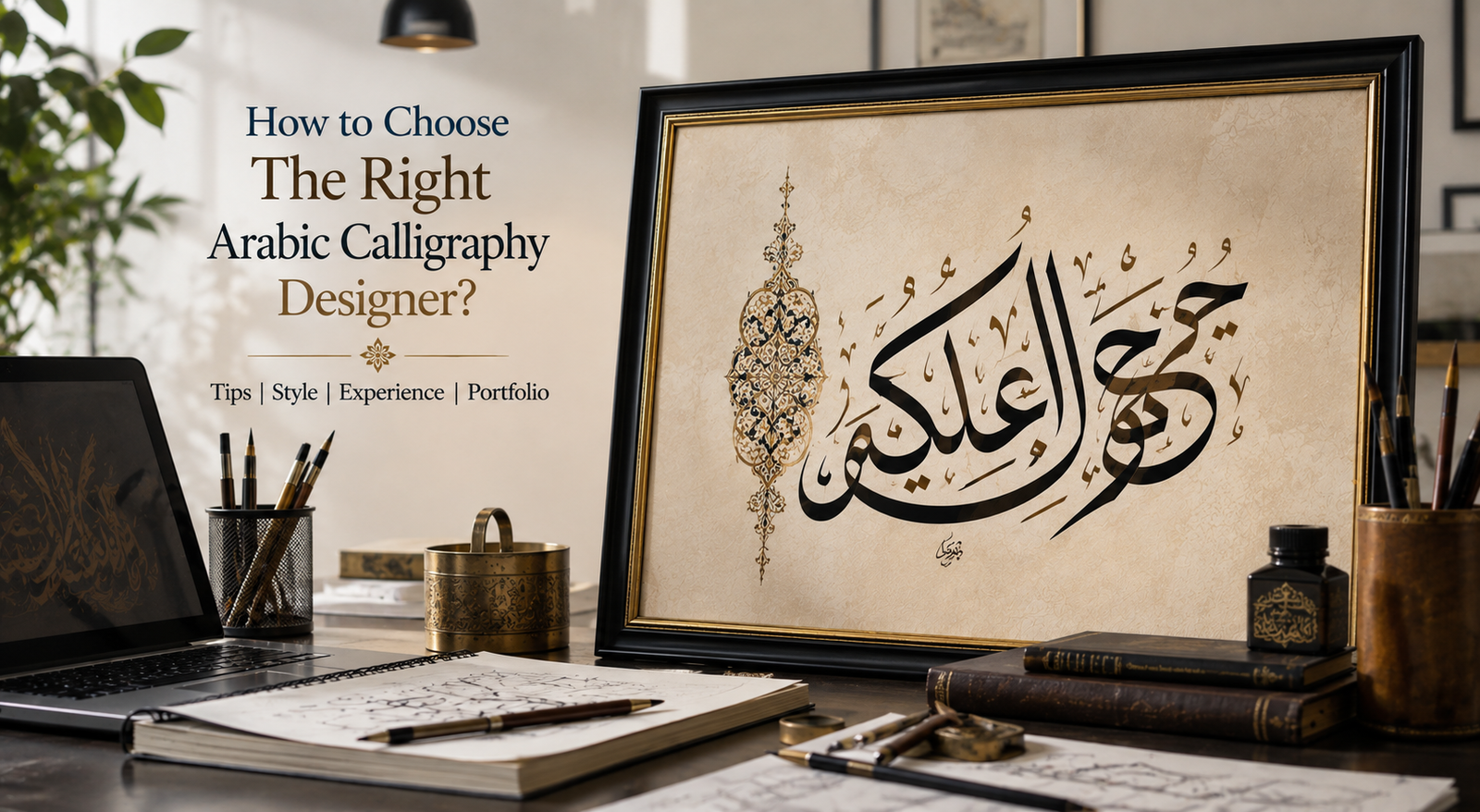
1 September، 2026
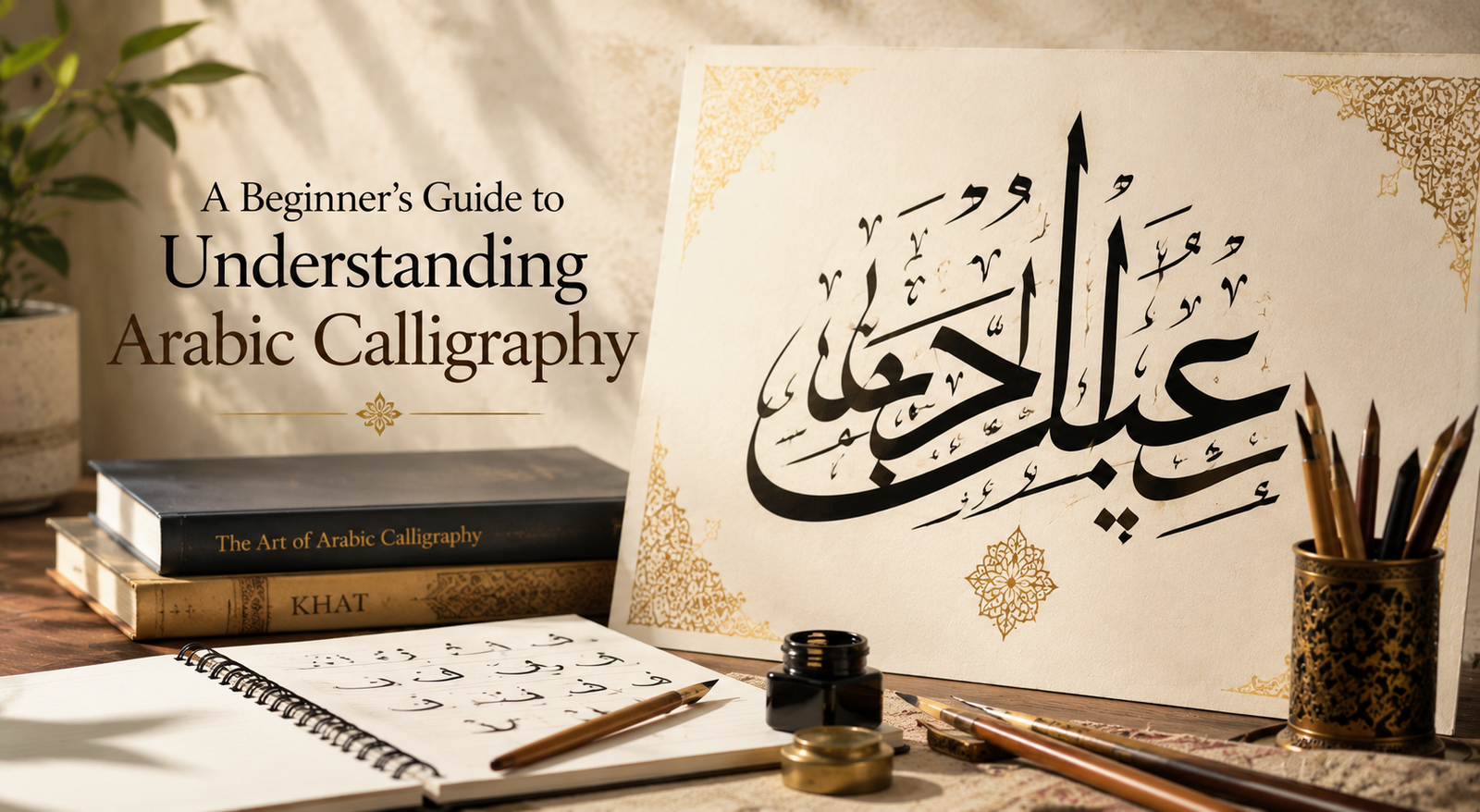
A Beginner’s Guide to Understanding Arabic Calligraphy
Arabic calligraphy is more than decorative handwriting. It is an art form built around proportion, rhythm, balance, letter structure, and cultural meaning. For centuries, artists have transformed Arabic letters into carefully composed visual expressions, and today the tradition continues through both classical techniques and contemporary creative approaches.
For beginners, Arabic calligraphy can initially seem complex because Arabic letters change shape depending on their position in a word, while established calligraphic styles follow precise rules. The good news is that you do not need to master every style or technique at once. Understanding the foundations, major styles, tools, and artistic principles provides a strong starting point.
This guide introduces the essential concepts behind Arabic calligraphy, explains how traditional and modern approaches differ in practice, and offers practical advice for anyone interested in learning, collecting, commissioning, or simply appreciating this distinctive art form.
Read More
Key Takeaways
- Arabic calligraphy is a visual art based on letter proportions, spacing, rhythm, and composition, not simply attractive handwriting.
- Traditional Arabic calligraphy includes established styles such as Thuluth, Naskh, Diwani, Kufic, and Ruq'ah, each with its own visual characteristics and applications.
- Modern and contemporary Arabic calligraphy can combine classical letterforms with abstract compositions, unconventional layouts, color, and mixed media.
- A skilled Arabic calligraphy artist needs both technical control and an understanding of Arabic letter structure, composition, and visual balance.
- Digital tools and an Arabic calligraphy generator can help with experimentation, but they do not necessarily reproduce the intentional craftsmanship of a trained calligrapher.
- Beginners can develop their skills by studying letter proportions, practicing individual forms, learning one style at a time, and gradually building complete compositions.
What Is Arabic Calligraphy?
Arabic calligraphy is the artistic practice of writing Arabic letters in carefully designed forms. The discipline combines writing and visual composition, using line quality, proportions, spacing, repetition, and rhythm to create an aesthetically balanced result. Arabic calligraphy has developed across different historical periods and regions, resulting in numerous scripts and artistic traditions. Some styles were closely associated with manuscripts and formal writing, while others became popular for architectural decoration, official documents, poetry, invitations, and artistic compositions. The appeal of calligraphy Arabic art comes partly from the flexibility of the Arabic script. Letters can connect naturally, curves can create movement, and words can be arranged into compositions that function almost like visual architecture. For this reason, Arabic calligraphy can communicate meaning through both language and form. A viewer may understand the written phrase while also responding to its visual rhythm, symmetry, movement, or emotional character.Why Is Arabic Calligraphy Considered an Art Form?
Arabic calligraphy becomes art when writing is deliberately shaped and composed for visual expression. A calligrapher considers factors such as:- Letter proportions
- Stroke thickness
- Curvature
- Vertical and horizontal movement
- Spacing between letters and words
- Overall composition
- Visual balance
- Contrast and rhythm
- Relationship between text and surrounding space
Understanding Traditional Arabic Calligraphy
Traditional Arabic calligraphy refers to established calligraphic practices that developed according to recognized rules, letter proportions, and methods of execution. Several major styles are important for beginners to recognize.Thuluth
Thuluth is known for its large, flowing letterforms and strong visual presence. It has historically been used for architectural inscriptions, religious texts, manuscripts, and decorative compositions. Its sweeping curves and complex connections make it visually impressive, but mastering it requires patience and careful practice.Naskh
Naskh is generally more compact and highly readable than some decorative scripts. It has played an important role in manuscript writing and Arabic typography. Because of its clarity, Naskh is also useful for beginners who want to understand fundamental Arabic letter proportions and connections.Kufic
Kufic is one of the best-known early Arabic scripts. Its forms can appear angular, geometric, and structured. Contemporary artists continue to reinterpret Kufic characteristics in architectural designs, logos, posters, patterns, and abstract compositions.Diwani
Diwani is recognized for its flowing, rounded, and highly decorative appearance. Historically associated with Ottoman administrative writing, it can create dense and elegant compositions. Its intricate letter connections make it particularly suitable for decorative artistic applications.Ruq'ah
Ruq'ah is generally simpler and more compact than highly ornamental scripts. It became widely used for everyday handwriting because it can be written relatively quickly. For a beginner, learning to recognize Ruq'ah helps demonstrate how Arabic writing can vary according to purpose and context.How Arabic Calligraphy Works
One of the most important things to understand is that Arabic letters do not always have one fixed visual shape. A letter may change depending on whether it appears at the beginning, middle, or end of a word, or whether it stands alone. Connections between letters also influence the final appearance. Calligraphers therefore learn individual letterforms as well as combinations and relationships. A typical learning process might begin with:- Understanding the Arabic alphabet.
- Studying basic letter proportions.
- Practicing individual letters.
- Learning connected letter combinations.
- Reproducing short words.
- Practicing complete phrases.
- Developing spacing and composition.
- Creating finished calligraphic artwork.
The Importance of Proportion and Geometry
Proportion is fundamental to Arabic calligraphy. Traditional calligraphers often use the shape of the writing instrument's nib and established proportional systems to determine letter dimensions. Small differences in height, width, angle, or curvature can significantly change the character of a script. The concept of the dot is particularly important in traditional practice. A calligrapher can use the width of the nib to establish a reference unit for measuring elements of letters. This creates consistency across a composition. Even artists working in Modern Arabic Calligraphy benefit from understanding these traditional principles. Modern work may intentionally stretch, simplify, rearrange, or abstract letters, but a strong understanding of structure gives the artist greater control over those creative decisions.Traditional and Contemporary Arabic Calligraphy
Traditional and contemporary approaches exist within the same broader artistic discipline, but they can have different visual goals. Traditional work generally places greater emphasis on established scripts, proportions, tools, and rules. Contemporary Arabic calligraphy may retain recognizable Arabic letterforms while exploring abstraction, unusual compositions, mixed media, typography, painting, digital techniques, or other artistic methods. Contemporary Arabic calligraphy does not necessarily mean abandoning tradition. Many artists study classical scripts first and then use that knowledge as a foundation for experimentation. This relationship between heritage and innovation is one reason Arabic calligraphy continues to appear relevant in galleries, homes, cultural projects, publications, fashion, architecture, and contemporary design.What Does an Arabic Calligraphy Artist Do?
An Arabic Calligraphy Artist creates visual compositions using Arabic script as the primary artistic language. The role can involve much more than writing a requested phrase. Depending on the project, an artist may need to:- Interpret the meaning of the text
- Select an appropriate calligraphic style
- Develop a composition
- Adjust proportions and spacing
- Consider the intended viewing distance
- Select materials or digital techniques
- Balance text with negative space
- Refine individual strokes
- Prepare the final artwork for its intended setting
What Makes a Skilled Arabic Calligraphy Designer?
An Arabic Calligraphy Designer combines calligraphic knowledge with design thinking. The distinction is especially useful when calligraphy needs to function within a larger visual project. For example, a designer may need to consider how a calligraphic composition works on a wall, invitation, artwork, publication, packaging, or digital screen. Important qualities include technical accuracy, strong composition, attention to spacing, understanding of visual hierarchy, and the ability to adapt lettering to different formats. A designer also needs to understand when a composition requires simplicity and when additional ornamentation would improve the result.Choosing an Arabic Calligraphy Style for Your Project
The right style depends on the purpose, text, mood, format, and desired visual character. For example, a formal composition may benefit from an established classical script. A geometric architectural project may suit a structured Kufic-inspired treatment. A highly decorative personal artwork may call for flowing forms. If you are commissioning work, start by explaining the purpose of the artwork rather than requesting a particular style without context. Useful information includes:- The exact Arabic text
- Translation or intended meaning
- Where the artwork will be displayed
- Desired dimensions
- Preferred artistic direction
- Whether the work should feel traditional or contemporary
- Color or material preferences
- Deadline, if applicable
Arabic Calligraphy for Weddings and Special Events
Arabic calligraphy can add a personal artistic element to wedding stationery and other celebrations. Arabic wedding invitations may incorporate names, meaningful phrases, dates, or traditional expressions. The calligraphy can become a central visual feature or work as a subtle decorative element. For an invitation, readability matters. Highly complex lettering may look beautiful as standalone artwork but can become difficult to read when reduced to a small printed format. A practical approach is to decide which words should receive the strongest visual emphasis and then build the rest of the layout around them. The same principle applies to certificates, family artwork, commemorative pieces, and personalized gifts.What Is an Arabic Calligraphy Service?
An Arabic Calligraphy Service generally refers to professional creation of custom Arabic lettering or calligraphic artwork for a specific purpose. The exact scope can vary. A commissioned service might involve a handwritten original, custom artwork, digital artwork, wall piece, event stationery, or another tailored application. Before commissioning a project, clarify what the final deliverable includes. Ask about the artwork format, dimensions, revision process, materials, delivery method, and intended usage. The price of custom calligraphy can vary considerably because there is no single standard rate. Complexity, size, materials, artistic technique, amount of customization, and project requirements can all affect the final cost.Can an Arabic Calligraphy Generator Replace a Calligrapher?
An Arabic Calligraphy Generator can be useful for experimenting with Arabic text, visual concepts, and digital lettering. However, automated generation should not automatically be treated as equivalent to handcrafted calligraphy. A trained calligrapher evaluates details that software may not handle according to the artistic traditions involved, including intentional stroke behavior, proportional relationships, composition, and the visual character of a particular script. Digital generators can be useful during the idea stage. For important artwork, however, it is sensible to verify the Arabic text carefully and consider whether the desired result requires human artistic control. This is particularly important for names, quotations, religious text, and personalized commissions because even a small textual error can change the intended meaning.Learning Arabic Calligraphy: Where Should Beginners Start?
The best way to learn is to focus on fundamentals before attempting complicated artwork. Start with one script rather than trying to learn several at once. Study the shapes of its letters, understand how the letters connect, and practice slowly. A beginner can build a routine around short sessions. Consistency is generally more useful than trying to complete a large amount of practice in a single sitting. Pay close attention to: Stroke control: Learn how changes in pressure, direction, and movement affect the line. Letter proportion: Study how tall, wide, curved, or compact each form should be within the chosen script. Spacing: Practice the relationship between letters and words rather than treating each letter as an isolated object. Rhythm: Look at how repeated strokes create movement throughout a composition. Negative space: Empty areas are part of the design. Crowding can make even technically accurate calligraphy feel unbalanced.Should You Attend an Arabic Calligraphy Workshop?
An Arabic Calligraphy Workshop can be valuable for beginners because an instructor can demonstrate techniques that are difficult to understand from static examples alone. A workshop may introduce participants to writing tools, nib preparation, ink handling, basic strokes, letter construction, and composition. When selecting a workshop, look for one that matches your experience level. Beginners usually benefit from instruction that prioritizes foundational technique instead of immediately focusing on elaborate finished artwork. If possible, review the instructor's work and understand what the workshop actually teaches before enrolling.Traditional Tools Used in Arabic Calligraphy
Traditional calligraphy has its own specialized tools. A traditional setup may include a reed pen, ink, paper, and an appropriate writing surface. The reed pen, often known as a qalam, is prepared with a carefully shaped nib. The angle and cut of the nib affect the character of the stroke. Ink consistency also matters because it influences flow, darkness, and control. Modern artists may combine these traditional tools with brushes, markers, digital tablets, vector software, painting materials, or other media. The tool can change the appearance of the artwork, but the underlying principles of proportion, rhythm, and composition remain important.Modern Arabic Calligrapher and Contemporary Creative Practice
A Modern Arabic Calligrapher may work between traditional calligraphy and contemporary visual art. Modern work can explore large-scale compositions, abstraction, layered lettering, unconventional orientation, mixed materials, color, and digital production. The strongest contemporary work often has a recognizable relationship with Arabic script even when the final composition moves beyond conventional writing. For viewers, this creates an interesting way to experience Arabic language and visual culture through an artistic perspective.How to Appreciate Arabic Calligraphy
You do not need to be able to read Arabic fluently to appreciate calligraphic artwork, although understanding the written meaning can add another layer of appreciation. When looking at a piece, consider:- How the letters move across the composition
- Where the visual weight is concentrated
- How empty space is used
- Whether the lettering feels balanced
- How individual strokes interact
- Whether the composition emphasizes particular words
- How the script relates to the artwork's purpose
Finding a Reliable Arabic Calligraphy Website
An Arabic Calligraphy Website can be a useful starting point when researching artists, viewing portfolios, understanding services, or exploring commissioned artwork. Look for clear examples of the artist's work and enough information to understand their artistic approach. A strong portfolio should help you evaluate consistency, craftsmanship, composition, and the types of projects the artist creates. For those exploring Arabic calligraphy in the United States, an online portfolio can also make it easier to discover artists whose work aligns with a particular artistic direction before discussing a custom project. Nihad Dukhan provides an online space at ndukhan.com where visitors can explore Arabic calligraphy work and learn more about the artist's creative practice. Visit Nihad Dukhan's websiteCommon Mistakes Beginners Make
Beginners often focus heavily on producing attractive finished pieces before developing control over individual letters. A better approach is to slow down and study the foundations. Another common mistake is switching between multiple scripts too quickly. Each script has its own visual language, so frequent switching can make it harder to recognize the structural differences. Beginners may also underestimate the importance of spacing. Even accurately formed letters can create a weak composition if they are positioned too closely or too far apart. Finally, avoid treating digital calligraphy as simply a shortcut to traditional practice. Digital tools can be valuable, but understanding the principles behind the lettering remains essential.How to Commission Custom Arabic Calligraphy
If you want a personalized piece, prepare the text carefully before contacting an artist. If the phrase is translated from another language, have the Arabic wording verified by someone qualified rather than relying entirely on automated translation. Then explain how you intend to use the artwork. For example, a commissioned piece might be intended for a home, office, wedding, cultural project, gift, exhibition, or digital application. The context can influence the composition, dimensions, materials, and level of detail. An experienced artist can then recommend an approach based on the project's artistic and practical requirements.Frequently Asked Questions About Arabic Calligraphy
1. What is Arabic calligraphy?
Arabic calligraphy is the artistic practice of creating visually balanced Arabic lettering through controlled strokes, proportions, spacing, rhythm, and composition. It has both historical traditions and contemporary artistic applications.2. What are the main types of Arabic calligraphy?
Major traditional styles include Thuluth, Naskh, Kufic, Diwani, and Ruq'ah. Each has distinctive letterforms, proportions, and historical uses.3. Is Arabic calligraphy difficult to learn?
It can take considerable practice because Arabic calligraphy involves precise letter construction, proportions, stroke control, and spacing. Beginners can make steady progress by focusing on one script and practicing its fundamental forms consistently.4. Can I create Arabic calligraphy digitally?
Yes. Digital tools can be used to create, refine, and experiment with Arabic lettering. However, the quality of the result depends on the tool and the user's understanding of Arabic letterforms and composition.5. What is the difference between traditional and modern Arabic calligraphy?
Traditional Arabic calligraphy generally follows established scripts and proportional rules. Modern Arabic calligraphy may incorporate those foundations while exploring abstraction, unconventional layouts, digital techniques, mixed media, and contemporary design approaches.6. How much does custom Arabic calligraphy cost?
There is no universal price. Cost can depend on the complexity, size, materials, technique, customization, and intended application of the artwork. A custom quote is usually more appropriate than relying on a standard price.7. Can Arabic calligraphy be used for wedding invitations?
Yes. Arabic calligraphy can be used for names, dates, phrases, headings, and decorative elements in wedding invitations. The lettering should be selected with the invitation's size, readability, and overall layout in mind.8. What should I look for in the best Arabic calligrapher for a project?
Look for strong technical control, a relevant portfolio, thoughtful composition, clear communication, and experience with the type of project you have in mind. The best choice depends on how well the artist's approach fits your specific requirements.9. Where can I learn more about Arabic calligraphy art?
You can explore established calligraphic traditions, study contemporary artists, attend an Arabic Calligraphy Workshop, visit exhibitions, and review artist portfolios online. Nihad Dukhan's website is one place to explore contemporary Arabic calligraphy and related artistic work.Conclusion
Arabic calligraphy brings language and visual art together through structure, movement, proportion, and meaning. Its history includes highly developed traditional scripts, while contemporary artists continue to explore new ways of presenting Arabic letters. For beginners, the most useful starting point is not trying to master everything immediately. Choose a script, study its structure, practice basic strokes, pay attention to spacing, and gradually build complete compositions. Understanding the foundations makes it easier to appreciate both traditional work and modern artistic interpretations. For anyone interested in exploring professionally created Arabic Calligraphy, including contemporary compositions and custom artwork, visit Nihad Dukhan to discover the artist's work and learn more about the creative possibilities of Arabic script. Explore Arabic Calligraphy by Nihad Dukhan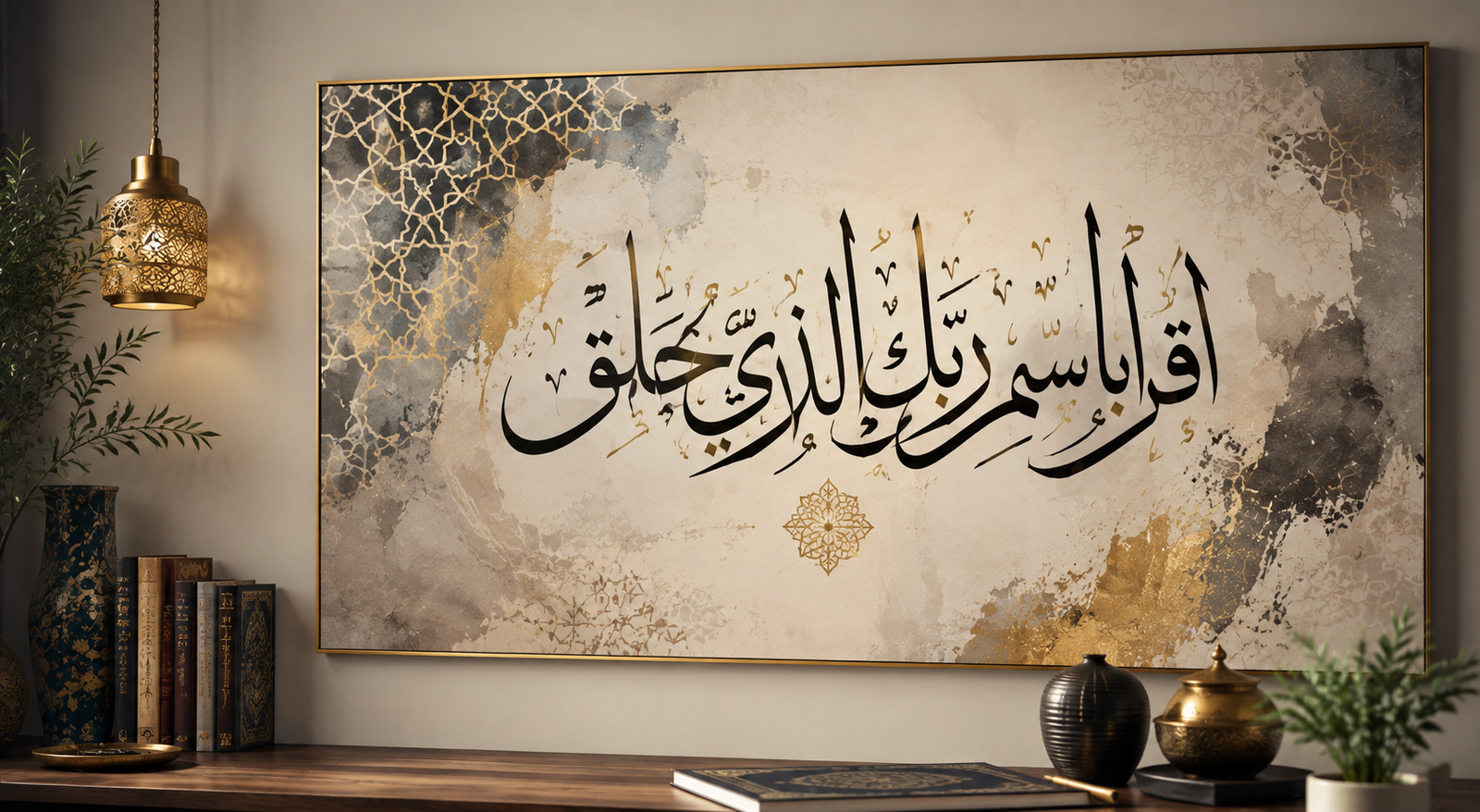
1 September، 2026
How Modern Islamic Calligraphy Is Shaping Contemporary Art?
Islamic calligraphy has long been recognised for its disciplined letterforms, spiritual depth, and remarkable visual beauty. Today, the art form is finding new expression through Modern Islamic Calligraphy, where established calligraphic principles meet contemporary composition, materials, colour, and artistic experimentation.
Modern Islamic Calligraphy does not simply replace traditional practice with something new. Instead, it builds on centuries of knowledge while giving artists greater freedom to explore scale, abstraction, negative space, mixed media, and modern interiors. This has helped Islamic Calligraphy Art reach galleries, homes, cultural spaces, weddings, design projects, and private collections across the United States and beyond.
For viewers, the appeal goes beyond decoration. A carefully created calligraphic work can connect language, faith, architecture, history, and personal identity within a single visual composition. That combination is one reason contemporary Islamic calligraphy continues to develop as an important part of contemporary art.
Read More
Key Takeaways
- Modern Islamic Calligraphy combines traditional calligraphic foundations with contemporary approaches to composition, materials, colour, and presentation.
- Contemporary artists can preserve the identity of Arabic script while experimenting with abstraction, scale, texture, geometry, and negative space.
- Islamic Calligraphy Wall Art can function as both meaningful artwork and an intentional element of interior design.
- Custom pieces are particularly suitable for meaningful occasions, including weddings, family celebrations, cultural spaces, and private collections.
- A strong contemporary calligraphy piece should balance visual creativity with respect for the written language and the meaning of the text.
- Choosing an artist for a custom commission should involve reviewing their portfolio, discussing the intended text, understanding the creative process, and confirming the final format.
What Is Modern Islamic Calligraphy?
Modern Islamic Calligraphy is an evolving form of calligraphic art that uses the foundations of Islamic and Arabic calligraphy while exploring contemporary artistic ideas. Traditional calligraphy places significant emphasis on proportion, letter construction, rhythm, spacing, balance, and disciplined execution. Modern practitioners may retain these principles while introducing new compositions, unconventional layouts, modern colour palettes, large-scale formats, textured surfaces, digital preparation, or mixed media. The result can range from highly refined script-based compositions to more abstract artworks in which letters become part of a larger visual structure. The key distinction is that modern does not necessarily mean disconnected from tradition. Many contemporary works remain deeply influenced by established calligraphic practices while responding to modern tastes and spaces.How Islamic Calligraphy Became Part of Contemporary Art
Islamic calligraphy has historically occupied a special position within visual culture because written language itself can become an artistic medium. Across different periods and regions, calligraphic styles developed distinctive characteristics. Scripts such as Kufic, Thuluth, Naskh, Diwani, and others demonstrate how Arabic lettering can be transformed through proportion, geometry, curvature, density, and rhythm. Contemporary artists inherit this rich visual vocabulary but are not limited to historical presentation methods. A modern composition might place carefully constructed lettering within an open field of negative space. Another may build an entire artwork around the repetition of a letterform. A large-scale piece might use layered textures to create visual depth, while a minimalist work may rely almost entirely on proportion and spacing. This freedom has expanded the role of Islamic Calligraphy from a primarily script-focused discipline into a broader artistic language.What Makes Contemporary Islamic Calligraphy Different?
Contemporary Islamic Calligraphy often focuses on how traditional script can communicate visually within modern artistic environments. Several characteristics commonly appear in contemporary work.Experimental Composition
Traditional calligraphy can follow established arrangements, while contemporary artists may explore asymmetry, circular compositions, fragmented structures, vertical arrangements, or carefully controlled abstraction. The composition remains intentional. Even when a piece appears spontaneous, successful work usually depends on careful decisions about spacing, visual weight, hierarchy, and movement.Modern Materials
Ink and paper remain important, but contemporary artists can work across a much wider range of surfaces and media. Depending on the project, calligraphy may be incorporated into canvas, wood, textured surfaces, architectural installations, digital artwork, or mixed-media pieces. Material selection affects the character of the finished work. A textured surface may create depth, while a smoother surface can emphasise precision and delicate letterforms.Colour and Visual Contrast
Traditional calligraphy is often associated with restrained palettes, but modern artists can explore a broader range of colours. Colour can establish mood, separate layers, create focal points, or help integrate the artwork with its surroundings. In a contemporary interior, for example, the colour strategy may be designed to complement the architecture without overpowering the written form.Abstraction
Abstraction is one of the most interesting developments in contemporary calligraphy. An artist may emphasise the rhythm and geometry of letters without presenting them in a conventional linear arrangement. Curves, dots, strokes, and repeated forms can become visual elements in their own right. However, abstraction requires care. When meaningful text is involved, artistic experimentation should not unnecessarily compromise legibility or the integrity of the script.The Relationship Between Traditional and Modern Islamic Calligraphy
Modern Islamic Calligraphy is strongest when creativity is supported by a serious understanding of traditional foundations. Traditional Islamic Calligraphy is not simply an old decorative technique. It involves established principles concerning letter proportions, stroke relationships, spacing, rhythm, and composition. Contemporary artists can reinterpret these principles rather than discard them. For example, an artist may use the proportional discipline of a traditional script while arranging the text within a highly contemporary geometric composition. Another artist might retain classical letter construction but introduce unconventional scale or surface texture. This relationship between continuity and experimentation gives contemporary Islamic calligraphy its distinctive character.Why Islamic Calligraphy Art Has Strong Contemporary Appeal
Islamic Calligraphy Art occupies an unusual position because it can communicate meaning and visual beauty simultaneously. A painting may create emotion through colour, shape, and texture. Calligraphy can do this while also carrying the meaning of written language. For many viewers, the artwork therefore has multiple layers. There is the visual layer, created through composition and form. There is the linguistic layer, created through the written text. There may also be a cultural, historical, or spiritual layer depending on the subject. This depth allows calligraphy to work particularly well in spaces where art is expected to have personal or cultural significance.Islamic Calligraphy Wall Art in Contemporary Interiors
Islamic Calligraphy Wall Art has become a natural choice for people looking for artwork that feels meaningful while fitting into modern interiors. The scale and composition of a calligraphic piece can influence how a room feels. A large artwork can create a strong focal point, while a smaller piece may contribute to a more intimate gallery-style arrangement. Placement matters as much as the artwork itself. Consider:- The available wall space
- Viewing distance
- Lighting conditions
- Existing architectural features
- Colour relationships
- The visual weight of surrounding furniture
- Whether the artwork is intended as a focal point or part of a collection
The Growing Interest in Custom Islamic Calligraphy
Custom Islamic Calligraphy allows a client to commission artwork around a particular text, occasion, space, or personal idea. This makes the process different from selecting a ready-made print. A custom project typically begins with understanding what the client wants the artwork to communicate. The artist then considers the wording, script, composition, dimensions, materials, and visual direction. For example, someone may want a meaningful calligraphic composition for a home, while another client may need artwork designed specifically for a large architectural wall. Customisation can therefore involve much more than simply changing the text. The entire visual structure can be developed around the intended purpose.Islamic Wedding Calligraphy: Creating Meaningful Artwork for Special Occasions
Islamic Wedding Calligraphy can add a deeply personal artistic element to wedding celebrations and related spaces. A custom wedding piece might incorporate meaningful Arabic text, names, dates, or other appropriate elements, depending on the client's requirements and the artist's approach. The strongest wedding calligraphy is not simply attractive. It should feel connected to the occasion. The artwork may later become part of the couple's home, allowing it to continue carrying personal significance after the celebration has ended. When commissioning such work, it is useful to discuss the wording carefully, confirm spelling and diacritical requirements where relevant, and review the proposed composition before production.Islamic Calligraphy Prints and Original Artwork
Islamic Calligraphy Prints make calligraphic artwork more accessible for people who want to incorporate the visual language of the art form into their homes or workspaces. Prints can reproduce an original composition while offering flexibility in size and presentation. They can be framed individually or incorporated into a broader wall arrangement. Original artwork, on the other hand, provides the physical qualities of the artist's chosen materials, including surface texture, brush or pen work, layering, and other details that may not be fully represented in reproduction. The right format depends on the intended setting, budget, scale, and importance of the piece.How an Islamic Calligraphy Commission Typically Works
An Islamic Calligraphy Commission is most successful when communication between artist and client is clear from the beginning. A typical process may include the following stages.1. Define the Purpose
Start by identifying where the artwork will be displayed and what role it should play. Is it intended for a home, office, wedding, cultural environment, gift, collection, or architectural space?2. Select the Text
The wording is central to the project. Clients should establish the exact text before the final artwork is produced. For meaningful or sacred text, accuracy deserves particular attention.3. Discuss the Artistic Direction
This is where the client and artist can discuss script preferences, overall composition, scale, materials, colours, and the desired visual character.4. Develop the Composition
The artist creates a visual structure that considers letterforms, spacing, balance, negative space, and the relationship between text and surrounding elements.5. Review and Refine
Depending on the project, preliminary concepts may be reviewed before the final artwork is produced. Clear feedback at this stage can help prevent misunderstandings later.6. Final Production
Once the direction is approved, the artist completes the work using the selected materials and format. The final presentation may include framing, mounting, or another suitable method depending on the project.How Much Does Custom Islamic Calligraphy Cost?
The cost of Custom Islamic Calligraphy can vary substantially because each commission is different. Factors that can influence pricing include the complexity of the composition, artwork size, materials, level of customisation, production method, preparation time, finishing requirements, and whether the piece is an original artwork or reproduction. A small, relatively simple composition will generally involve a different level of work from a large, highly detailed original piece designed for a specific architectural space. For an accurate estimate, clients should provide the artist with the intended text, approximate dimensions, preferred format, desired materials if known, and information about where the work will be displayed.How to Choose an Islamic Calligraphy Artist
Choosing an artist should involve more than looking for an attractive finished image. A portfolio can reveal how consistently an artist handles lettering, composition, scale, and different artistic approaches. Look for evidence that the artist understands both the visual and linguistic dimensions of calligraphy. It is also useful to ask about the creative process. Questions might include:- How is the text checked before final production?
- Which calligraphic styles does the artist work with?
- Can the composition be customised for a particular space?
- What materials and formats are available?
- How are revisions handled?
- What information is needed before a commission begins?
The Role of the Artist in Preserving Meaning While Exploring New Forms
Modernisation creates opportunities, but it also creates responsibility. Arabic script has an established visual structure, and meaningful texts require appropriate care. An artist working in contemporary Islamic calligraphy needs to balance experimentation with respect for the text. That balance can be seen in decisions about letter proportions, spacing, readability, composition, and material treatment. The goal is not necessarily to make every piece traditional or every piece abstract. The goal is to create a coherent artwork in which the written form and artistic concept support each other. This is one reason technical knowledge remains important even in highly contemporary work.How Modern Islamic Calligraphy Is Influencing Contemporary Art
The influence of Modern Islamic Calligraphy can be seen in several broader developments within contemporary visual culture. First, it challenges the idea that writing and visual art must remain separate. Letters can function simultaneously as language and image. Second, it encourages artists to explore cultural identity through contemporary visual methods. Rather than presenting heritage only through historical reproduction, artists can engage with it through new forms. Third, calligraphy demonstrates how disciplined structure can coexist with artistic experimentation. The strongest contemporary compositions often depend on both freedom and control. Finally, modern calligraphy can create a bridge between personal expression and shared cultural visual language. This makes it relevant not only to galleries but also to homes, public environments, celebrations, and design-led spaces.Exploring Modern Islamic Calligraphy with Nihad Dukhan
For those interested in contemporary approaches to Islamic and Arabic calligraphy, Nihad Dukhan offers a dedicated artistic perspective on the relationship between calligraphic tradition and contemporary visual expression. Visitors can explore the artist's work, artistic approach, and available calligraphy projects through the official website. Explore Nihad Dukhan's calligraphy work For a potential commission, it is helpful to approach the artist with clear information about the desired text, approximate size, intended location, and overall artistic direction. This gives the artist a stronger foundation for developing a piece that fits both the meaning and the physical environment.The Future of Contemporary Islamic Calligraphy
The future of Contemporary Islamic Calligraphy is likely to remain diverse because the art form can evolve without abandoning its historical foundations. Artists can continue exploring new surfaces, scales, digital processes, architectural applications, and mixed-media approaches while maintaining the core importance of Arabic lettering. Technology may also influence how artists plan and present their work. Digital tools can assist with composition and visualisation, while the physical artwork can still depend on traditional artistic skills and handcrafted techniques. What remains important is the relationship between form and meaning. As contemporary audiences increasingly look for artwork that reflects identity, culture, craftsmanship, and personal significance, calligraphy has a strong foundation from which to continue evolving.Frequently Asked Questions About Modern Islamic Calligraphy
What is Modern Islamic Calligraphy?
Modern Islamic Calligraphy is a contemporary approach to Islamic and Arabic calligraphic art that combines traditional principles of lettering and composition with modern artistic techniques, materials, layouts, and visual concepts.Is Modern Islamic Calligraphy still based on traditional techniques?
It can be. Many contemporary artists study traditional calligraphic principles and then reinterpret them through modern compositions, materials, scale, colour, or abstraction. Modern work can therefore maintain a strong connection to traditional practice.What is the difference between Islamic Calligraphy Art and ordinary decorative lettering?
Islamic Calligraphy Art is rooted in the artistic treatment of Arabic or other scripts associated with Islamic visual culture. It can involve established calligraphic principles concerning proportion, letter construction, rhythm, and composition rather than simply using decorative fonts.Can I commission Custom Islamic Calligraphy for my home?
Yes. A custom piece can be designed around your preferred text, dimensions, artistic direction, and intended display space. Discussing the room and available wall area with the artist can help determine an appropriate composition.Is Islamic Calligraphy suitable for wedding artwork?
Yes. Islamic Wedding Calligraphy can provide meaningful artwork for wedding celebrations and can also become a lasting piece for the couple's home. The wording, spelling, composition, and design should be agreed carefully before production.What should I provide for an Islamic Calligraphy Commission?
Useful information includes the exact text, intended purpose, approximate dimensions, preferred style if you have one, display location, preferred materials, and any important design requirements. Reference images can also help communicate your preferred visual direction.Are Islamic Calligraphy Prints available in different sizes?
Print formats can vary depending on the artwork and production method. Size, framing, paper or other presentation materials, and intended display location should be discussed when selecting a print.How do I choose the right Islamic Calligraphy Wall Art?
Consider the meaning of the text, the size of the available wall, viewing distance, lighting, interior surroundings, and the visual character of the artwork. A strong choice should work both aesthetically and contextually within the intended space.Can contemporary calligraphy be abstract?
Yes. Contemporary Islamic calligraphy can use abstraction to emphasise the movement, geometry, rhythm, and visual structure of letters. The level of abstraction should suit the purpose of the artwork and the importance of maintaining the intended meaning.Conclusion
Modern Islamic Calligraphy demonstrates how an established artistic tradition can continue to evolve without losing its connection to language, craftsmanship, and cultural meaning. Through experimental compositions, contemporary materials, abstraction, and thoughtful integration into modern spaces, calligraphy has expanded its role within contemporary art. From Islamic Calligraphy Wall Art and prints to Custom Islamic Calligraphy, wedding pieces, and commissioned artworks, the possibilities are broad. Yet the foundation remains the same: thoughtful lettering, disciplined composition, meaningful text, and respect for the artistic tradition. If you would like to explore contemporary Islamic calligraphy and discover the work of Nihad Dukhan, visit the official website to view the artist's portfolio and learn more about available artistic projects. Visit Nihad Dukhan's official website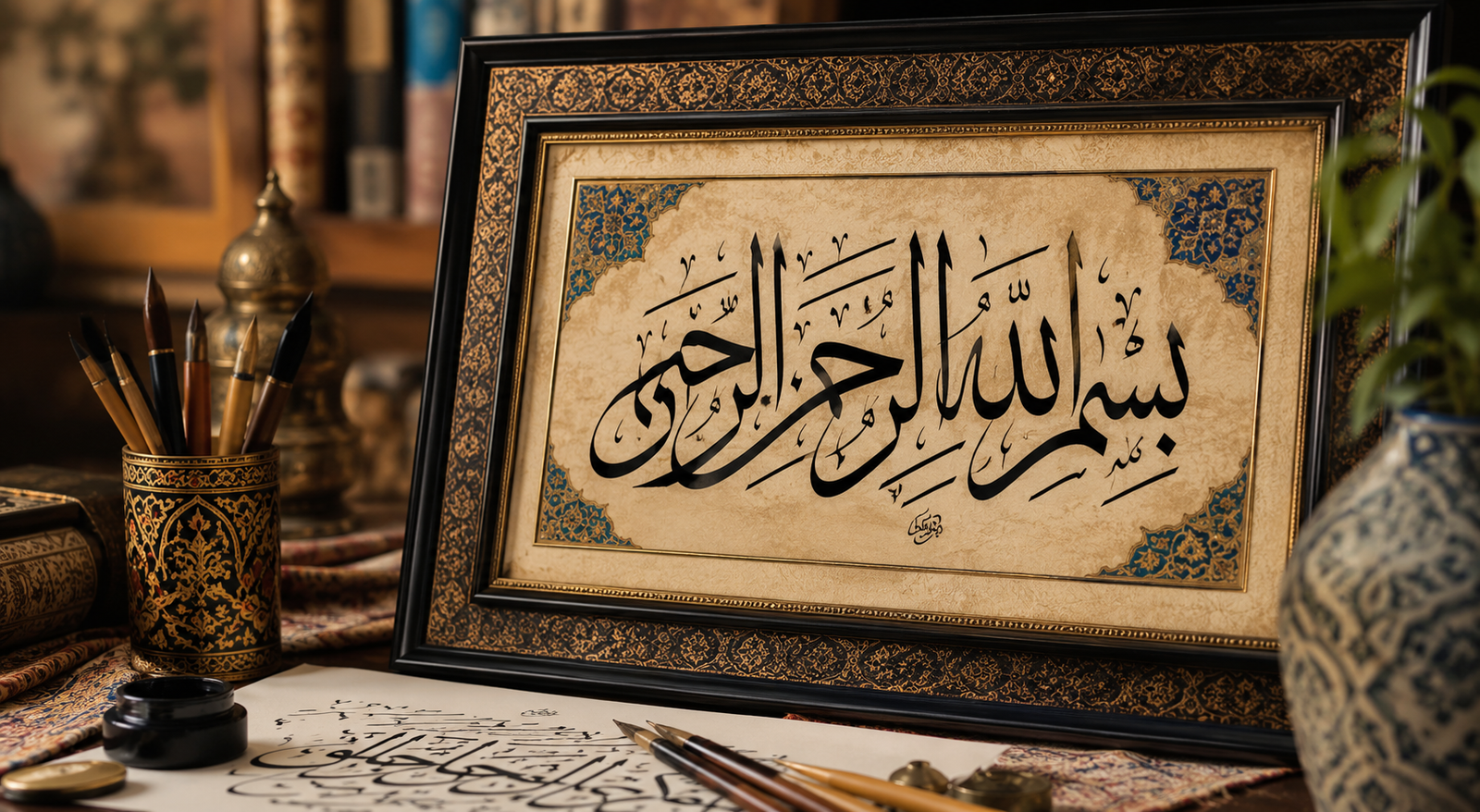
1 September، 2026
Islamic Calligraphy: Exploring Beauty, Form & Meaning
Islamic calligraphy is more than beautiful Arabic lettering. It is a visual art form shaped by language, proportion, rhythm, spirituality, and centuries of artistic tradition. From carefully written Qur'anic verses to contemporary compositions created for homes, weddings, and meaningful spaces, Islamic calligraphy continues to evolve while preserving its connection to Arabic script and Islamic culture.
For many people in the United States, Islamic calligraphy offers a meaningful way to bring faith, heritage, identity, and artistic expression into everyday surroundings. Understanding its styles, techniques, symbolism, and applications can help you appreciate the art more deeply and choose the right piece for your own space or occasion.
Read More
Key Takeaways
- Islamic calligraphy combines writing and visual art, using Arabic script, proportion, spacing, composition, and rhythm to create meaningful artwork.
- Traditional Islamic calligraphy includes established scripts such as Thuluth, Naskh, Diwani, and Kufic, each with distinctive visual characteristics and historical uses.
- Modern Islamic calligraphy can reinterpret traditional scripts through contemporary compositions, colors, layouts, and artistic techniques while maintaining respect for the written text.
- Islamic calligraphy wall art and prints can add cultural and spiritual meaning to homes, offices, prayer spaces, and community environments.
- Custom Islamic calligraphy is particularly suitable for meaningful phrases, names, verses, wedding artwork, gifts, and commissioned pieces where personalization matters.
- Choosing a calligraphy artist involves considering script knowledge, composition, craftsmanship, cultural sensitivity, and the intended use of the artwork, rather than appearance alone.
What Is Islamic Calligraphy?
Islamic calligraphy is the artistic practice of writing Arabic and other scripts associated with Islamic artistic traditions in a visually refined and intentional manner. It can incorporate Qur'anic verses, prophetic sayings, prayers, Arabic poetry, names, meaningful phrases, or other culturally significant text. The defining feature is not simply the use of Arabic letters. Skilled Islamic calligraphy depends on the relationship between individual letters, words, lines, spacing, proportions, and the overall composition. A calligrapher may spend considerable time studying how a particular letter is formed, how it connects to neighboring letters, and how the complete text should occupy a page or artistic surface. This makes Islamic calligraphy both a writing discipline and a visual art. The artwork can be highly traditional, carefully following established rules, or more contemporary, using creative layouts and artistic treatments while retaining the character of the script.Why Is Islamic Calligraphy Important?
Islamic calligraphy has a particularly significant place in Islamic art because written language has historically been central to the transmission and presentation of religious knowledge. Arabic calligraphy became especially prominent in the decoration of manuscripts, architectural spaces, ceramics, textiles, metalwork, and other artistic objects. Qur'anic text has been an important subject within the tradition, although Islamic calligraphy also extends beyond religious scripture. Its importance comes from several interconnected elements:Language as Art
Arabic letters have distinctive shapes, connections, curves, and proportions. When arranged by an experienced calligrapher, written language can become an intricate visual composition.Discipline and Precision
Traditional calligraphy requires control of the writing instrument, consistency of proportions, careful spacing, and an understanding of established scripts. The disciplined nature of the practice is part of its artistic character.Cultural Identity
For many people, Arabic calligraphy represents language, heritage, family history, and cultural identity. A carefully selected piece can therefore have meaning beyond decoration.Spiritual Expression
Religious verses, prayers, and phrases can provide a visual reminder of faith and reflection. The meaning of the text remains an important part of the artwork.Major Styles of Traditional Islamic Calligraphy
Traditional Islamic calligraphy encompasses numerous scripts and regional approaches. Each script has its own proportions, shapes, rhythm, and historical associations.Thuluth
Thuluth is recognized for its elegant, flowing forms and strong vertical elements. It has historically been used in architectural inscriptions, manuscripts, and decorative compositions. Its visual presence makes it particularly effective when the calligraphy itself is intended to become a major part of the artwork.Naskh
Naskh is known for its clarity and balanced letterforms. It has played an important role in manuscript production and the writing of Arabic texts. Because of its readability, Naskh demonstrates how calligraphy can remain artistic while also serving a practical communication purpose.Kufic
Kufic is one of the most recognizable early Arabic scripts. Its angular and geometric character makes it particularly suitable for architectural decoration and contemporary geometric compositions. Modern artists may draw inspiration from Kufic structures when creating minimalist Islamic calligraphy art.Diwani
Diwani is known for its flowing appearance and closely arranged letterforms. Historically associated with Ottoman administrative contexts, it later became appreciated as a decorative calligraphic style. Its complex visual rhythm can create highly expressive compositions.Nastaliq and Other Regional Traditions
Nastaliq developed primarily within Persianate calligraphic traditions and is strongly associated with Persian writing. Other scripts and regional approaches also demonstrate how Islamic calligraphy developed across different cultures and languages. This broader history is important because Islamic calligraphy is not a single visual style. It represents a wide artistic landscape shaped by different communities, periods, languages, and aesthetic traditions.Modern Islamic Calligraphy and Contemporary Expression
Modern Islamic calligraphy builds upon traditional knowledge while allowing artists greater freedom in composition and presentation. A contemporary calligrapher might use traditional letterforms but arrange them in an unconventional composition. Another artist may combine Arabic lettering with geometric forms, abstract backgrounds, carefully selected colors, or minimalist design. The goal does not have to be abandoning tradition. Instead, contemporary Islamic calligraphy can create a dialogue between established calligraphic principles and modern visual culture. This approach is particularly relevant to interior design in the United States, where people may want artwork that reflects Islamic identity while fitting naturally into contemporary homes and workspaces. Good modern Islamic calligraphy still depends on understanding the script. Creative freedom works best when it is supported by strong knowledge of letter construction, proportions, composition, and the meaning of the written text.Islamic Calligraphy Art: More Than Decoration
The visual beauty of Islamic calligraphy can immediately attract attention, but the meaning behind the words often gives the artwork its deeper significance. Consider a piece featuring a short prayer. The composition may be visually elegant, but the viewer may also connect with the words personally. Similarly, an Arabic name rendered artistically can represent family, heritage, or identity. A Qur'anic verse may serve as a meaningful reminder within a prayer area or home. This combination of form and meaning is one of the strongest characteristics of Islamic calligraphy art. A successful composition considers both:- What the text means
- How the text looks
- How the letters interact
- How much visual space the composition needs
- Where the artwork will be displayed
- How easily the text can be understood or appreciated
How Is Islamic Calligraphy Created?
Creating high-quality calligraphy involves much more than copying Arabic text into a decorative font. A traditional approach begins with selecting and preparing the text. The artist must pay close attention to spelling, letterforms, diacritical marks, and the intended meaning. The script is then considered. Different texts may work better with different visual structures depending on their length, purpose, and desired presentation.1. Text Selection
The first step is identifying exactly what will be written. For religious content, accuracy is especially important.2. Script Selection
The calligrapher determines which script or visual approach suits the text and composition.3. Letter Construction
Traditional calligraphy relies on established proportions. The writing instrument, angle, stroke thickness, and movement influence the appearance of each letter.4. Composition
Words and lines must be arranged so that the artwork feels balanced. Empty space is not wasted space. It helps define the rhythm and visual hierarchy of the piece.5. Refinement
The artist reviews spacing, alignment, proportions, and overall harmony. Small adjustments can significantly change the appearance of the finished composition.6. Final Presentation
Depending on the project, the calligraphy may become framed artwork, a print, digital artwork, architectural decoration, wedding stationery, or another creative format.Islamic Calligraphy Wall Art for American Homes
Islamic calligraphy wall art can work in many types of interiors, including living rooms, entryways, offices, libraries, prayer spaces, and bedrooms. The best placement depends on the meaning and visual character of the artwork. A large composition can become a focal point in an open room, while a smaller piece may work well within a gallery-style arrangement. When choosing wall art, consider the relationship between the artwork and its surroundings. Wall size, lighting, furniture, viewing distance, and interior style can all affect how the calligraphy is experienced. For religious text, placement also deserves thoughtful consideration. Many people prefer to display meaningful verses or prayers in clean, respectful locations where the artwork can be appreciated properly.Islamic Calligraphy Prints
Islamic calligraphy prints provide a more accessible way to enjoy calligraphic artwork without commissioning an original physical piece. A print can reproduce a digital or scanned calligraphy composition and make it suitable for framing or display. Quality matters, particularly when the artwork contains detailed Arabic lettering. Fine strokes, diacritical marks, and small spaces should remain clear in the final reproduction. Before purchasing a print, consider the artwork's resolution, intended print size, paper quality, framing requirements, and the accuracy of the written text.Custom Islamic Calligraphy
Custom Islamic calligraphy allows the artwork to be created around a specific text, purpose, size, or visual direction. A custom commission might feature:- A meaningful Qur'anic verse
- A personal prayer or Arabic phrase
- A family name
- A meaningful Arabic name
- A wedding phrase
- A personalized gift
- A composition designed for a specific wall or interior
Islamic Wedding Calligraphy
Islamic wedding calligraphy can add a distinctive cultural and artistic element to wedding celebrations. Arabic calligraphy may be incorporated into invitations, welcome signs, seating displays, decorative artwork, gifts, ceremony materials, or keepsake pieces. Personalization can make wedding calligraphy particularly meaningful. Names, dates, blessings, prayers, or carefully selected Arabic phrases can become part of an artwork that remains significant after the celebration. Because wedding materials often need to be reproduced across multiple formats, the original artwork should be created with its intended applications in mind.Islamic Calligraphy Workshops
An Islamic calligraphy workshop can introduce participants to the principles behind the art rather than simply teaching them to imitate a finished design. A useful workshop may cover:- Basic Arabic letterforms
- Pen or writing-tool handling
- Stroke control
- Letter proportions
- Connections between letters
- Spacing and rhythm
- Basic composition
- Practice exercises
- Development of a finished piece
How to Choose an Islamic Calligraphy Artist
Selecting an artist requires looking beyond a single attractive image. Start by reviewing the artist's portfolio. Look for consistency in letterforms, composition, spacing, and overall craftsmanship. If you are commissioning religious text, accuracy should be a priority. Ask how the artist handles text verification and whether they can explain the script or artistic approach being used. You should also consider the artist's experience with the type of project you need. A wedding commission, large wall artwork, personalized name piece, and traditional calligraphic composition may require different approaches. Communication is equally important. A professional commission process should establish the text, dimensions, format, artistic direction, timeline, and final deliverables before the artwork is completed. For collectors and clients looking for original Arabic calligraphic work, Nihad Dukhan provides an opportunity to explore Islamic calligraphy through an artist-led approach. You can view the available work and learn more about the artist through the official website at ndukhan.com.What Does an Islamic Calligraphy Commission Usually Involve?
The exact process depends on the artist and project, but a thoughtful Islamic Calligraphy Commission commonly follows several stages. First, the client explains the purpose of the artwork and provides the requested text. The artist then considers the appropriate script, size, composition, and medium. The next stage may involve developing a concept or preliminary composition. Once the direction is established, the artist creates and refines the final artwork. For larger or highly personalized projects, clients may need to provide additional information about the display location, dimensions, preferred aesthetic, or reproduction requirements. Costs can vary substantially because original calligraphy is custom artwork. Factors such as text length, complexity, size, materials, technique, framing, and personalization can influence the final price. For that reason, it is more useful to request a project-specific quote than to rely on a single general price.Traditional Principles That Still Matter in Contemporary Work
Contemporary Islamic calligraphy can look very different from historical manuscripts, yet several foundational principles remain relevant. Proportion helps letters maintain visual consistency. Spacing controls rhythm and readability. Balance prevents one area of the composition from becoming unintentionally heavy. Hierarchy helps the viewer understand where to look first. Negative space gives the lettering room to breathe. Legibility becomes especially important when the artwork contains meaningful religious or cultural text. These principles explain why sophisticated calligraphy can feel balanced even when the viewer cannot identify exactly what makes the composition work.How to Display Islamic Calligraphy Respectfully
Displaying Islamic calligraphy requires consideration of both aesthetics and cultural context. Choose a clean, appropriate location and avoid placing meaningful religious text where it may be treated casually or exposed to unnecessary damage. Lighting should allow the artwork to be viewed clearly without causing excessive glare or deterioration. Framing can also protect the piece while helping it integrate with the surrounding interior. Most importantly, understand the meaning of the text before displaying it. A visually beautiful composition becomes more meaningful when the viewer knows what it communicates.The Growing Role of Islamic Calligraphy in Contemporary Design
Islamic calligraphy continues to find new applications across interior design, digital art, architecture, fashion, stationery, events, and personalized artwork. Digital tools have also expanded the possibilities for composition and reproduction. Artists can prepare work for different formats while maintaining the fundamental character of Arabic lettering. At the same time, the availability of digital design tools makes artistic knowledge even more important. Software can reproduce shapes, but it does not automatically provide the historical understanding, calligraphic discipline, textual awareness, and compositional judgment developed through practice. The future of Islamic calligraphy is therefore not simply about choosing between traditional and contemporary approaches. It is about understanding the foundations of the art while finding thoughtful ways to communicate its beauty and meaning to modern audiences.Frequently Asked Questions About Islamic Calligraphy
What is Islamic calligraphy?
Islamic calligraphy is an artistic tradition centered on beautifully formed writing, particularly Arabic script and writing associated with Islamic cultures. It combines language with visual principles such as proportion, rhythm, spacing, balance, and composition.What are the main types of Islamic calligraphy?
Major Arabic calligraphic scripts include Thuluth, Naskh, Kufic, and Diwani, among others. Each has distinctive structural and historical characteristics, and different scripts may suit different types of compositions.Is Islamic calligraphy only used for Qur'anic verses?
No. Islamic calligraphy can feature Qur'anic verses, prayers, prophetic sayings, Arabic poetry, names, cultural expressions, and other meaningful text. The subject depends on the purpose and context of the artwork.What makes modern Islamic calligraphy different?
Modern Islamic calligraphy often combines traditional Arabic lettering principles with contemporary compositions, materials, colors, layouts, or artistic techniques. It can offer a modern visual experience while remaining connected to the foundations of calligraphic practice.Can I order custom Islamic calligraphy?
Yes. Custom Islamic calligraphy can be created around specific text, names, phrases, dimensions, occasions, or artistic requirements. The final possibilities depend on the artist, medium, and scope of the project.Is Islamic calligraphy suitable for wedding decorations?
Yes. Islamic wedding calligraphy can be used for invitations, signage, decorative artwork, keepsakes, and personalized wedding materials. Names, dates, blessings, and meaningful phrases can be incorporated into the design.How much does an Islamic calligraphy commission cost?
There is no single standard price. Commission costs can depend on the text, script, size, complexity, materials, technique, personalization, and final format. A project-specific quote is the most reliable way to determine the cost.How should I choose an Islamic calligraphy artist?
Review the artist's portfolio and pay attention to script quality, composition, consistency, accuracy, and experience with similar projects. For meaningful religious text, text accuracy and respectful presentation should be especially important considerations.Can Islamic calligraphy be used as wall art?
Yes. Islamic calligraphy wall art can be created in many sizes and formats for homes, offices, prayer spaces, and other appropriate environments. The artwork should be selected according to the text, available space, interior setting, and desired visual character.Conclusion
Islamic calligraphy brings together language, artistic discipline, cultural history, and meaning in a uniquely visual form. Traditional scripts provide a foundation built through centuries of practice, while modern and contemporary approaches allow artists to explore new compositions and applications. For anyone interested in Arabic lettering, Islamic art, personalized artwork, or meaningful interior decoration, understanding the relationship between form and meaning makes the experience of choosing or commissioning calligraphy much richer. Nihad Dukhan offers a dedicated space to explore Arabic calligraphic artwork and artistic possibilities. Visit ndukhan.com to discover the work and explore how Islamic calligraphy can become a meaningful part of your own collection, space, or special project.
27 July، 2026
Professional Islamic Calligraphy Service: What to Expect & How to Order
Islamic Calligraphy is becoming increasingly popular among people in the USA who want meaningful artwork for weddings, home décor, gifts, mosques, prayer spaces, and religious institutions. As interest grows in authentic, handcrafted art, many buyers are choosing a professional Islamic Calligraphy Service instead of generic decorative prints or automated designs.
A professional Islamic Calligraphy Service creates custom artwork based on sacred texts, Arabic names, meaningful phrases, or selected religious themes. The process typically includes consultation, script selection, design development, revisions, production, and delivery.
Whether you are looking for a Quranic verse to display in your home, a personalized wedding gift, or an original piece for a mosque or Islamic center, working with an experienced calligrapher can make the final artwork more meaningful and visually refined. Understanding what to expect before placing an order helps you choose the right artist, communicate your vision clearly, and receive a piece that respects both artistic quality and the importance of the text.
Read More
What Is a Professional Islamic Calligraphy Service?
A professional Islamic Calligraphy Service provides custom or carefully designed calligraphic artwork based on Arabic script, Quranic verses, Hadith, Islamic phrases, names, and other meaningful text. Unlike mass-produced wall art, professional work combines artistic composition, knowledge of traditional scripts, careful text preparation, and attention to the final presentation. Islamic Calligraphy is not simply the act of writing Arabic words beautifully. It involves understanding letter proportions, spacing, composition, script characteristics, visual balance, and the cultural and religious significance of the chosen text. Depending on the project, a professional calligrapher may create a handmade original, a digital artwork, a print-ready design, or a finished piece suitable for framing and display. For clients in the USA, a professional service can also simplify the ordering process. Instead of trying to find a suitable design from unrelated online marketplaces, clients can discuss their requirements directly with an experienced artist. This makes it possible to request specific verses, names, sizes, styles, colors, and formats while receiving guidance throughout the project.What to Expect from a Professional Islamic Calligraphy Service
When you order custom artwork, the experience should involve more than simply choosing a design and paying for a product. A professional Islamic Calligraphy Service usually follows a structured process that helps transform an idea into a finished piece of art.Consultation and Understanding Your Vision
The process generally begins with a conversation about what you want to create. You may already have a specific Quranic verse, Hadith, Arabic name, or phrase in mind, or you may need help selecting an appropriate text for a wedding, home, gift, or religious space. During the consultation, important details may include the purpose of the artwork, preferred dimensions, intended location, color preferences, interior style, budget, and desired completion timeframe. For example, a piece intended for a modern living room may require a different composition from artwork designed for a traditional mosque interior. A good consultation also gives the artist an opportunity to understand your expectations. Clear communication at this stage can help prevent misunderstandings later, especially when the artwork includes Arabic text where accuracy and correct presentation are particularly important.Script and Style Selection
One of the most important decisions in Islamic Calligraphy is selecting an appropriate script. Different Arabic calligraphy styles have distinct visual characteristics and historical traditions. Naskh is known for its clarity and readability. It is often associated with formal Arabic writing and can be suitable when the text needs to remain easy to read. Thuluth is recognized for its elegant, flowing appearance and strong vertical forms. It is frequently used for architectural decoration, religious artwork, and prominent Quranic compositions. Diwani is known for its highly decorative and flowing appearance. It can be particularly attractive for names, celebratory artwork, and compositions that require an ornamental style. Other styles, including Kufic and contemporary approaches, may also be appropriate depending on the text and desired visual result. A professional calligrapher can explain the differences and recommend a style based on the purpose of the artwork. The choice should not be based only on appearance. The script must also work well with the length of the text, the composition, the available space, and the overall purpose of the piece.Custom Design Drafts and Revisions
Once the text and general direction have been decided, the artist may prepare an initial design or draft. This stage allows the client to review the overall composition before the final artwork is completed. A draft may show the arrangement of the Arabic text, the general shape of the composition, decorative elements, colors, or the relationship between the calligraphy and the surrounding space. Depending on the project, the artist may provide digital previews or discuss the design concept before moving forward. Revisions are often an important part of custom work. A client may request adjustments to the layout, size, color balance, or overall visual direction. However, revisions should be discussed clearly in advance because different artists and projects may have different revision policies. The goal is to create a final composition that reflects the client's vision while preserving the integrity and visual strength of the calligraphy.Choice of Medium
Professional Islamic Calligraphy can be created in several formats. The right choice depends on the client's preferences, budget, display location, and desired level of originality. Canvas artwork is popular for home décor because it can create a soft, contemporary appearance while remaining suitable for a range of interior styles. Digital prints can offer flexibility in sizing and may be practical for clients who want a high-quality design reproduced in multiple formats. Framed artwork provides a finished presentation and can be particularly suitable for gifts, living rooms, offices, and religious spaces. Wall art may involve larger compositions designed specifically for a particular architectural space. In such cases, scale and visibility become important considerations. Some clients may prefer a completely handmade piece, while others may want a digital design that can be printed at a specific size. A professional Islamic Calligraphy Service should explain the available options and help the client choose a medium that suits the project.Delivery and Shipping Across the USA
For clients ordering from different parts of the country, delivery is another important consideration. A professional service should provide clear information about production timelines, packaging, shipping methods, and delivery expectations. Large or delicate artwork may require additional protective packaging to reduce the risk of damage during transportation. Framed pieces and original artwork may also need special handling. Before ordering, it is helpful to confirm whether the service ships to your location, how shipping costs are calculated, whether the artwork will arrive ready to display, and what the estimated delivery timeframe is. Clear expectations make the ordering experience smoother for both the artist and the client.Common Uses for Islamic Calligraphy Services
Islamic Calligraphy has a wide range of applications in homes, celebrations, religious spaces, and professional environments. Its versatility allows clients to commission artwork that is both visually attractive and personally meaningful.Quranic Verses for Home and Mosque Décor
One of the most common uses is displaying Quranic verses in homes, prayer rooms, mosques, and Islamic centers. A carefully selected verse can become an important part of a space's atmosphere while also serving as a meaningful reminder of faith. The artwork may be created for a living room, entrance area, prayer space, study, or a mosque wall. The size, script, and composition can be selected according to the architectural environment. Because sacred text carries deep significance, accuracy should always be a priority when commissioning religious artwork.Wedding and Anniversary Gifts
Custom calligraphy is also popular for weddings, anniversaries, and other important life events. Couples may choose an Arabic phrase, Quranic verse, or personalized composition that reflects their relationship and values. A custom piece can be more meaningful than a generic gift because it is created specifically for the recipient. The design may be chosen to match the couple's home, wedding theme, or personal preferences.Personalized Names and Family Artwork
Arabic names can be transformed into elegant calligraphic compositions for individuals, couples, families, and children. Personalized artwork may be created as a birthday gift, housewarming present, wedding gift, or family keepsake. Some clients also request compositions featuring multiple family names or meaningful phrases. The design can be adapted to create a balanced visual arrangement rather than simply presenting the text in a standard format.Corporate and Religious Institution Orders
Businesses, Islamic schools, community organizations, mosques, and religious institutions may also commission calligraphic artwork. Large projects can include multiple pieces for offices, reception areas, classrooms, prayer spaces, or event venues. For institutional projects, consistency in style, size, and presentation may be particularly important. A professional artist can help coordinate the visual direction across multiple pieces.How to Choose the Right Islamic Calligraphy Service
Choosing an artist or service provider requires more than looking at a single attractive image. The right choice depends on artistic quality, experience, communication, and the ability to handle your specific requirements.Review the Portfolio
Start by reviewing the artist's previous work. Look for variety in scripts, compositions, colors, sizes, and project types. A portfolio can help you understand whether the artist's style matches your expectations. Pay attention to the quality of the lettering, composition, spacing, and overall presentation. A strong portfolio should demonstrate consistency rather than only one impressive example.Consider Experience with Sacred Texts
When your project involves Quranic verses or Hadith, experience and attention to accuracy are especially important. Ask whether the artist is familiar with the text and how the wording is checked before the final design is produced. A professional approach should treat religious text with care and respect. The artwork should be aesthetically refined without compromising the integrity of the words.Look for Customization Flexibility
Every client has different needs. You may want a particular verse, name, script, color palette, size, or medium. A flexible Islamic Calligraphy Service should be able to discuss custom requirements and explain what is realistically possible. The artist should also be honest when a particular layout or script may not work well with the chosen text.Evaluate Communication and Turnaround Time
Good communication is essential for custom work. Before ordering, confirm how the consultation process works, how drafts are shared, how revisions are handled, and when the final artwork is expected. Turnaround time can vary depending on the complexity of the project, whether the piece is handmade, the number of revisions required, and the current workload of the artist. Clear communication helps ensure that your expectations match the actual production schedule.How to Order: Step-by-Step Process
Ordering custom Islamic Calligraphy can be straightforward when the process is clearly organized. The following steps provide a practical overview for clients in the USA.1. Browse the Portfolio
Begin by exploring the available artwork and reviewing the artist's style. You can visit Nihad Dukhan's official portfolio and website to explore examples of calligraphic work and understand the artistic direction. Review the scripts, compositions, colors, and types of projects that interest you. Saving examples can make it easier to explain your preferences during the consultation.2. Share Your Requirements
The next step is to communicate what you want. This may include the exact Quranic verse, Hadith, Arabic name, phrase, preferred script, desired size, color preferences, and intended use. If you are unsure about the script or composition, explain the purpose of the artwork. An experienced artist can often provide suggestions based on the space and the type of text involved.3. Discuss the Consultation and Design Direction
During the consultation, the artist and client can discuss the project in greater detail. This is the stage to confirm the medium, dimensions, layout, color direction, and any important visual preferences. It is also useful to discuss the estimated timeline and the expected process for reviewing the design.4. Review the Draft
Once the initial concept or draft is prepared, review it carefully. Check the overall composition, visual balance, text, and general appearance. If changes are needed, communicate them clearly and as early as possible. Specific feedback is generally more useful than broad comments. For example, explaining that you prefer a more open composition or a different balance of colors gives the artist clearer direction.5. Approve the Final Design
After the agreed revisions have been completed, the final design can be approved. This approval confirms that the composition is ready for production or final delivery. For sacred text, clients should take the opportunity to carefully review the wording before final approval.6. Receive the Finished Artwork
The final step is delivery. Depending on the chosen format, the artwork may be supplied as a digital file, print, canvas, framed piece, or another agreed medium. For physical orders, confirm the delivery address and shipping details. Once the artwork arrives, follow any care instructions provided by the artist, especially for original or delicate pieces.Why Choose Nihad Dukhan for Your Islamic Calligraphy Needs?
Choosing the right artist is ultimately about finding someone whose artistic approach, experience, and attention to detail align with your project. Nihad Dukhan provides a professional approach to custom Islamic Calligraphy for clients seeking meaningful and visually refined artwork. The work can be suitable for a variety of needs, including home décor, weddings, gifts, personalized compositions, religious spaces, and larger institutional projects. A focus on thoughtful composition and authentic calligraphic expression allows each piece to be approached as more than a standard decorative product. For USA-based clients, the ability to discuss a project remotely can make the process accessible regardless of location. Clients can communicate their requirements, review the design direction, and arrange the final format according to the project. Whether you already know exactly what you want or need guidance selecting a script and composition, a professional consultation can help turn your idea into a finished piece that feels personal, respectful, and suitable for its intended space.Frequently Asked Questions
What is an Islamic calligraphy service?
An Islamic calligraphy service creates custom or professionally designed artwork featuring Arabic script, Quranic verses, Hadith, Islamic phrases, names, and other meaningful text. Services may include consultation, script selection, design drafts, revisions, handmade artwork, digital files, prints, canvas pieces, framed art, and delivery.How much does a professional Islamic calligraphy service cost?
The cost varies depending on the complexity of the design, the type of text, the script, the size, the medium, whether the work is handmade or digital, and the level of customization required. The best approach is to discuss your project directly with the artist and request a personalized quote.How long does it take to complete a custom Islamic calligraphy order?
The timeline depends on the complexity of the artwork, the chosen medium, the number of revisions, and the artist's current schedule. A simple digital design may take less time than a detailed handmade piece. Always confirm the estimated completion time before placing an order.Can I request a specific Quranic verse or Hadith?
Yes, many professional calligraphers accept requests for specific Quranic verses, Hadith, Arabic names, or meaningful phrases. When requesting sacred text, it is important to provide the wording accurately and work with an artist who takes text accuracy and respectful presentation seriously.Do Islamic calligraphy services ship across the USA?
Many professional services can arrange delivery to clients throughout the USA, although shipping availability and costs may vary by artwork type and destination. Before ordering, confirm the shipping options, packaging process, estimated delivery time, and whether the artwork will arrive ready for display.What's the difference between digital and handmade Islamic calligraphy?
Handmade calligraphy is physically created by the artist and may offer a unique original artwork with visible characteristics of the artistic process. Digital calligraphy is created or refined digitally and can offer flexibility in sizing, reproduction, and printing. Both formats can produce beautiful results when created professionally.Can Islamic calligraphy be personalized with names?
Yes. Arabic names, family names, couples' names, and other personalized text can often be incorporated into custom compositions. The artist may recommend a particular script or layout depending on the length and structure of the name and the intended style of the artwork.What should I look for when hiring an Islamic calligraphy service?
Review the artist's portfolio, experience with Arabic and sacred texts, customization options, communication process, revision policy, production timeline, and delivery arrangements. It is also important to choose an artist whose style matches your expectations and who approaches religious content with appropriate care and respect.How do I place an order for custom Islamic calligraphy?
The process usually begins by reviewing the artist's portfolio and sharing your requirements. You then discuss the text, style, size, medium, and design direction during a consultation. After reviewing and approving the draft, the artist completes the final artwork and arranges delivery or digital file transfer.Conclusion
A professional Islamic Calligraphy Service can help transform meaningful Arabic text into artwork that is personal, visually refined, and appropriate for homes, weddings, gifts, mosques, offices, and religious institutions. The process typically involves consultation, script selection, custom design, revisions, production, and delivery. Choosing the right artist means looking beyond appearance. Experience, text accuracy, customization, communication, and respect for the meaning of the work all matter. With the right approach, Islamic Calligraphy becomes more than decoration—it becomes a lasting expression of faith, identity, culture, and personal meaning. If you are ready to explore custom options, visit Nihad Dukhan's website and portfolio to begin your project and discover how your vision can become a finished calligraphic artwork. Ready to order your custom piece? Visit ndukhan.com to start your Islamic calligraphy journey today.
27 July، 2026
What is Modern Arabic Calligraphy? Trends & Examples
Arabic calligraphy has evolved far beyond its traditional roots. Once primarily associated with religious manuscripts, mosques, and classical artistic traditions, it is now influencing contemporary branding, fashion, interiors, murals, digital art, and global visual culture. Arabic Calligraphy continues to preserve centuries of cultural heritage while adapting to new creative environments.
Modern Arabic Calligraphy is the contemporary interpretation of Arabic lettering through experimental forms, digital tools, abstract compositions, graffiti, typography, and mixed media. Unlike traditional styles, it allows artists to reinterpret letterforms and compositions while maintaining a connection to the visual identity of the Arabic script.
This evolution has made modern Arabic calligraphy increasingly relevant to designers, collectors, homeowners, brands, and art enthusiasts across the USA. From minimalist wall art to expressive calligraffiti and personalized name designs, the art form demonstrates how heritage can remain meaningful while embracing innovation. Understanding its origins, techniques, trends, and everyday applications provides a clearer picture of why this creative movement continues to grow globally.
Read More
What is Modern Arabic Calligraphy? A Clear Definition
Modern Arabic Calligraphy is the contemporary practice of creating artistic compositions with Arabic letters and script while using experimental styles, modern design principles, unconventional materials, and digital technologies. It may preserve recognizable Arabic letterforms, but it is not limited to the strict rules, tools, and compositions associated with classical calligraphic schools. Traditional Arabic calligraphy generally emphasizes established scripts, disciplined proportions, formal techniques, and historical rules passed down through generations. Modern Arabic Calligraphy, by contrast, gives artists greater freedom to manipulate scale, spacing, texture, color, composition, and visual form. A contemporary artist may combine Arabic letters with abstract painting, graffiti, geometric design, photography, animation, or Western typography. The writing may remain readable, become partially abstract, or function primarily as a visual structure. The key distinction is not that modern work abandons tradition. Rather, it reinterprets tradition for a contemporary audience. Artists may still draw inspiration from classical scripts such as Kufic, Thuluth, Naskh, or Diwani while adapting their visual qualities for modern creative environments. As a result, Modern Arabic Calligraphy can appear as a painting, digital illustration, logo, mural, fashion graphic, installation, or personalized artwork. Its defining characteristic is the creative dialogue between the heritage of Arabic script and the visual language of contemporary design.How Modern Arabic Calligraphy Differs from Traditional Styles
The relationship between contemporary and traditional practice is best understood as an evolution rather than a complete separation. Traditional Arabic calligraphy is built around established systems of proportion, letter construction, rhythm, and discipline. Historically, the calligrapher's mastery depended on precise control of the pen, ink, paper, and script rules. Modern Arabic Calligraphy often begins with that foundation but expands the creative possibilities. Artists may preserve the essential identity of Arabic letters while changing how those letters are arranged, interpreted, or presented. This creates a broader visual vocabulary suitable for modern art and design. One of the most visible differences is the influence of graffiti and street art. Calligraffiti combines the expressive energy of urban lettering with Arabic script. Large-scale murals may use sweeping strokes, layered colors, dramatic textures, and bold compositions that would not typically appear in formal manuscript traditions. Abstract art has also influenced contemporary approaches. In some works, the viewer may recognize individual letters, while in others the script becomes an almost architectural arrangement of lines and curves. The emotional impact may be more important than immediate readability. Typography represents another major difference. Traditional calligraphy generally focuses on writing and artistic script production. Contemporary designers may treat Arabic letters as flexible visual forms that can be adjusted for logos, packaging, editorial layouts, websites, and advertising campaigns. Digital tools have further expanded the possibilities. Tablets, vector software, animation programs, and generative design systems allow artists to experiment with forms that would be difficult to create manually. A single calligraphic composition can be resized, animated, layered, or adapted for multiple formats. However, modern experimentation does not automatically make a piece culturally meaningful or artistically successful. Strong contemporary work usually demonstrates an understanding of the structure and character of Arabic script. The most compelling artists often combine technical knowledge of traditional forms with the freedom to experiment. This balance is important. If the connection to the script is completely lost, the result may become generic abstraction. If experimentation is too limited, the work may simply reproduce historical styles without offering a contemporary perspective. The strength of Modern Arabic Calligraphy lies in this space between preservation and innovation. It allows artists to respect the identity of Arabic writing while exploring how it can function within a global design environment.Key Trends Shaping Modern Arabic Calligraphy Today
The contemporary movement is developing across multiple creative industries. Artists are working on canvas, walls, screens, clothing, architecture, packaging, and public installations. Several important trends are shaping how audiences experience Arabic script today.Calligraffiti: Where Calligraphy Meets Street Art
Calligraffiti is one of the most recognizable developments in contemporary Arabic lettering. The term combines calligraphy and graffiti, describing artwork that uses the visual qualities of calligraphic writing within the expressive environment of street art. Large-scale murals may feature dramatic brushwork, layered backgrounds, spray-paint textures, and energetic compositions. Unlike traditional calligraphy, which is often created for close and focused viewing, calligraffiti is designed to communicate across public spaces. The style can also create cultural dialogue. Arabic script may appear on urban walls in cities where different languages, communities, and artistic traditions meet. In the USA, this makes calligraffiti particularly relevant to multicultural neighborhoods, public art programs, galleries, and contemporary design projects. Some calligraffiti artists prioritize readability, while others create compositions where letters become symbolic shapes. Both approaches demonstrate how Arabic writing can function as language and visual art at the same time.Minimalist and Abstract Interpretations
Minimalism has become another important trend. Instead of using complex compositions or many colors, contemporary artists may focus on a single word, phrase, or letterform. A minimalist piece may use black ink on a neutral background, a small number of geometric shapes, or carefully balanced negative space. The simplicity allows the structure of the script to become the central visual element. Abstract interpretations take the idea further. Letters may be stretched, repeated, rotated, layered, or partially concealed. In some cases, the viewer first experiences the artwork as an abstract composition and only later notices the underlying Arabic script. This approach has strong connections to contemporary interior design. Minimalist artwork can complement modern homes, offices, restaurants, galleries, and hospitality spaces without appearing visually overwhelming. The trend also reflects a broader interest in visual storytelling. A single Arabic word can carry emotional, spiritual, cultural, or personal meaning while remaining visually elegant.Digital and AI-Assisted Design Tools
Digital technology has transformed how artists create, test, and distribute contemporary Arabic lettering. Digital tablets allow artists to draw with pressure-sensitive tools that can replicate aspects of traditional brush and pen movement. Vector software makes it possible to refine shapes, adjust proportions, experiment with color, and prepare artwork for different applications. A composition created for a canvas may later be adapted for a website, social media graphic, product package, or large-scale mural. Animation has introduced another dimension. Arabic letters can appear gradually, transform into patterns, or move across a screen. This has created opportunities for motion graphics, film titles, digital campaigns, and interactive installations. AI-assisted design tools are also influencing the creative process. They can help generate visual directions, explore compositions, and support experimentation. However, technology does not replace the artistic understanding required to create culturally appropriate and visually coherent work. The most effective digital workflows usually combine human creativity with technology. The artist remains responsible for meaning, composition, cultural context, and refinement. Digital tools simply provide additional ways to explore and execute an idea.Fusion with Western Typography and Branding
Contemporary designers increasingly explore how Arabic script can interact with Latin typography. This is particularly important for global brands serving multilingual audiences. A brand identity may place Arabic and English lettering side by side, creating a visual relationship between different writing systems. Designers must consider differences in direction, letter structure, spacing, rhythm, and visual weight. When handled carefully, the result can be both functional and culturally distinctive. Arabic lettering may become an important part of a brand's identity rather than simply a translated version of English text. This fusion is visible in logos, packaging, advertising campaigns, editorial design, fashion labels, restaurants, cultural institutions, and technology products. The trend also demonstrates that Arabic script has a place within global design systems. It can be modern, sophisticated, playful, minimal, luxurious, or experimental depending on the creative direction.Use in Fashion, Murals, and Interior Design
Fashion has embraced Arabic lettering through clothing graphics, accessories, runway visuals, and textile patterns. A single word or phrase may be transformed into a repeating pattern or placed prominently as a statement graphic. Murals offer another major opportunity. Artists can create large-scale work for community spaces, galleries, restaurants, offices, and cultural events. The scale allows the movement and structure of the script to become part of the architecture. Interior design has also helped expand the audience for contemporary calligraphic art. Homeowners and designers may use framed artwork, canvas pieces, sculptural lettering, and custom wall installations to introduce cultural meaning into modern spaces. These applications show that Arabic Calligraphy is no longer limited to books, religious institutions, or specialist exhibitions. It now exists within the everyday visual environment.Examples of Modern Arabic Calligraphy in Everyday Use
One reason contemporary Arabic lettering continues to grow is its versatility. It can function as fine art, personal expression, cultural decoration, and commercial design.Home Decor
In homes, contemporary Arabic artwork may appear as framed prints, canvas paintings, metal wall pieces, wooden installations, or digital art. Popular subjects include meaningful words, names, poetry, blessings, and short quotations. The design can be adapted to different interior styles. A minimalist black-and-white composition may suit a modern apartment, while textured or colorful artwork may work better in an eclectic or artistic space.Weddings and Special Events
Personalized calligraphic artwork is increasingly used for weddings, engagement celebrations, anniversaries, and cultural events. Names, dates, initials, and meaningful phrases can become part of invitations, welcome signs, seating displays, backdrops, and keepsake artwork. Because the script has a strong visual identity, even a short phrase can create a memorable design element.Corporate Branding
Businesses may incorporate Arabic lettering into logos, packaging, signage, campaigns, and brand storytelling. This is especially relevant for organizations that want to communicate cultural heritage or reach Arabic-speaking audiences. A professionally designed Arabic wordmark can help create a distinctive identity while supporting bilingual communication.Wall Art and Public Murals
Large-scale wall art allows artists to experiment with size, texture, and visual impact. A mural may use a recognizable phrase or transform letters into an abstract composition that interacts with the surrounding architecture. Public artwork can also create a sense of cultural visibility and community connection.Personalized Name Art
Personalized name artwork remains one of the most popular applications. An individual's name can be designed in a traditional-inspired script, a modern abstract style, a geometric composition, or a bold calligraffiti approach. The artwork may be created for a home, office, gift, celebration, or personal collection. This demonstrates how Modern Arabic Calligraphy can connect cultural identity with individual expression.Tools and Mediums Used in Modern Arabic Calligraphy
Contemporary artists use a combination of traditional materials and modern technology. The choice of tools often depends on the desired style, scale, and final application.Digital Tablets
Digital tablets are widely used for creating and refining artwork. Pressure sensitivity allows artists to control line weight and movement, while digital layers make experimentation easier.Design Software
Vector and illustration software can help artists create scalable artwork for logos, websites, packaging, murals, and print products. Digital tools also make it easier to test different layouts and color combinations.Canvas and Paint
Canvas remains a popular medium for physical artwork. Artists may use acrylic, watercolor, ink, oil, spray paint, or mixed-media techniques to create texture and depth.Traditional Qalam
The traditional qalam, or reed pen, remains important for artists who want to preserve the physical experience of classical calligraphy. Some contemporary artists begin with a qalam composition and then digitize, enlarge, manipulate, or combine it with modern materials.Mixed Media
Mixed-media artwork may combine ink, paint, collage, wood, metal, photography, textiles, and digital printing. This approach allows Arabic lettering to become part of a larger visual environment. The most interesting contemporary work often combines old and new. A traditional stroke may become the foundation for a digitally edited composition, while a digital design may be recreated by hand on canvas. This exchange between methods reinforces the idea that Modern Arabic Calligraphy is an evolving practice rather than a fixed category.Frequently Asked Questions About Modern Arabic Calligraphy
What is modern Arabic calligraphy?
Modern Arabic Calligraphy is the contemporary interpretation of Arabic script through experimental lettering, abstract art, graffiti, typography, digital tools, and mixed media. It may draw inspiration from traditional scripts while using modern compositions, materials, and creative techniques for art and design.How is modern Arabic calligraphy different from traditional Arabic calligraphy?
Traditional Arabic calligraphy generally follows established scripts, proportions, tools, and artistic rules. Modern approaches are more experimental and may incorporate abstract forms, graffiti, digital technology, Western typography, unusual materials, and unconventional compositions while still drawing inspiration from the structure of Arabic lettering.What are the latest trends in modern Arabic calligraphy?
Major trends include calligraffiti, minimalist compositions, abstract lettering, digital and AI-assisted design, bilingual branding, fashion graphics, large-scale murals, personalized name art, and contemporary interior decoration. These trends show how Arabic script is increasingly being used across both fine art and commercial design.Is modern Arabic calligraphy still considered authentic art?
Yes. Artistic authenticity does not require an artwork to copy historical styles exactly. Contemporary Arabic calligraphy can remain culturally meaningful when artists understand the script, respect its heritage, and use experimentation thoughtfully. Modern interpretation expands the visual possibilities of the art form rather than automatically rejecting its traditions.What is calligraffiti?
Calligraffiti is a creative style that combines the techniques and visual qualities of calligraphy with graffiti and street art. Arabic calligraffiti may use large-scale lettering, expressive brushwork, spray-paint textures, bold colors, and public murals to create highly visual contemporary compositions.Can modern Arabic calligraphy include names or personal quotes?
Yes. Names, short quotations, poetry, meaningful words, and personal messages are frequently used in contemporary Arabic calligraphic artwork. The text can be designed in minimalist, abstract, geometric, traditional-inspired, or highly expressive styles depending on the artist's approach and the purpose of the piece.What materials are used in modern Arabic calligraphy?
Common materials include reed pens, ink, brushes, acrylic paint, watercolor, canvas, wood, metal, spray paint, digital tablets, and design software. Many artists combine traditional tools such as the qalam with modern digital techniques and mixed-media materials.Is modern Arabic calligraphy popular in home decor?
Yes. Contemporary Arabic artwork is used in homes as framed prints, canvas paintings, wall installations, personalized name art, and decorative pieces. Its combination of cultural meaning and visual design allows it to complement minimalist, modern, traditional, and eclectic interior styles.How has digital design influenced modern Arabic calligraphy?
Digital design has made experimentation, editing, animation, scaling, and distribution easier. Artists can create lettering on tablets, refine compositions digitally, adapt designs for different formats, and combine hand-drawn work with software-based techniques. AI-assisted tools are also being explored for creative ideation, although human artistic judgment remains essential.Conclusion: The Future of Modern Arabic Calligraphy
Modern Arabic Calligraphy demonstrates how a historic artistic tradition can continue to evolve without losing its cultural significance. By combining the structure and heritage of Arabic script with graffiti, abstraction, digital technology, typography, fashion, branding, and interior design, contemporary artists are introducing Arabic lettering to new audiences around the world. The movement is not simply about making traditional forms look modern. It is about exploring new ways for language, identity, design, and visual culture to interact. From personal name artwork to large-scale public murals, Arabic Calligraphy now exists across a broad creative landscape. For audiences in the USA and beyond, this evolution offers an opportunity to experience Arabic script as both cultural heritage and contemporary art. Its future will likely continue to be shaped by artists who understand the past while confidently exploring new creative possibilities. Bring the elegance of modern Arabic calligraphy into your space with custom artwork by Nihad Dukhan.
27 July، 2026
Arabic Calligraphy Explained: 8 Styles You Should Know
Arabic Calligraphy is one of the richest visual art traditions in the world, combining language, geometry, rhythm, history, and artistic expression in a single written form. Developed over centuries across the Middle East, North Africa, and regions influenced by Islamic culture, it transforms Arabic letters into carefully balanced visual compositions.
Arabic calligraphy is the artistic practice of writing Arabic letters and words in carefully developed scripts, each with its own proportions, shapes, rules, and visual character. The seven major styles include Kufic, Naskh, Thuluth, Diwani, Muhaqqaq, Riq'a, and Maghrebi.
These styles are more than different handwriting techniques. Each one reflects a particular historical period, cultural setting, practical purpose, and artistic philosophy. Some are highly geometric and architectural, while others are fluid, decorative, or designed for everyday writing.
For audiences in the USA, learning the differences between these styles offers a valuable introduction to a global art form that appears in museums, architecture, interior design, wedding artwork, digital media, branding, and contemporary fine art. Whether you are exploring Arabic script for cultural knowledge, collecting artwork, planning a custom design, or studying visual typography, understanding the major styles provides the foundation for appreciating this enduring tradition.
Read More
What Is Arabic Calligraphy? A Quick Overview
Arabic calligraphy is the artistic discipline of shaping Arabic letters into visually harmonious compositions according to established rules of proportion, line, spacing, and movement. Unlike ordinary handwriting, traditional calligraphy is created through deliberate control of every stroke, curve, angle, and connection between letters. The Arabic writing system is particularly well suited to visual art because letters connect within words and can be stretched, compressed, curved, layered, and arranged in many different ways. This flexibility has allowed calligraphers to develop numerous scripts with distinct personalities. The term Arabic calligraphy can refer to both traditional scripts and contemporary artistic interpretations of Arabic writing. Historically, calligraphers worked with reed pens, natural inks, and specially prepared papers. Today, artists may also use brushes, digital tablets, vector software, and other modern tools while preserving principles inherited from classical traditions. The major scripts discussed in this guide are Kufic, Naskh, Thuluth, Diwani, Muhaqqaq, Riq'a, and Maghrebi. Together, they represent the remarkable range of Arabic writing styles developed across different regions and historical periods.A Brief History of Arabic Calligraphy
The history of Arabic calligraphy is closely connected to the development and spread of the Arabic writing system. Early Arabic scripts evolved from earlier writing traditions in the Arabian Peninsula and surrounding regions. As Arabic became increasingly important for administration, literature, scholarship, and religious texts, the need for consistent and refined written forms encouraged the development of more structured scripts. The early centuries of Islam played a particularly important role in the growth of Arabic calligraphy. The writing of the Quran created a strong cultural emphasis on accurate, beautiful, and respectful presentation of Arabic text. Early manuscripts often used bold, angular forms that later became associated with early Kufic traditions. As Islamic civilization expanded from the Arabian Peninsula into the Middle East, North Africa, Central Asia, and parts of Europe, different regions developed their own approaches to writing. Calligraphers refined letter proportions and established rules that helped distinguish one script from another. Scripts suited to manuscripts differed from those used for monumental architecture, official documents, or everyday communication. By the medieval period, calligraphy had become one of the most respected artistic disciplines in many Islamic societies. Calligraphers were not simply copying text; they were studying geometry, balance, rhythm, and the visual relationships between letters. In many traditions, mastery required years of disciplined practice under an experienced teacher. The Ottoman era produced especially influential developments in scripts such as Thuluth and Diwani. Meanwhile, North African and Andalusian traditions developed distinctive forms that are now commonly associated with Maghrebi calligraphy. Over time, Arabic calligraphy spread through architecture, manuscripts, coins, textiles, ceramics, metalwork, and decorative objects. Its influence continues today. Contemporary artists and designers combine traditional principles with modern composition, digital tools, abstract forms, and new materials. This long history explains why Arabic calligraphy is not a single visual style. It is a broad family of traditions shaped by geography, purpose, technology, and artistic innovation.8 Major Styles of Arabic Calligraphy You Should Know
Kufic — The Oldest Angular Script
Kufic is widely regarded as one of the oldest major styles of Arabic calligraphy and is named after Kufa, an important historical city in present-day Iraq. Early forms of the script became especially important for writing early Quranic manuscripts and formal inscriptions. The most recognizable feature of Kufic is its strong geometric character. Letters often appear angular, structured, and carefully aligned. Horizontal strokes may be extended, while vertical elements create a sense of architectural order. Depending on the historical period and regional variation, Kufic can appear highly rigid or more decorative and complex. One reason Kufic became so influential is its visual strength. The script can create powerful compositions even when viewers cannot read Arabic. Its lines, angles, and repeating structures make it especially suitable for monumental design. Historically, Kufic appeared in manuscripts, architectural inscriptions, coins, and decorative objects. Today, it remains popular in interior design, wall art, logos, typography, jewelry, and contemporary visual art. Modern artists may use traditional Kufic principles or reinterpret the script in minimalist and geometric ways. Square Kufic, for example, has become particularly popular in contemporary design because letters can be arranged into grid-based compositions. For designers and collectors, Kufic represents the architectural side of Arabic calligraphy. Its visual identity is structured, bold, historic, and highly adaptable to modern compositions.Naskh — Clear, Readable, and Widely Used
Naskh is one of the most recognizable and readable Arabic calligraphy styles. Its name is associated with copying or transcription, reflecting its historical importance in manuscripts and written texts. Compared with the angular appearance of Kufic, Naskh is generally more rounded, flowing, and compact. The letters are carefully proportioned, and the script is designed to support clear reading. This balance between beauty and legibility made it highly practical for books, manuscripts, and educational texts. Naskh developed and evolved over centuries, with important refinements made by skilled calligraphers who established more consistent rules for letter shapes and proportions. Its clarity helped it become one of the most influential scripts in Arabic writing. Today, Naskh remains widely encountered in printed Arabic text and digital typography. It is also frequently used in artistic calligraphy when the artist wants the words to remain easy to read. Among the major forms of Arabic calligraphy, Naskh is often considered one of the most accessible for beginners and general audiences because its letterforms are relatively clear and familiar. It demonstrates how calligraphy can be both visually refined and functionally readable. For artwork, educational material, manuscripts, and text-based designs, Naskh offers a strong combination of elegance, clarity, and historical importance.Thuluth — Decorative and Used in Mosque Architecture
Thuluth is one of the most celebrated decorative scripts in the history of Arabic calligraphy. The name is commonly associated with the Arabic word for “one-third,” traditionally connected to the proportions of the pen or the structural characteristics of the script. Thuluth is known for its large, sweeping, and highly expressive letterforms. Long vertical strokes, broad curves, dramatic extensions, and complex connections give the script a strong sense of movement. Unlike highly compact writing styles, Thuluth often allows letters to expand across a composition. The script became particularly important in religious architecture and monumental inscriptions. It can be seen in mosques, religious buildings, historical monuments, and decorative panels across the Islamic world. Its visual grandeur makes it well suited to large-scale applications. Thuluth is also used for Quranic verses, titles, ceremonial artwork, and decorative compositions. Because of its complexity, creating balanced Thuluth requires significant technical skill. Small changes in spacing or proportion can affect the entire visual rhythm of a composition. In contemporary design, Thuluth continues to appear in wall art, custom commissions, architectural decoration, wedding artwork, and cultural exhibitions. Its dramatic appearance makes it particularly effective when the goal is to create a sense of elegance, tradition, and visual importance. Among the major Arabic calligraphy styles, Thuluth is often recognized for its theatrical presence and sophisticated ornamental quality.Diwani — Ornamental Script Used in Ottoman Courts
Diwani developed during the Ottoman period and is strongly associated with official documents, royal administration, and court culture. Its purpose and appearance were shaped by the need to create a distinctive, elegant, and sometimes difficult-to-read script for formal communications. The script is characterized by curved letterforms, dense composition, flowing connections, and decorative complexity. Letters may be arranged closely together, creating an ornamental texture across the page. The overall effect can be highly fluid and visually intricate. Diwani was used for official correspondence and documents connected to Ottoman government institutions. Its complex appearance also helped distinguish important administrative writing from ordinary text. A related form, often known as Jali Diwani, is even more decorative and may include additional dots, ornaments, and carefully arranged details. This version is particularly suited to artistic compositions. Today, Diwani is frequently used for decorative artwork, wedding invitations, certificates, logos, wall designs, and special occasion pieces. Because of its flowing and luxurious appearance, it is especially popular for designs intended to communicate elegance. For modern viewers, Diwani demonstrates how Arabic calligraphy can function almost like a visual pattern. Even when the words are readable, the overall composition often has a strong decorative impact.Muhaqqaq — A Refined Script for Quranic Manuscripts
Muhaqqaq is a highly refined classical script historically associated with important manuscripts, particularly Quranic texts. Its name is often connected with ideas of precision, correctness, or careful execution, reflecting the disciplined nature of the script. The style is known for its large scale, elegant proportions, elongated horizontal strokes, and carefully controlled curves. Compared with some compact scripts, Muhaqqaq can appear open and spacious, giving individual letters a strong visual presence. During important periods of manuscript production, Muhaqqaq was valued for presenting significant religious and literary texts in a formal and dignified manner. Its refined structure required considerable control from the calligrapher. Although it is less common in everyday writing today, Muhaqqaq remains important to the study of classical Arabic calligraphy. Artists and specialists continue to practice and preserve its traditional characteristics. Contemporary uses may include fine art, manuscript-inspired artwork, exhibitions, educational demonstrations, and carefully researched recreations of historical styles. Its visual character makes it especially appealing to people interested in the relationship between writing, scholarship, and cultural heritage. Muhaqqaq illustrates the highly disciplined side of calligraphy. Its beauty comes not from casual spontaneity but from proportion, precision, and the careful relationship between every letter and the surrounding space.Riq'a — A Simplified Everyday Script
Riq'a is a practical and simplified Arabic script developed for everyday handwriting. Compared with highly formal styles such as Thuluth or Muhaqqaq, Riq'a is more compact, direct, and efficient. Its letterforms are generally designed to be written quickly and comfortably. The script uses simplified shapes and reduced complexity, making it suitable for notes, personal writing, informal communication, and daily use. Riq'a became particularly popular in the modern period as a practical handwriting style. Its development reflects an important principle in the history of Arabic writing: not every script was created for monumental art or religious manuscripts. Some were developed to make communication faster and more accessible. For beginners, Riq'a can provide an interesting introduction to the relationship between handwriting and formal calligraphic traditions. It shows how Arabic letterforms can be adapted for speed while maintaining their fundamental identity. In modern visual culture, Riq'a may appear in informal branding, editorial design, handwriting-inspired artwork, signage, and contemporary illustrations. Designers may also draw inspiration from its compact forms when creating modern Arabic typography. Among the major styles of Arabic calligraphy, Riq'a represents practicality and everyday communication. Its simplicity is not a lack of artistic value; instead, it reflects a different purpose from highly ornamental scripts.Maghrebi — A North African and Andalusian Tradition
Maghrebi calligraphy developed in North Africa and was also associated with the broader cultural world of Islamic Spain, or Al-Andalus. It includes regional variations that reflect the artistic and historical development of western Islamic societies. The script is known for its rounded, distinctive, and often highly expressive forms. Certain letter shapes and proportions can differ noticeably from eastern Arabic calligraphic traditions. The writing may appear more relaxed, curved, and visually distinctive. Maghrebi traditions were important in manuscripts, religious texts, scholarly works, and regional documentation. Different areas developed their own variations, making the term Maghrebi represent a family of related styles rather than a single completely uniform form. Today, Maghrebi calligraphy is valued for its cultural identity and historical importance. It appears in exhibitions, manuscript studies, contemporary artwork, cultural projects, and designs inspired by North African heritage. For audiences unfamiliar with the diversity of Arabic writing, Maghrebi is especially valuable because it demonstrates that Arabic calligraphy developed differently across regions. The visual language of a manuscript from North Africa may look substantially different from a script associated with Ottoman Turkey or the Middle East. Modern artists may preserve traditional forms or combine Maghrebi influences with contemporary composition. This makes the style relevant not only to historical study but also to modern cultural and artistic expression. Ta’liq — A Flowing Persian-Influenced Calligraphic Tradition Ta’liq is a distinctive calligraphic style that developed in Persia and became particularly important for writing Persian and other languages using the Arabic script. Its name is commonly associated with a hanging or suspended quality, reflecting the script’s flowing appearance and distinctive arrangement of letters. Unlike the strong geometric structure of Kufic or the highly formal appearance of Muhaqqaq, Ta’liq is known for its fluid, sloping, and graceful letterforms. Letters often appear to hang from an implied line, creating a sense of movement and visual rhythm. The script can have an elegant, slightly informal character while still requiring considerable technical control. Historically, Ta’liq was used for correspondence, literary works, official documents, and Persian manuscript traditions. It played an important role in the development of later Persian calligraphic styles, including Nastaliq, which became especially famous for its expressive and flowing composition. Today, Ta’liq continues to influence contemporary artwork, Persian-inspired calligraphy, cultural exhibitions, typography, and decorative designs. Its inclusion in the wider study of Arabic-script calligraphic traditions highlights the broader cultural world in which Arabic letters have been adapted and developed. For modern audiences, Ta’liq is especially interesting because it demonstrates how the Arabic script can take on different visual identities across languages and regions. Its flowing structure and elegant movement make it a distinctive addition to the history of calligraphy.How These Styles Are Used in Modern Arabic Calligraphy
Modern Arabic calligraphy extends far beyond traditional manuscripts and religious architecture. Artists, designers, architects, and creative professionals continue to adapt classical scripts for contemporary audiences while preserving their cultural and visual foundations. In home decor, calligraphic artwork is used for framed pieces, wall panels, canvas prints, and custom interior installations. Different scripts create different atmospheres. Kufic may suit minimalist or geometric interiors, while Thuluth can create a more traditional and dramatic visual statement. Weddings and special events are another important area. Names, dates, blessings, and meaningful phrases can be arranged into personalized compositions. Diwani and flowing decorative styles are often attractive for formal invitations and ceremonial artwork. Digital art has also expanded the possibilities of Arabic calligraphy. Artists can create compositions for social media, websites, digital exhibitions, motion graphics, and multimedia projects. Traditional letterforms may be combined with abstract shapes, photography, animation, or contemporary typography. Branding is another growing application. Businesses may use custom Arabic lettering to create a distinctive identity, especially when communicating heritage, craftsmanship, luxury, or cultural connection. However, effective branding requires more than simply selecting an attractive script. Letterforms must remain appropriate to the intended audience and purpose. Modern Arabic calligraphy therefore exists between tradition and innovation. Its strongest contemporary examples respect the structural principles of classical scripts while exploring new materials, technologies, layouts, and artistic ideas.Tools and Techniques Behind Arabic Calligraphy
Traditional Arabic calligraphy depends on specialized tools and disciplined technique. The most iconic tool is the qalam, a pen traditionally made from a carefully prepared reed. The angle, cut, and flexibility of the pen influence the thickness and character of each stroke. Ink is another essential element. Traditional calligraphers have used different types of inks and pigments, often selected for their color, consistency, and interaction with the writing surface. Black ink remains widely associated with classical manuscript writing, while colored and metallic inks may be used for decorative artwork. Paper also matters. Calligraphers may prepare or select surfaces with specific textures and absorbency. Smooth paper allows the pen to move cleanly and helps preserve fine details. Technique involves more than simply copying letter shapes. Calligraphers study proportions, pen angles, spacing, rhythm, line placement, and the relationship between positive and negative space. Repeated practice is essential for developing consistency. Modern artists may combine traditional tools with brushes, markers, digital tablets, vector software, and graphic design programs. Digital tools allow compositions to be scaled, edited, animated, and adapted for different formats. However, technology does not automatically replace traditional skill. A digital design can reproduce shapes, but understanding the structure and visual logic of classical Arabic calligraphy remains essential for creating work that feels balanced and authentic.Frequently Asked Questions
What is Arabic calligraphy?
Arabic calligraphy is the artistic practice of writing Arabic letters in visually balanced and carefully structured forms. It includes numerous historical scripts, each with unique proportions, stroke patterns, and uses. The tradition has been applied to manuscripts, architecture, decorative art, personal names, typography, and contemporary digital design.What are the main styles of Arabic calligraphy?
The seven major styles commonly discussed are Kufic, Naskh, Thuluth, Diwani, Muhaqqaq, Riq'a, and Maghrebi. Each developed in different historical or regional contexts. Some are primarily associated with manuscripts, some with architecture or official documents, and others with everyday handwriting.Which Arabic calligraphy style is easiest to read?
Naskh is generally considered one of the easiest classical styles to read because its letters are clearly formed and proportioned for legibility. Riq'a is also practical and familiar as an everyday handwriting style. Readability can vary depending on the specific artist, composition, and level of stylization.What is the oldest style of Arabic calligraphy?
Kufic is widely recognized as one of the oldest major Arabic calligraphy styles. Early forms were used in important manuscripts and inscriptions. Its angular, geometric appearance reflects the early development of formal Arabic writing and remains influential in both historical and contemporary design.What's the difference between Kufic and Naskh?
Kufic is generally angular, geometric, and structured, while Naskh is more rounded, flowing, and focused on readability. Kufic is often associated with inscriptions, architectural design, and historical manuscripts. Naskh became especially important for books, manuscripts, printed text, and clear written communication.Is Arabic calligraphy the same as Islamic calligraphy?
Not exactly. Arabic calligraphy refers to artistic writing using the Arabic script, while Islamic calligraphy is a broader cultural category that may include calligraphic traditions used in Islamic art. Islamic calligraphy can involve Arabic and, in some historical contexts, other languages written in Arabic-derived scripts.What tools are used to create Arabic calligraphy?
Traditional tools include the qalam, ink, and carefully prepared paper. Calligraphers may also use rulers, ink containers, brushes, and other materials depending on the style. Contemporary artists increasingly use digital tablets and design software alongside traditional tools.Can Arabic calligraphy be customized with names or quotes?
Yes. Custom calligraphic artwork can be created using names, meaningful phrases, poetry, quotations, dates, and other text. The appropriate style depends on the desired appearance, readability, cultural context, and intended use. A skilled artist can adapt the composition to create a balanced and personalized design.How has Arabic calligraphy evolved with digital design?
Digital design has expanded the ways Arabic calligraphy can be created, edited, animated, and distributed. Artists can combine classical scripts with typography, illustration, motion graphics, and digital media. However, strong digital work still benefits from an understanding of traditional letter proportions and calligraphic principles.Conclusion
The diversity of Arabic calligraphy reflects centuries of artistic development across different cultures, regions, and historical periods. From the geometric strength of Kufic and the readability of Naskh to the grandeur of Thuluth, the ornamentation of Diwani, the refinement of Muhaqqaq, the practicality of Riq'a, and the regional character of Maghrebi, each style offers a distinct visual language. Understanding these seven traditions makes it easier to appreciate how writing can become architecture, decoration, cultural memory, and fine art. Today, Arabic calligraphy continues to evolve through contemporary artwork, interior design, branding, weddings, digital media, and custom creative projects while remaining connected to its historical foundations. Explore custom Arabic calligraphy artwork crafted by Nihad Dukhan in any of these timeless styles.
27 July، 2026
Inside Islamic Calligraphy: Symbolism, Sacred Texts & Technique
Islamic Calligraphy is far more than beautifully arranged lettering. It is a spiritual, cultural, and artistic tradition in which written language becomes a visual expression of faith, history, identity, and devotion. For centuries, calligraphers have transformed sacred words, poetry, and meaningful expressions into works of art that communicate both visually and intellectually.
Islamic calligraphy is the artistic practice of writing Arabic and other languages associated with Islamic culture in carefully developed scripts and compositions. It is especially known for presenting Quranic verses, religious expressions, and meaningful texts through disciplined lettering, proportion, rhythm, and design.
Unlike ordinary handwriting, the tradition combines technique with symbolism. Every curve, proportion, spacing decision, and composition can contribute to the overall meaning of a piece. From ancient manuscripts to contemporary wall art in American homes, Islamic calligraphy continues to connect written language with artistic expression.
For modern audiences in the USA, studying Islamic calligraphy offers a fascinating way to understand the relationship between art, spirituality, language, and cultural heritage. Its enduring appeal lies not only in its visual beauty but also in the depth of meaning contained within the written word.
Read More
What Is Islamic Calligraphy? A Brief Definition
Islamic Calligraphy is the artistic discipline of creating visually refined written compositions using Arabic and other scripts connected with Islamic cultures. It is commonly associated with Quranic text, religious phrases, the Names of Allah, poetry, and expressions that carry spiritual or cultural significance. Unlike standard writing, calligraphy follows carefully developed rules concerning letter proportions, stroke weight, spacing, alignment, and composition. A skilled calligrapher does not simply write words; they construct a balanced visual system in which letters become part of an artistic design. Although Arabic is the language most strongly associated with Islamic calligraphic traditions, Islamic art has developed across many regions, including the Middle East, North Africa, Persia, Central Asia, South Asia, and the Ottoman world. As a result, different cultures developed distinct scripts, materials, decorative methods, and artistic approaches. At its core, Islamic calligraphy brings together language, visual harmony, cultural history, and spiritual reflection. It can appear in manuscripts, mosque architecture, ceramics, textiles, metalwork, wood, paintings, and contemporary digital art.The Origins and History of Islamic Calligraphy
The history of Islamic calligraphy is closely connected to the development and preservation of the Arabic written word. In the early Islamic period, writing became especially significant because of the importance of recording, preserving, and transmitting the Quran. As the Muslim world expanded, the need for accurate and beautiful writing encouraged the development of increasingly refined scripts. Early Arabic writing was not yet standardized into the many recognizable styles known today. Over time, calligraphers and scholars worked to improve letter forms, proportions, readability, and consistency. The growth of Islamic civilization created new centers of learning and artistic production, allowing calligraphy to develop across different regions. The Quran played a central role in this evolution. As copies of the sacred text were produced, calligraphers developed techniques that balanced legibility with visual beauty. The written page became an important artistic space, with carefully arranged text, decorative illumination, and precise manuscript production. One of the earliest influential styles was Kufic, associated with the city of Kufa and known for its strong, angular forms. It was used in early Quranic manuscripts and architectural decoration. As writing needs changed, more fluid scripts developed for faster writing and improved readability. The Abbasid period was particularly important for the formal development of Arabic scripts. Calligraphers and scholars contributed to systems of proportion that helped establish consistent relationships between letters. This encouraged calligraphy to become a recognized discipline rather than simply a practical method of writing. The tradition then spread and evolved across a vast geographical area. Persian calligraphers developed elegant styles suited to Persian literature and poetry. Ottoman artists refined monumental scripts for architecture and religious decoration. In South Asia, calligraphy became closely connected with Mughal art, manuscript culture, architecture, and decorative arts. North Africa and Andalusia also developed their own regional approaches. Each cultural environment contributed new visual characteristics while maintaining a connection to the broader tradition. This history explains why Islamic calligraphy cannot be reduced to one script or one visual style. It is a family of artistic traditions shaped by language, religion, geography, technology, and generations of artistic practice.The Symbolism Behind Islamic Calligraphy
The power of Islamic calligraphy comes partly from the fact that its visual beauty is closely connected to the meaning of the written word. A composition may be admired for its balance and design, but its deeper significance often comes from the text it presents.Why Calligraphy Replaced Figurative Art in Islamic Tradition
It is important to avoid oversimplifying Islamic artistic history. Islamic cultures have produced many forms of figurative art, including illustrated manuscripts, architectural decoration, textiles, and paintings. However, in many religious contexts, particularly those connected with the decoration of mosques and Quranic manuscripts, calligraphy became the dominant visual language. This prominence was influenced by the special status of the written word in Islam. Religious texts, especially the Quran, were not simply ordinary literature. The words themselves carried profound spiritual importance. Presenting them beautifully offered artists a way to create meaningful decoration without relying on representations of prophets or divine figures. As a result, writing became a central artistic medium. Walls, domes, manuscripts, tiles, ceramics, and objects could be decorated with carefully composed text. Calligraphy offered both visual beauty and intellectual meaning. The tradition also encouraged artists to explore abstraction, geometry, rhythm, and ornament. Letters could be stretched, balanced, repeated, layered, or arranged into complex compositions while remaining connected to language.Connection Between the Written Word and the Divine
The written word holds an especially important place in Islamic culture because revelation is fundamentally connected with language and recitation. The Quran is experienced through reading, recitation, memorization, and reflection. Its written form therefore carries both textual and visual significance. This relationship gives calligraphy a distinctive character. A Quranic composition is not merely decorative text. For many viewers, it represents a reminder of faith, spiritual guidance, remembrance, and reflection. The act of writing can also be viewed as a disciplined practice requiring patience and concentration. A calligrapher must repeat forms, control the hand, maintain proportions, and work carefully. This process can create a connection between artistic discipline and personal reflection. The visual composition may therefore operate on multiple levels. A viewer may first notice the balance of the letters, then recognize the text, and finally reflect on its deeper meaning.Symbolic Meaning of Specific Letters and Forms
Individual letters and forms can carry symbolic associations within Islamic artistic and cultural traditions. However, meanings should be approached carefully because interpretations can vary according to religious scholarship, historical context, regional tradition, and the specific text being used. The Arabic alphabet itself is visually distinctive. Its connected forms create opportunities for rhythm, repetition, extension, and balance. Horizontal strokes may create a sense of stability, while vertical forms can introduce height and emphasis. Curves and rounded shapes can soften a composition. Some calligraphic compositions emphasize symmetry and geometric order. Others use flowing movement to create a sense of rhythm. A circular composition may suggest unity or completeness in an artistic sense, while a vertical arrangement can draw attention upward within an architectural setting. The dot, used traditionally as a measurement unit in many calligraphic systems, is especially important technically. It helps establish the proportions of letters and demonstrates how mathematical discipline supports artistic expression. In this way, symbolism in Islamic calligraphy is not limited to hidden meanings assigned to individual letters. It also emerges through the relationship between text, composition, proportion, repetition, space, and cultural understanding.Sacred Texts in Islamic Calligraphy
Sacred and meaningful texts are among the most important subjects in Islamic calligraphy. The Quran, Hadith, and the Names of Allah are frequently represented in artistic compositions, although the choice of text and its presentation require respect and careful attention to accuracy.Quranic Verses
Quranic verses are among the most recognizable forms of calligraphic art. They may appear in manuscripts, mosque interiors, architectural panels, framed artwork, ceramics, and contemporary home decor. Artists often select verses according to the purpose of the piece. A composition for a home may focus on themes such as peace, gratitude, guidance, protection, patience, or remembrance. Architectural calligraphy may use text that complements the spiritual purpose of a mosque or religious space. Accuracy is essential when presenting Quranic text. A calligrapher must carefully reproduce the wording, spelling, diacritical marks, and intended script. Artistic creativity should never compromise the integrity of the sacred text.Hadith and Religious Expressions
Hadith, which refers to reports concerning the sayings, actions, and teachings of the Prophet Muhammad, may also appear in calligraphic art. Short religious expressions and traditional phrases are also commonly used. These works may serve as reminders of ethical values, spiritual principles, or important aspects of Islamic belief. The artistic presentation can make the words visually prominent while encouraging viewers to reflect on their meaning.The Names of Allah: Asma-ul-Husna
The Asma-ul-Husna, or the Beautiful Names of Allah, are another important subject in Islamic artistic traditions. Individual names or collections of names may be arranged in decorative compositions. Artists may explore the visual qualities of Arabic letters to create balanced layouts. The names can be presented individually, in circular compositions, or as part of larger decorative arrangements. Because these texts are sacred or religiously meaningful, context matters. A professional calligrapher should understand the importance of accuracy, respectful presentation, and appropriate placement.Major Styles and Techniques of Islamic Calligraphy
The history of Islamic calligraphy includes numerous scripts, each with its own visual character, historical background, and technical requirements. Some styles are associated with manuscripts, others with monumental architecture, official documents, poetry, or decorative art.Kufic
Kufic is one of the earliest and most recognizable Arabic calligraphic styles. It is known for its angular, geometric, and structured appearance. Early forms of Kufic were particularly important in Quranic manuscripts and architectural decoration. Its strong horizontal and vertical elements make it suitable for inscriptions carved into stone, displayed on tiles, or incorporated into geometric designs. Over time, many variations developed. Some versions became highly decorative, while others remained relatively simple and monumental. Today, Kufic continues to influence modern graphic design, logos, wall art, typography, and architectural decoration.Naskh
Naskh is known for its clarity, readability, and balanced proportions. It became especially important for manuscripts and the writing of books. Compared with the angular appearance of early Kufic, Naskh generally has a more rounded and fluid character. Its readability made it highly suitable for extended texts, including religious manuscripts. Many modern Arabic typefaces are influenced by the principles of Naskh. Its continued importance demonstrates how traditional calligraphic forms can influence contemporary digital typography.Thuluth
Thuluth is often recognized for its elegant, flowing, and monumental appearance. It features elongated vertical strokes, large sweeping curves, and complex compositions. The style has been widely used in mosque architecture, monumental inscriptions, Quranic decoration, and formal artistic compositions. Its visual presence makes it particularly effective when text must be seen from a distance. Thuluth requires significant technical skill. Letter proportions, spacing, overlapping forms, and extended strokes must work together to create harmony.Diwani
Diwani developed during the Ottoman period and is associated with flowing, decorative, and sometimes highly intricate writing. The script is characterized by curved forms and closely connected letters. Historically, it was used in official documents and courtly contexts. Its ornamental qualities later made it popular in artistic compositions. Because of its complexity, Diwani can appear mysterious to viewers unfamiliar with Arabic writing. Its beauty often comes from the balance between legibility and decorative movement.Muhaqqaq
Muhaqqaq is a refined script historically used for important manuscripts, including Quranic texts. It is known for its clear, elongated forms and elegant proportions. The script can create a sense of dignity and spaciousness on the page. Although less commonly seen in everyday modern writing, it remains important in the history of manuscript calligraphy. Together, these styles demonstrate the diversity of the tradition. Islamic calligraphy is not one uniform visual language. It is a broad artistic field in which different scripts developed for different purposes, regions, and aesthetic preferences.Tools and Techniques Used by Islamic Calligraphers
Traditional Islamic calligraphy depends on specialized tools and careful preparation. The most famous instrument is the qalam, a pen traditionally made from a reed. A calligrapher carefully cuts and shapes the reed to create the correct nib angle. The shape of the nib affects the width, direction, and character of every stroke. Even small changes can significantly alter the appearance of a script. Ink is another important element. Traditional inks may be prepared using materials such as soot, pigments, binders, and water. Different colors can be used for decorative purposes, although black ink remains strongly associated with manuscript writing. Paper preparation also has a long history. Traditional papers may be treated, polished, and prepared to create a smooth surface that allows the pen to move consistently. Burnishing can help produce a refined finish. Calligraphers also use rulers, guides, measuring systems, and specialized tools to maintain proportion. In many traditional systems, the dot serves as a basic unit for measuring letter dimensions. Modern artists may combine traditional techniques with contemporary materials. Acrylic paint, watercolor, canvas, wood, metal, glass, and specialized papers are now widely used. Digital techniques have also expanded creative possibilities. Artists can use digital tablets, vector software, and typography tools to experiment with composition, scale, and color. However, digital design does not automatically replace traditional expertise. Understanding letter structure, proportion, script rules, and cultural context remains essential.The Role of Islamic Calligraphy in Modern Art and Design
Today, Islamic calligraphy continues to evolve while maintaining a connection to centuries of tradition. In the USA, it can be found in homes, galleries, cultural exhibitions, mosques, restaurants, studios, and private collections. Home decor is one of the most visible modern applications. Framed calligraphy may be used as a meaningful focal point in living rooms, entryways, prayer spaces, and offices. Many people value these works not only for their visual appearance but also for the personal or spiritual meaning of the text. Mosque architecture remains another important setting. Calligraphy may be incorporated into walls, domes, mihrabs, tiles, and architectural panels. The tradition is also increasingly visible in wedding and event design. Meaningful Arabic phrases, names, and decorative compositions can be used in invitations, signage, seating displays, and personalized artwork. Gifting culture has further expanded interest. A custom calligraphic piece may commemorate a wedding, birth, anniversary, religious occasion, or family milestone. Modern artists are also experimenting with mixed media, abstract compositions, contemporary color palettes, digital illustration, and large-scale installations. These developments show that tradition and innovation can coexist. For American audiences interested in art and culture, contemporary calligraphy provides a way to engage with Islamic heritage through a visual language that is both historically rooted and creatively adaptable.Frequently Asked Questions About Islamic Calligraphy
What is Islamic calligraphy?
Islamic calligraphy is the artistic practice of creating visually refined written compositions using Arabic and other scripts connected with Islamic cultures. It often includes Quranic verses, religious expressions, the Names of Allah, poetry, and culturally meaningful text. The art focuses on proportion, structure, rhythm, spacing, and visual harmony.Why is calligraphy so important in Islamic art?
Calligraphy became especially important because written language, particularly Quranic text, holds profound significance in Islamic culture. It provided a way to create beautiful religious art centered on the written word. Over centuries, calligraphers developed sophisticated scripts that became central to manuscripts, architecture, decoration, and visual culture.What are the main styles of Islamic calligraphy?
Major styles include Kufic, Naskh, Thuluth, Diwani, and Muhaqqaq. Other regional and historical scripts also exist. Each style has distinct characteristics. Kufic is often geometric and angular, Naskh is highly readable, Thuluth is monumental and flowing, Diwani is decorative, and Muhaqqaq is refined and associated with manuscript traditions.What tools are used in Islamic calligraphy?
Traditional tools include the qalam, usually a carefully prepared reed pen, along with ink, prepared paper, rulers, and measuring tools. Calligraphers may also use specialized surfaces and pigments. Modern practitioners sometimes work with canvas, wood, glass, metal, acrylics, digital tablets, and design software.Is Islamic calligraphy only religious in nature?
No. Although religious texts are extremely important, Islamic calligraphic traditions have also been used for poetry, literature, architecture, cultural expressions, names, proverbs, and decorative designs. The term broadly relates to calligraphic traditions associated with Islamic cultures and is not limited exclusively to sacred text.What is the difference between Islamic and Arabic calligraphy?
Arabic calligraphy refers specifically to artistic writing using the Arabic script or Arabic language, while Islamic calligraphy is a broader cultural category associated with Islamic artistic traditions. The two overlap significantly, especially because Arabic calligraphy has historically been central to Islamic art, but Islamic calligraphy may also reflect Persian, Ottoman, South Asian, and other regional traditions.Can non-Arabic speakers learn Islamic calligraphy?
Yes. Non-Arabic speakers can learn the techniques of Islamic calligraphy. However, learning the script, understanding letter forms, and developing proper technique are important. When working with Quranic or other sacred text, learners should also take extra care to verify accuracy and understand the meaning and respectful context of the words.What materials are Islamic calligraphy pieces usually made on?
Traditional pieces may be created on prepared paper, parchment, manuscripts, and architectural surfaces. Contemporary artworks may use canvas, wood, glass, ceramics, metal, textiles, and digital media. The choice depends on the artistic purpose, the script, the environment, and the desired visual effect.How has Islamic calligraphy evolved in modern times?
Modern artists combine traditional scripts with contemporary media, abstract compositions, graphic design, new materials, and digital technology. While some artists preserve classical methods, others reinterpret traditional letterforms for modern interiors, exhibitions, branding, architecture, and personal art collections.Conclusion
Islamic calligraphy represents one of the world's most sophisticated relationships between written language and visual art. Its history reflects the development of scripts, manuscripts, architecture, scholarship, and cultural exchange across centuries and regions. Its significance comes from more than beautiful lettering. The discipline combines technical precision with spiritual reflection, cultural identity, symbolism, and artistic creativity. From the geometric strength of Kufic to the flowing elegance of Thuluth and the readability of Naskh, each style contributes to a rich visual heritage. For contemporary audiences in the USA, Islamic calligraphy offers an opportunity to appreciate art that connects history with modern creativity. Whether found in a sacred space, museum, home, or contemporary gallery, its enduring power lies in the ability to transform meaningful words into visual experiences that invite both appreciation and reflection. Discover the beauty of authentic Islamic calligraphy — explore custom pieces crafted by Nihad Dukhan.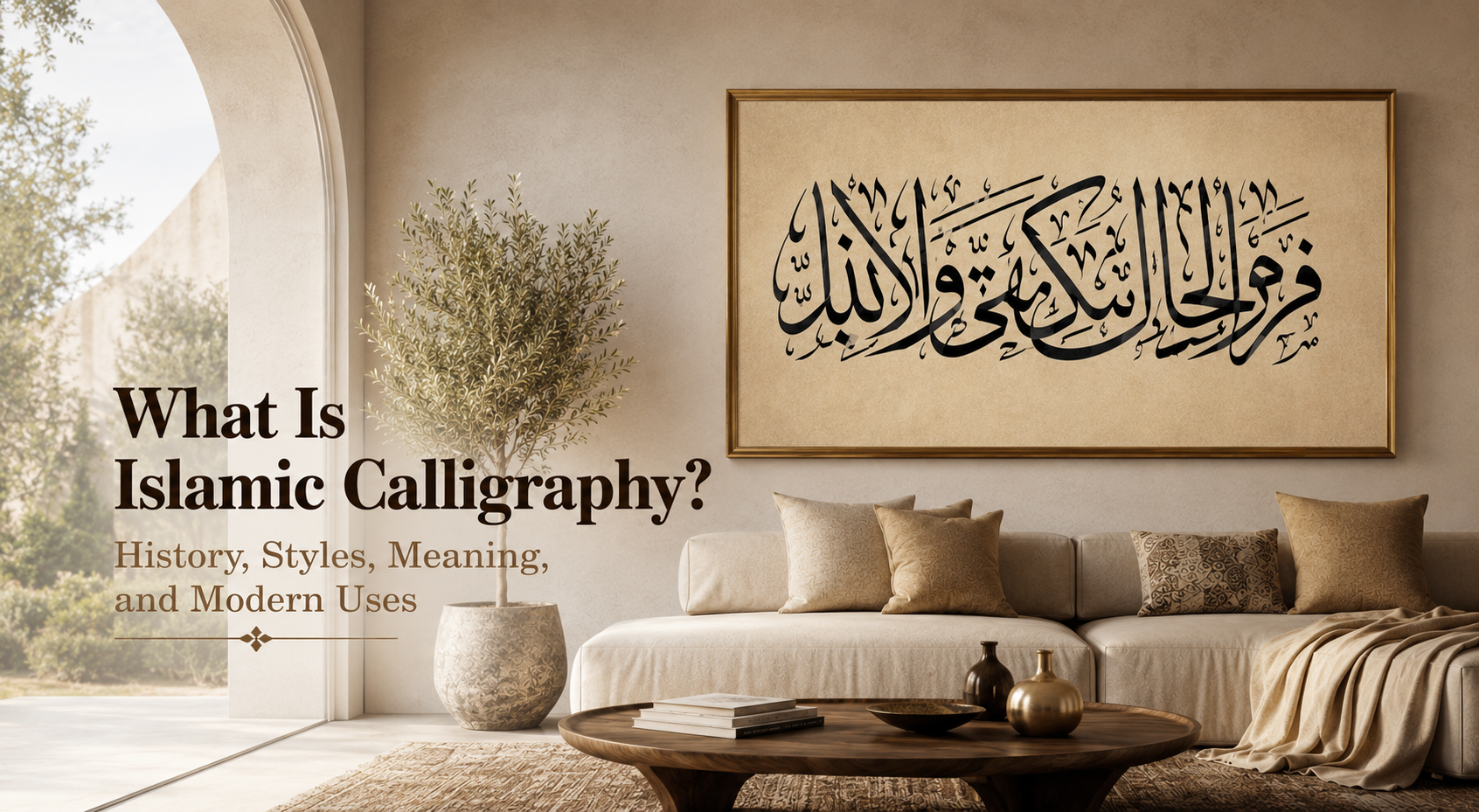
29 June، 2026
What Is Islamic Calligraphy? History, Styles, Meaning, and Modern Uses
Islamic calligraphy is one of the most admired art forms in the world. It combines language, spirituality, culture, and artistic expression into a visual tradition that has remained relevant for more than a thousand years. From the walls of historic mosques to contemporary home décor in the United States, Islamic calligraphy continues to inspire people through its beauty and deeper meaning.
Unlike many artistic traditions that focus primarily on imagery, Islamic calligraphy places written words at the center of artistic creation. Verses from the Quran, meaningful prayers, poetry, and inspirational messages are transformed into elegant designs that communicate both visual beauty and spiritual significance.
Today, collectors, interior designers, art enthusiasts, and homeowners increasingly appreciate Islamic calligraphy wall art for its timeless appeal and cultural richness. Understanding its history, styles, symbolism, and modern applications can help anyone make informed decisions when exploring this remarkable art form.
Read More
Understanding Islamic Calligraphy
Islamic calligraphy is the artistic practice of writing Arabic script in a decorative and aesthetically refined manner. While Arabic is the primary language associated with Islamic calligraphy, the art extends beyond simple handwriting. Every curve, line, proportion, and composition is carefully crafted to create harmony and visual impact. The tradition emerged as a way to preserve and honor sacred texts, particularly the Quran. Over centuries, calligraphers developed sophisticated techniques and styles that elevated writing into one of the highest forms of artistic expression within Islamic civilization. The beauty of Islamic calligraphy lies in its ability to communicate meaning on multiple levels. A viewer may appreciate the visual elegance of the design while also connecting with the spiritual or cultural message conveyed through the text.The Origins and History of Islamic Calligraphy
The roots of Islamic calligraphy can be traced back to the 7th century with the emergence of Islam. As the Quran was revealed and recorded, preserving its words accurately became a priority. Early Muslim scribes devoted significant effort to developing scripts that would ensure clarity and consistency.Early Development
During the earliest years of Islam, handwritten manuscripts played a critical role in preserving religious teachings. Scribes carefully copied Quranic verses, gradually refining letterforms and writing techniques. One of the earliest scripts used extensively for Quranic manuscripts was Kufic. Named after the city of Kufa in present-day Iraq, this style featured strong geometric shapes and angular lines. Kufic became widely recognized for its dignity and visual strength.Expansion Across Civilizations
As Islamic civilization expanded across the Middle East, North Africa, Spain, Central Asia, and beyond, calligraphy evolved alongside local artistic traditions. Different regions developed distinctive styles while maintaining respect for established principles. Calligraphy appeared in manuscripts, architecture, ceramics, textiles, coins, and decorative objects. It became an essential element of Islamic visual culture and a symbol of intellectual and spiritual achievement.The Golden Age of Calligraphy
Between the 10th and 16th centuries, Islamic calligraphy reached extraordinary levels of sophistication. Master calligraphers established formal rules governing letter proportions, spacing, composition, and balance. These standards created consistency while still allowing artists to express creativity. Many of the styles developed during this period remain influential today.Why Islamic Calligraphy Holds Deep Meaning
Islamic calligraphy is more than decoration. It carries layers of religious, cultural, and personal significance. For many people, calligraphy serves as a visual reminder of faith, values, and spiritual reflection. Quranic verses, names of Allah, prophetic sayings, and meaningful prayers often appear in calligraphic artworks because they inspire contemplation and connection. Even individuals who do not read Arabic frequently appreciate Islamic calligraphy because of its universal artistic appeal. The flowing forms, balanced compositions, and intricate designs communicate beauty that transcends language barriers. In contemporary settings, Islamic calligraphy often symbolizes:- Spiritual connection
- Cultural heritage
- Artistic excellence
- Personal inspiration
- Respect for tradition
Major Styles of Islamic Calligraphy
Over centuries, numerous calligraphic styles emerged. Each possesses unique characteristics and historical significance.Kufic Script
Kufic is among the oldest forms of Arabic calligraphy. It is characterized by bold, angular lines and geometric structures. Historically, Kufic appeared in early Quran manuscripts, architectural inscriptions, and decorative art. Modern artists frequently use it in contemporary designs because of its striking visual impact and adaptability to geometric compositions.Naskh Script
Naskh became one of the most widely used Arabic scripts due to its clarity and readability. Its rounded letterforms and balanced proportions make it suitable for books, religious texts, and educational materials. Many printed Arabic publications still rely on Naskh-inspired typography.Thuluth Script
Thuluth is known for its elegance, sweeping curves, and elongated vertical strokes. Often used in architectural decoration and ceremonial inscriptions, Thuluth creates a sense of grandeur and sophistication. Many mosque interiors feature Quranic verses rendered in this style.Diwani Script
Developed during the Ottoman period, Diwani is highly decorative and intricate. Its flowing lines and artistic complexity made it popular for royal documents and official correspondence. Today, Diwani remains admired for its ornamental beauty.Farsi or Nastaliq Script
Commonly associated with Persian artistic traditions, Nastaliq features graceful, sloping letterforms. This style is often used for poetry and literary works because of its expressive and fluid appearance.Contemporary Calligraphy Styles
Modern artists frequently blend traditional principles with innovative approaches. Abstract compositions, mixed media artworks, digital designs, and minimalist interpretations have expanded the possibilities of Islamic calligraphy while preserving its cultural roots.Islamic Calligraphy in Architecture
One of the most impressive applications of Islamic calligraphy appears in architecture. Throughout history, calligraphic inscriptions have decorated mosques, schools, palaces, and public buildings. Rather than serving only as decoration, these inscriptions often communicate religious teachings, historical information, or inspirational messages. Calligraphy may be carved into stone, painted onto walls, integrated into tilework, or crafted from wood and metal. The result is an architectural experience where words become part of the physical environment. Visitors to historic Islamic landmarks frequently encounter stunning examples of calligraphy that blend seamlessly with geometric patterns and arabesque motifs.Islamic Calligraphy as Wall Art
In recent years, Islamic calligraphy wall art has gained significant popularity among homeowners in the United States. People appreciate its ability to add elegance, meaning, and cultural depth to interior spaces. Calligraphy artworks complement a wide range of design styles, including traditional, contemporary, minimalist, and luxury interiors. Common placement areas include:- Living rooms
- Entryways
- Dining rooms
- Prayer spaces
- Offices
- Bedrooms
Modern Uses of Islamic Calligraphy
Islamic calligraphy continues to evolve beyond traditional settings.Home Décor
Custom wall art remains one of the most popular applications. Homeowners seek pieces that reflect faith, identity, and artistic taste while enhancing their interiors.Corporate and Professional Spaces
Businesses, cultural institutions, and professional offices increasingly incorporate Islamic calligraphy to create welcoming and visually engaging environments.Educational and Cultural Exhibitions
Museums, universities, and cultural centers frequently showcase calligraphic works to educate audiences about Islamic history, language, and artistic traditions.Digital Design
Modern technology has expanded the reach of Islamic calligraphy. Artists now create digital compositions for websites, branding materials, publications, and social media content while preserving traditional aesthetics.Personalized Art Commissions
Many collectors commission custom pieces featuring family names, favorite verses, meaningful quotations, or personal messages. This personalized approach makes Islamic calligraphy highly relevant in contemporary life.How to Choose Islamic Calligraphy Wall Art
Selecting the right piece involves more than choosing an attractive design. First, consider the meaning behind the text. Understanding the message can create a deeper connection with the artwork. Next, evaluate the artistic style. Some interiors benefit from bold geometric compositions, while others complement flowing, traditional scripts. Size and placement are equally important. A large statement piece can anchor an entire room, while smaller works may create subtle visual interest. Material selection also affects the overall appearance. Canvas, metal, wood, acrylic, and mixed media artworks each offer distinct aesthetic qualities. Working with experienced artists and specialists can help ensure authenticity, craftsmanship, and lasting value.Preserving the Tradition in the Modern World
Despite technological advances and changing artistic trends, Islamic calligraphy remains a thriving art form. Educational programs, workshops, exhibitions, and online platforms continue to introduce new generations to its beauty and significance. Contemporary artists demonstrate that tradition and innovation can coexist. By respecting classical foundations while embracing modern techniques, they ensure that Islamic calligraphy remains relevant in today's global art landscape. This balance between heritage and creativity helps preserve a cultural legacy that has inspired people for centuries.The Role of Nihad Dukhan in Contemporary Islamic Calligraphy
For those interested in exploring authentic Islamic calligraphy art, Nihad Dukhan has become a respected name recognized for combining artistic excellence with deep appreciation for traditional calligraphic principles. Through his work and educational resources available at ndukhan.com, visitors can discover a wide range of Islamic calligraphy artworks that reflect both historical influences and contemporary artistic vision. His approach highlights the enduring relevance of Islamic calligraphy while making it accessible to modern audiences across the United States.Frequently Asked Questions
What is Islamic calligraphy?
Islamic calligraphy is the artistic practice of creating beautiful and meaningful designs using Arabic script. It is widely used in religious, cultural, and decorative contexts.Why is Islamic calligraphy important?
It preserves sacred texts, reflects cultural heritage, and serves as a powerful form of artistic expression that combines beauty with meaning.What language is used in Islamic calligraphy?
Arabic is the most common language, although Persian, Turkish, and other languages have also been represented through calligraphic traditions.What are the main styles of Islamic calligraphy?
Major styles include Kufic, Naskh, Thuluth, Diwani, and Nastaliq, each with distinct visual characteristics and historical backgrounds.Is Islamic calligraphy only religious?
No. While many works feature religious texts, artists also create calligraphy using poetry, inspirational sayings, personal names, and cultural themes.Can Islamic calligraphy fit modern interior design?
Yes. Contemporary Islamic calligraphy complements minimalist, modern, traditional, and luxury interiors, making it highly versatile for home décor.How do I choose authentic Islamic calligraphy art?
Look for reputable artists, understand the meaning of the text, evaluate craftsmanship, and select a style that aligns with your personal preferences and space.Is Islamic calligraphy popular in the United States?
Interest in Islamic calligraphy continues to grow across the United States as homeowners, collectors, and designers seek meaningful and culturally rich artwork.Where can I learn more about Islamic calligraphy?
Educational resources, exhibitions, museums, workshops, and specialist artists such as Nihad Dukhan offer valuable insights into the history, styles, and significance of Islamic calligraphy.Final Thoughts
Islamic calligraphy stands at the intersection of art, history, language, and spirituality. Its rich heritage, diverse styles, and enduring symbolism have allowed it to remain relevant for more than a millennium. From historic manuscripts and architectural masterpieces to contemporary wall art and digital design, Islamic calligraphy continues to inspire admiration around the world. Explore the timeless beauty of Islamic calligraphy through the curated artwork and educational resources available at ndukhan.com and discover how meaningful words can transform any space into something truly memorable.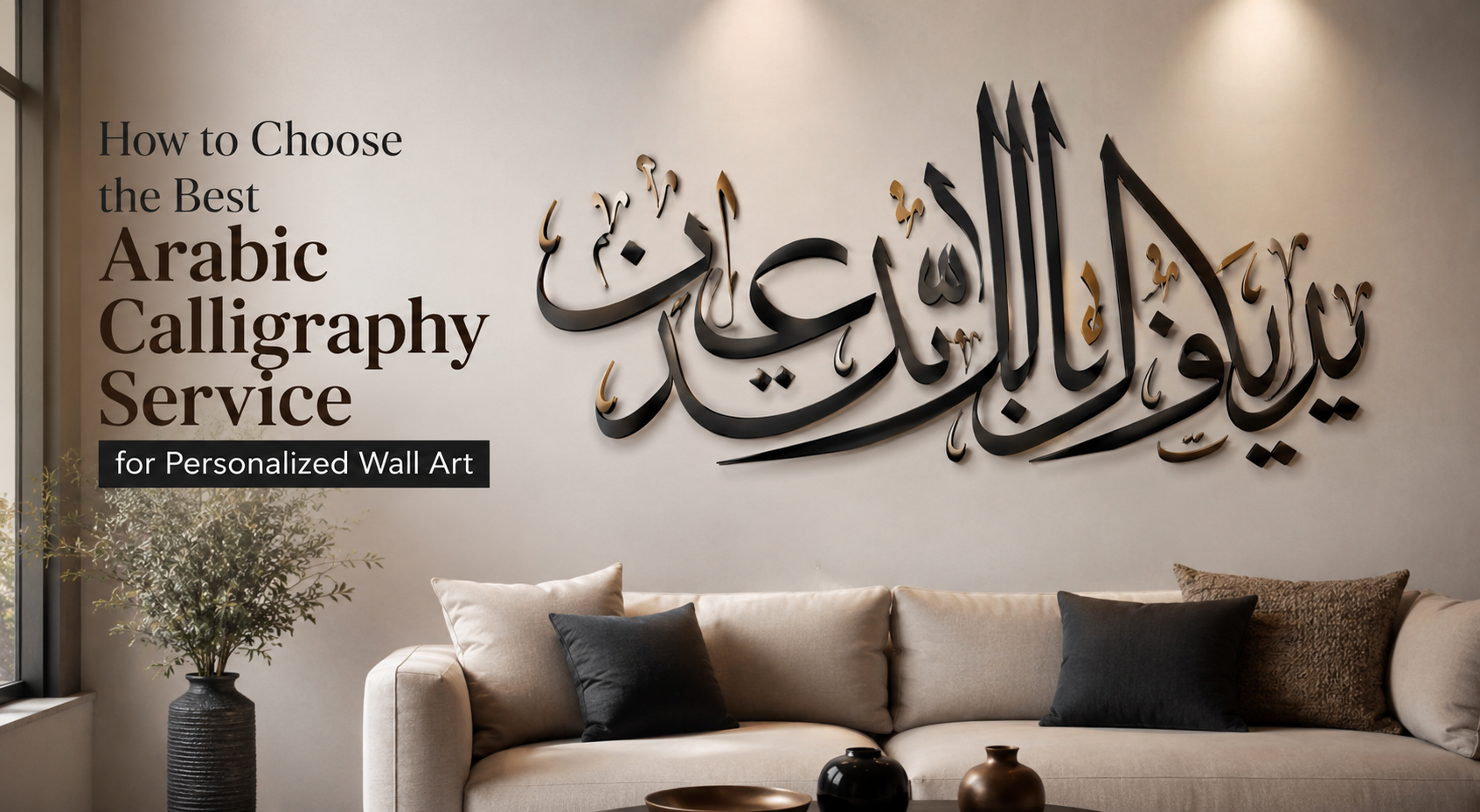
29 June، 2026
How to Choose the Best Arabic Calligraphy Service for Personalized Wall Art
Arabic calligraphy has long been admired for its elegance, cultural significance, and artistic beauty. Today, personalized Arabic calligraphy wall art has become a popular choice for homeowners, art collectors, interior designers, and gift buyers across the United States. From meaningful Quranic verses and family names to inspirational quotes and custom artistic compositions, personalized calligraphy transforms words into timeless visual masterpieces.
The growing demand for custom wall art has also increased the number of artists and services offering Arabic calligraphy. While having more options can be beneficial, choosing the right Arabic calligraphy service requires careful consideration. The quality of the artwork, artistic expertise, customization options, and authenticity of the design can significantly impact the final result.
This guide explains how to identify a high-quality Arabic calligraphy service and what factors matter most when investing in personalized wall art.
Read More
Why Personalized Arabic Calligraphy Wall Art Is So Popular
Personalized wall art allows people to display meaningful words, names, or messages in a way that reflects their personality and values. Arabic calligraphy adds an additional layer of beauty because the script itself becomes part of the artistic expression. Unlike mass-produced decorative pieces, custom calligraphy artwork carries personal significance. It often celebrates important life moments, family heritage, faith, achievements, or meaningful relationships. Many homeowners in the United States are incorporating Arabic calligraphy into modern interiors because it blends artistic sophistication with personal storytelling. The result is décor that feels unique, elegant, and deeply meaningful.What Makes a Great Arabic Calligraphy Service?
Not all calligraphy services deliver the same level of craftsmanship. The best services combine artistic skill, cultural understanding, design expertise, and attention to detail. A professional Arabic calligraphy artist understands how letters interact visually, how spacing affects readability, and how artistic composition creates balance within a piece. The goal is not simply writing words in Arabic. The goal is transforming language into visual art that works beautifully within a specific space.Artistic Expertise Matters
Arabic calligraphy is a specialized art form that requires years of study and practice. Different styles have unique structures, proportions, and visual characteristics. An experienced artist understands:- Letter formation
- Visual harmony
- Composition principles
- Traditional calligraphic rules
- Contemporary artistic adaptations
Authentic Understanding of Arabic Script
Accuracy is essential when creating personalized Arabic calligraphy. A professional service should have a deep understanding of Arabic language structure and calligraphic traditions. Even small spelling or stylistic errors can affect the meaning and visual quality of a piece. Authenticity becomes especially important when creating artwork featuring Quranic verses, religious phrases, poetry, or family names.Understanding Different Arabic Calligraphy Styles
One important step in selecting a calligraphy service is understanding the styles available. Each style creates a different visual impression and works best in different settings.Diwani
Diwani is known for its flowing curves and decorative appearance. It often creates a luxurious and elegant look suitable for sophisticated interiors.Thuluth
Thuluth features elongated letters and dramatic compositions. It is frequently used for large artistic pieces and architectural displays.Naskh
Naskh offers clarity and readability. It works well for pieces where legibility is a priority.Modern Arabic Calligraphy
Modern calligraphy combines traditional foundations with contemporary artistic interpretation. This style is popular among homeowners seeking artwork that complements modern interior design. A skilled service should help clients choose a style that aligns with their aesthetic goals and the intended placement of the artwork.Questions to Ask Before Hiring an Arabic Calligraphy Artist
Before committing to a project, asking the right questions can help ensure a positive experience.Can the Artwork Be Fully Customized?
Customization is often the main reason people seek personalized calligraphy. Ask whether the artist can adapt:- Names
- Quotes
- Verses
- Color schemes
- Layout preferences
- Size requirements
What Is the Creative Process?
Understanding the process helps set expectations. A professional service typically includes: Initial consultation, concept development, design refinement, client feedback, and final production. Transparency throughout the process often leads to stronger results and greater customer satisfaction.Are Design Proofs Provided?
Design previews allow clients to review concepts before final production. This step helps ensure accuracy and gives clients an opportunity to request adjustments if needed.Evaluating Portfolio Quality
A portfolio provides valuable insight into an artist's capabilities. Look beyond individual pieces and evaluate overall consistency. High-quality portfolios often demonstrate: Strong composition, creative diversity, technical precision, and professional presentation. Pay attention to how the artwork interacts with different environments. Well-designed pieces should look visually balanced whether displayed in homes, offices, galleries, or commercial spaces.Signs of Professional Craftsmanship
Professional calligraphy typically exhibits: Clean lines, balanced spacing, intentional composition, and strong visual flow. The artwork should feel cohesive rather than crowded or disconnected. Every element should contribute to the overall artistic message.Choosing the Right Medium for Your Space
The best Arabic calligraphy service should offer guidance regarding materials and presentation options. Different mediums create different visual effects.Canvas Artwork
Canvas remains a popular option because it offers a timeless gallery-style appearance. It works well in living rooms, offices, bedrooms, and reception areas.Fine Art Prints
Fine art prints provide excellent detail and can be framed according to personal preferences. They are often suitable for collectors seeking museum-quality presentation.Original Handcrafted Artwork
Original pieces provide a unique artistic experience because each work is individually created by the artist. Collectors often value original artwork for its exclusivity and craftsmanship. The right medium depends on budget, design goals, and intended display location.Matching Calligraphy with Interior Design
Personalized wall art should complement its surroundings. An experienced calligraphy artist considers factors such as room size, color palette, furniture style, lighting conditions, and wall dimensions. Modern interiors often benefit from minimalist compositions and contemporary calligraphic interpretations. Traditional interiors may pair beautifully with classical styles and intricate decorative elements. The best artwork feels integrated into the space rather than simply added as decoration.The Importance of Meaning in Personalized Calligraphy
One reason Arabic calligraphy remains so powerful is its ability to communicate meaning through both language and visual design. Many clients choose phrases that reflect personal values, family traditions, spiritual beliefs, or life goals. The emotional significance behind the chosen text often becomes the defining feature of the artwork. A skilled artist understands how to visually reinforce that meaning through composition, style, and presentation. This combination of message and artistry creates a deeper connection between the viewer and the artwork.Digital Versus Handcrafted Calligraphy
Modern technology has expanded the possibilities of Arabic calligraphy. Some projects are created digitally, while others are handcrafted using traditional techniques. Both approaches can produce exceptional results when executed by experienced artists. Digital methods allow precise customization and flexibility. Handcrafted works often showcase the unique character and expressive qualities of the artist's hand. Rather than focusing solely on the method, evaluate the final quality, artistic vision, and overall craftsmanship.Why Experience and Reputation Matter
Experience often influences the quality and consistency of the final artwork. Artists who have worked on a wide range of projects typically develop stronger design instincts and problem-solving abilities. A proven track record demonstrates reliability and professional expertise. When researching Arabic calligraphy services, look for: Client testimonials, portfolio depth, artistic consistency, and clear communication practices. These indicators often reveal whether an artist can successfully execute personalized projects.Finding a Trusted Arabic Calligraphy Artist
For clients seeking personalized Arabic calligraphy wall art in the United States, working directly with an established artist can provide a more collaborative and rewarding experience. Nihad Dukhan has built a reputation for creating sophisticated Arabic calligraphy artwork that blends traditional calligraphic principles with contemporary artistic expression. Through the official website, ndhukhan.com, clients can explore a diverse portfolio of custom pieces, learn about available services, and discover artwork tailored to individual preferences and spaces. A direct artist-client relationship often results in greater personalization, clearer communication, and artwork that accurately reflects the client's vision.Frequently Asked Questions
What should I look for in an Arabic calligraphy service?
Look for artistic expertise, a strong portfolio, customization options, design consultation, and experience creating personalized artwork.How much does custom Arabic calligraphy wall art cost?
Pricing varies depending on artwork size, complexity, materials, customization requirements, and whether the piece is digital, printed, or handcrafted.Which Arabic calligraphy style is best for modern homes?
Modern Arabic calligraphy and simplified contemporary interpretations often complement modern interior design particularly well.Can Arabic calligraphy be personalized with names?
Yes. Many clients request family names, wedding gifts, anniversary pieces, or personalized decorative artwork featuring names and meaningful words.Is Arabic calligraphy suitable for non-Arabic speakers?
Absolutely. Many people appreciate Arabic calligraphy for its artistic beauty while also valuing the meaning behind the text.How long does a custom calligraphy project take?
Project timelines vary depending on complexity, revisions, and production methods. Discussing timelines during the consultation process is recommended.What size should Arabic calligraphy wall art be?
The ideal size depends on wall dimensions, viewing distance, room layout, and the visual impact desired.Can Arabic calligraphy fit contemporary interior design styles?
Yes. Modern Arabic calligraphy is frequently incorporated into minimalist, contemporary, transitional, and luxury interior designs.Why is portfolio review important before choosing a service?
A portfolio demonstrates artistic quality, consistency, versatility, and the artist's ability to execute personalized concepts successfully.Final Thoughts
Choosing the best Arabic calligraphy service involves more than selecting an artist who can write Arabic text. It requires evaluating artistic expertise, authenticity, customization capabilities, design quality, and the ability to create meaningful artwork that enhances your living space. Taking the time to review portfolios, understand calligraphic styles, and communicate your vision clearly can help ensure that your personalized wall art becomes a lasting centerpiece for years to come. Discover beautifully crafted personalized Arabic calligraphy wall art and explore custom artistic possibilities at Nihad Dukhan's website today.
1 September، 2026
How to Choose the Right Arabic Calligraphy Designer
Choosing the right Arabic Calligraphy Designer is about much more than finding someone who can write beautiful Arabic letters. A strong designer understands proportion, letter structure, composition, cultural context, visual balance, and the purpose behind the artwork. The right professional should also be able to translate your idea into a finished piece that feels authentic, readable, and visually appropriate for its intended setting.
Whether you need artwork for your home, a creative project, a brand identity, an exhibition, or Arabic Wedding Invitations, it helps to evaluate a designer's artistic approach, experience, portfolio, communication, and ability to meet your requirements.
For people searching for an Arabic Calligraphy Artist in the United States, this guide explains what to look for, which questions to ask, how the design process usually works, and how to make a confident decision without choosing based on appearance alone.
Read More
Key Takeaways
- The best Arabic Calligraphy Designer for a project should understand both the artistic and linguistic aspects of Arabic lettering.
- A portfolio should show consistency, authentic calligraphic structure, different compositions, and work relevant to your intended project.
- Traditional Arabic Calligraphy and contemporary styles serve different visual purposes, so identify the style you want before commissioning artwork.
- A professional Arabic Calligraphy Service should clearly explain the creative process, revisions, deliverables, timelines, and usage rights.
- Digital tools such as an Arabic Calligraphy Generator can be useful for experimentation, but they do not necessarily provide the artistic judgment, custom composition, and human craftsmanship of a specialist.
- Clear communication about the Arabic text, intended use, dimensions, preferred style, and budget can significantly improve the final result.
What Does an Arabic Calligraphy Designer Do?
An Arabic Calligraphy Designer creates visually refined Arabic lettering for artistic, cultural, decorative, commercial, or personal purposes. Their work can involve handwritten calligraphy, digital compositions, custom lettering, logo-style artwork, wall pieces, invitations, manuscripts, or mixed-media designs. The role combines several disciplines. A designer needs knowledge of Arabic letterforms and calligraphic rules while also understanding composition, spacing, hierarchy, contrast, and visual presentation. Arabic calligraphy is particularly sensitive to proportion. Small changes in the relationship between letters, dots, spacing, and line structure can affect both readability and aesthetics. A skilled designer therefore considers the Arabic text as a complete visual composition rather than simply converting words into decorative lettering. Depending on the project, the designer may work in established styles such as Thuluth, Naskh, Diwani, Kufic, or Ruq'ah, or develop a more contemporary interpretation inspired by traditional principles.Why Choosing the Right Designer Matters
Arabic calligraphy carries linguistic, artistic, and cultural meaning. The appearance of a finished design can influence how the words are understood and experienced. A visually attractive design may still be unsuitable if the Arabic text has been altered incorrectly, the composition makes reading difficult, or the selected style does not fit the purpose. For example, artwork intended for a formal cultural setting may benefit from a disciplined traditional approach, while a modern interior design project might call for Contemporary Arabic Calligraphy with a cleaner composition. The designer's role is to balance meaning and aesthetics. This becomes particularly important for religious phrases, names, poetry, quotations, and personalized artwork. The source text should be verified carefully before the design process begins.Start by Defining Your Project
Before contacting an Arabic calligraphy professional, define what you actually need. This makes it easier to identify a designer whose skills match your project. Consider the following questions: What Arabic text do you want to use? Where will the artwork be displayed or published? Do you prefer Traditional Arabic Calligraphy, contemporary lettering, or a combination of traditional principles with a modern visual treatment? What size should the final artwork be? Will it be printed, framed, engraved, embroidered, displayed digitally, or used online? Do you need a specific color palette? Do you require a particular file format? Will the artwork be used personally or commercially? The more information you can provide, the easier it becomes for the designer to understand your expectations.Examine the Arabic Calligraphy Portfolio
A portfolio is one of the most useful ways to assess an Arabic Calligraphy Artist. Do not judge a portfolio only by asking whether the artwork looks attractive. Examine the details. Look for consistency in letter proportions, spacing, composition, line flow, and overall balance. Check whether the designer can work with different compositions rather than repeatedly producing nearly identical designs. A strong portfolio may include examples of traditional pieces, modern compositions, personalized artwork, decorative projects, or digital applications. Pay particular attention to projects similar to yours. If you need a wedding design, look for relevant invitation or event work. If you need wall artwork, examine large-format compositions. If you need a digital identity, review examples that demonstrate clean digital execution. A portfolio should help you answer one important question: Can this designer achieve the visual language my project requires?Understand Traditional Arabic Calligraphy
Traditional Arabic Calligraphy is built around established scripts, proportions, techniques, and artistic conventions. Styles such as Thuluth, Naskh, Diwani, Kufic, and Ruq'ah each have distinct characteristics. Understanding these differences can help you communicate more effectively with a designer. Thuluth is often recognised for its expressive curves, elongated forms, and strong presence. Naskh is associated with clarity and readability. Kufic is known for its geometric qualities and can work particularly well in structured compositions. Diwani is often recognised for its flowing and decorative appearance. A knowledgeable designer should be able to explain why a particular style may suit your text and intended application. You do not necessarily need to become an expert in Arabic scripts before commissioning artwork. However, knowing the basic distinction between traditional scripts and contemporary interpretations can help you make better creative decisions.Consider Contemporary Arabic Calligraphy
Contemporary Arabic Calligraphy expands the visual possibilities of traditional lettering. Designers may experiment with composition, scale, negative space, geometric forms, color, texture, layering, and digital techniques while retaining recognizable elements of Arabic calligraphic aesthetics. This approach can work well in modern interiors, exhibitions, creative campaigns, digital artwork, and design projects that require a distinctive visual identity. Modern Arabic Calligraphy does not have to abandon traditional principles. In many strong compositions, contemporary design builds on the foundations of classical calligraphy while introducing a different visual context. When reviewing a designer's work, look for evidence that experimentation is intentional rather than simply decorative.Check Linguistic Accuracy
A beautiful calligraphic composition still needs accurate Arabic text. Before approving artwork, verify the spelling, wording, diacritics where relevant, and intended meaning. This is especially important for names, quotations, poetry, religious passages, and personalized messages. If the designer does not speak Arabic fluently, that does not automatically mean they cannot create good calligraphy. However, the text should come from a reliable source and be independently verified when accuracy is important. For personalized work, provide the exact Arabic wording rather than asking the designer to translate an English phrase unless translation is specifically part of the service. A professional should also be comfortable asking for clarification when the supplied text is ambiguous.Look for Genuine Artistic Skill
Arabic calligraphy requires more than selecting an attractive font. A specialist may understand how letterforms are constructed, how strokes interact, how spacing affects rhythm, and how individual letters behave when combined into a larger composition. This distinction is especially relevant when considering an Arabic Calligraphy Generator. Automated tools can be useful for exploring ideas quickly, but generated lettering may not provide the same level of custom composition, artistic judgment, refinement, and personal interpretation as commissioned work. A human designer can make decisions based on the exact text, available space, intended mood, cultural context, and physical or digital application. For a unique artwork, those decisions can make a substantial difference.Ask About the Design Process
A clear process is a positive sign when selecting an Arabic Calligraphy Service. While every artist works differently, a professional project often follows a structure similar to this:1. Project Brief
You provide the Arabic text, purpose, dimensions, preferred style, references, and other requirements.2. Creative Direction
The designer discusses suitable calligraphic approaches, composition ideas, and presentation options.3. Initial Concepts
Depending on the project, the designer may develop sketches or preliminary compositions before refining the selected direction.4. Refinement
The chosen concept is carefully developed with attention to letter structure, spacing, balance, and overall presentation.5. Final Artwork
The completed artwork is supplied in the agreed format and specifications. A clearly defined process reduces misunderstandings and gives both sides a shared understanding of what will be delivered.Ask About Revisions and Deliverables
Before commissioning a project, clarify what is included. Ask how many revision rounds are provided, what constitutes a revision, which file formats you will receive, and whether the final artwork is supplied in high resolution. For digital projects, common requirements may include formats such as PNG, JPEG, PDF, SVG, or other vector formats depending on the application. For printed artwork, ask about the appropriate resolution and dimensions. If the artwork will be used commercially, clarify usage rights and licensing. Personal display, social media use, merchandise, packaging, advertising, and resale can involve different requirements. These details are easier to resolve before the work begins than after the final artwork has been delivered.Consider the Designer's Communication Style
Artistic ability is important, but communication also affects the quality of a commissioned project. A good designer should listen carefully to your requirements, ask useful questions, explain relevant creative decisions, and communicate clearly about the project scope. Be cautious of unclear expectations on either side. If you cannot explain what you need, the designer may have difficulty interpreting the brief. Similarly, if important details about the process are not discussed beforehand, misunderstandings can arise later. Good communication does not mean agreeing with every suggestion. It means having a constructive conversation about what will work best for the project.Think About Budget and Value
The cost of Arabic calligraphy can vary significantly depending on the complexity of the artwork, amount of customization, technique, size, delivery format, timeline, and intended usage. A simple digital composition may require considerably less work than a highly detailed custom artwork created for physical production. Instead of focusing only on the lowest price, consider what is included in the service. A professional quote may cover creative development, custom lettering, revisions, final artwork preparation, and usage considerations. Ask for a clear project estimate before work begins. The goal should be to understand the value and scope of the service rather than treating calligraphy as a standard one-size-fits-all product.Choosing an Arabic Calligrapher for Wedding Invitations
Arabic Wedding Invitations require special attention because the calligraphy becomes part of an important personal occasion. Names, dates, venues, family names, and quotations should be checked carefully before final approval. The style should also complement the invitation's overall design. Elegant flowing calligraphy may create a different impression from geometric Kufic-inspired lettering or a minimalist contemporary composition. If the invitation is bilingual, consider how the Arabic and English typography will interact. The two scripts do not need to look identical, but they should feel visually balanced within the overall layout. A designer experienced with personalized invitation work can help create an Arabic element that feels integrated rather than added as an afterthought.Ask These Questions Before Hiring an Arabic Calligraphy Designer
Before starting a project, a short conversation can reveal whether a designer is suitable. Useful questions include:- Which Arabic calligraphy styles do you specialize in?
- Can you create custom compositions rather than using standard digital fonts?
- How do you verify the accuracy of the Arabic text?
- Can you provide examples similar to my project?
- What information do you need from me before starting?
- How does your revision process work?
- Which final file formats will I receive?
- What are the expected turnaround times?
- Are commercial usage or licensing requirements included?
- How is the final artwork prepared for printing or digital use?
Look for a Balance of Tradition and Creativity
The strongest Calligraphy Arabic Art can respect established principles while still feeling appropriate for its intended environment. A designer should understand when restraint is more effective than excessive decoration. They should also know how to use negative space, scale, alignment, contrast, and composition to give the lettering room to breathe. For a traditional artwork, this may mean preserving the character of a classical script. For a contemporary project, it may mean adapting calligraphic elements into a more experimental composition. The right approach depends on the text and purpose.Choosing a Professional Arabic Calligraphy Website
An Arabic Calligraphy Website can provide useful insight before you make contact with a designer. Look beyond the homepage. Explore portfolio pages, project descriptions, service information, artist background, and contact details. A well-organized website can help you understand the designer's artistic focus and the types of commissions they accept. For example, Nihad Dukhan provides an online place to explore the work and artistic direction associated with Nihad Dukhan. The website should not be your only basis for a decision, but it can be a useful starting point for understanding an artist's work.When an Arabic Calligraphy Workshop May Help
If your interest extends beyond commissioning artwork, an Arabic Calligraphy Workshop can provide a different type of experience. Workshops can introduce participants to calligraphic principles, tools, letter construction, scripts, composition, and the discipline involved in developing handwriting. Learning even the basics can change the way you evaluate finished calligraphy. You begin to notice spacing, stroke control, proportions, and the relationship between individual letters. For people interested in developing their own skills, a workshop can be a valuable introduction before pursuing more advanced study.Red Flags to Watch For
A few warning signs deserve attention before commissioning artwork. Be cautious when a portfolio provides no indication of the designer's own work, project terms are consistently unclear, or the designer cannot explain how the Arabic text will be handled. Unclear pricing, vague deliverables, unrealistic promises, or pressure to approve work without reviewing the text can also create unnecessary problems. Another concern is a portfolio that appears heavily dependent on generic digital fonts when the project specifically requires custom calligraphy. The goal is not to find a designer who claims to do everything. It is to find someone whose demonstrated skills match your particular needs.How Nihad Dukhan Fits Into the Selection Process
For anyone researching an Arabic Calligraphy Designer in the United States, Nihad Dukhan offers a place to explore professional Arabic calligraphy work and determine whether the artistic style aligns with a particular project. Rather than choosing an artist solely because of a keyword or search result, take time to review the available artwork, understand the designer's creative approach, and communicate your requirements clearly. You can explore the work and available information through the Nihad Dukhan website. The most productive starting point is a clear brief. Include your Arabic text, intended application, preferred aesthetic, dimensions, deadline, and any relevant visual references.Frequently Asked Questions
1. What should I look for in an Arabic Calligraphy Designer?
Look for strong knowledge of Arabic calligraphy, authentic letter construction, a relevant portfolio, attention to detail, clear communication, and a well-defined design process. The designer should be able to create artwork suited to your specific purpose rather than relying only on generic templates.2. How much does Arabic calligraphy design cost?
Pricing varies according to customization, complexity, size, technique, revisions, turnaround time, and intended usage. The best approach is to provide a clear project brief and request a quote based on the actual requirements.3. What is the difference between traditional and modern Arabic calligraphy?
Traditional Arabic Calligraphy generally follows established scripts and principles developed through the history of Arabic calligraphic practice. Modern or contemporary approaches may incorporate traditional letterforms while experimenting with composition, scale, materials, digital techniques, and visual presentation.4. Is an Arabic Calligraphy Generator suitable for professional artwork?
An Arabic Calligraphy Generator can be useful for exploring concepts or producing quick lettering, but it may not offer the custom composition and artistic refinement required for specialized artwork. A professional calligrapher can adapt the lettering to the project's exact context and visual requirements.5. Can an Arabic Calligraphy Artist create personalized wedding artwork?
Yes. Personalized calligraphy can be created for names, invitations, quotations, signage, keepsakes, and other wedding materials. Accuracy is particularly important, so all names, dates, and Arabic wording should be carefully checked before final approval.6. How do I know if Arabic calligraphy is authentic?
Look for evidence of correct letter proportions, consistent structure, appropriate spacing, and knowledge of established scripts. A knowledgeable artist should also be able to explain the stylistic approach used in the artwork.7. What information should I give a calligraphy designer?
Provide the exact Arabic text, intended use, dimensions, preferred style, visual references, color preferences, deadline, and required file format. If the artwork will be used commercially, also explain the intended usage.8. Should I choose a traditional or contemporary Arabic calligraphy style?
Choose based on the project's purpose and visual setting. Traditional styles can provide a connection to established calligraphic heritage, while contemporary approaches may work better for modern interiors, creative projects, branding, or experimental artwork.9. Can Arabic calligraphy be delivered as digital artwork?
Yes. Arabic calligraphy can be prepared for many digital and print applications. The appropriate file format depends on how the artwork will be used, so discuss technical requirements with the designer before the final artwork is prepared.Conclusion
Choosing the right Arabic Calligraphy Designer starts with understanding your project and evaluating more than visual appeal. Look at the designer's portfolio, knowledge of Arabic scripts, linguistic accuracy, creative process, communication, deliverables, and experience with projects similar to yours. The right artist should be able to balance meaning, craftsmanship, composition, and your intended visual direction. That balance is what turns Arabic lettering into thoughtful Calligraphy Arabic Art. If you are exploring custom Arabic calligraphy for a personal, artistic, cultural, wedding, interior, or creative project, visit Nihad Dukhan to explore the work and learn more about the available artistic direction.
1 September، 2026
A Beginner’s Guide to Understanding Arabic Calligraphy
Arabic calligraphy is more than decorative handwriting. It is an art form built around proportion, rhythm, balance, letter structure, and cultural meaning. For centuries, artists have transformed Arabic letters into carefully composed visual expressions, and today the tradition continues through both classical techniques and contemporary creative approaches.
For beginners, Arabic calligraphy can initially seem complex because Arabic letters change shape depending on their position in a word, while established calligraphic styles follow precise rules. The good news is that you do not need to master every style or technique at once. Understanding the foundations, major styles, tools, and artistic principles provides a strong starting point.
This guide introduces the essential concepts behind Arabic calligraphy, explains how traditional and modern approaches differ in practice, and offers practical advice for anyone interested in learning, collecting, commissioning, or simply appreciating this distinctive art form.
Read More
Key Takeaways
- Arabic calligraphy is a visual art based on letter proportions, spacing, rhythm, and composition, not simply attractive handwriting.
- Traditional Arabic calligraphy includes established styles such as Thuluth, Naskh, Diwani, Kufic, and Ruq'ah, each with its own visual characteristics and applications.
- Modern and contemporary Arabic calligraphy can combine classical letterforms with abstract compositions, unconventional layouts, color, and mixed media.
- A skilled Arabic calligraphy artist needs both technical control and an understanding of Arabic letter structure, composition, and visual balance.
- Digital tools and an Arabic calligraphy generator can help with experimentation, but they do not necessarily reproduce the intentional craftsmanship of a trained calligrapher.
- Beginners can develop their skills by studying letter proportions, practicing individual forms, learning one style at a time, and gradually building complete compositions.
What Is Arabic Calligraphy?
Arabic calligraphy is the artistic practice of writing Arabic letters in carefully designed forms. The discipline combines writing and visual composition, using line quality, proportions, spacing, repetition, and rhythm to create an aesthetically balanced result. Arabic calligraphy has developed across different historical periods and regions, resulting in numerous scripts and artistic traditions. Some styles were closely associated with manuscripts and formal writing, while others became popular for architectural decoration, official documents, poetry, invitations, and artistic compositions. The appeal of calligraphy Arabic art comes partly from the flexibility of the Arabic script. Letters can connect naturally, curves can create movement, and words can be arranged into compositions that function almost like visual architecture. For this reason, Arabic calligraphy can communicate meaning through both language and form. A viewer may understand the written phrase while also responding to its visual rhythm, symmetry, movement, or emotional character.Why Is Arabic Calligraphy Considered an Art Form?
Arabic calligraphy becomes art when writing is deliberately shaped and composed for visual expression. A calligrapher considers factors such as:- Letter proportions
- Stroke thickness
- Curvature
- Vertical and horizontal movement
- Spacing between letters and words
- Overall composition
- Visual balance
- Contrast and rhythm
- Relationship between text and surrounding space
Understanding Traditional Arabic Calligraphy
Traditional Arabic calligraphy refers to established calligraphic practices that developed according to recognized rules, letter proportions, and methods of execution. Several major styles are important for beginners to recognize.Thuluth
Thuluth is known for its large, flowing letterforms and strong visual presence. It has historically been used for architectural inscriptions, religious texts, manuscripts, and decorative compositions. Its sweeping curves and complex connections make it visually impressive, but mastering it requires patience and careful practice.Naskh
Naskh is generally more compact and highly readable than some decorative scripts. It has played an important role in manuscript writing and Arabic typography. Because of its clarity, Naskh is also useful for beginners who want to understand fundamental Arabic letter proportions and connections.Kufic
Kufic is one of the best-known early Arabic scripts. Its forms can appear angular, geometric, and structured. Contemporary artists continue to reinterpret Kufic characteristics in architectural designs, logos, posters, patterns, and abstract compositions.Diwani
Diwani is recognized for its flowing, rounded, and highly decorative appearance. Historically associated with Ottoman administrative writing, it can create dense and elegant compositions. Its intricate letter connections make it particularly suitable for decorative artistic applications.Ruq'ah
Ruq'ah is generally simpler and more compact than highly ornamental scripts. It became widely used for everyday handwriting because it can be written relatively quickly. For a beginner, learning to recognize Ruq'ah helps demonstrate how Arabic writing can vary according to purpose and context.How Arabic Calligraphy Works
One of the most important things to understand is that Arabic letters do not always have one fixed visual shape. A letter may change depending on whether it appears at the beginning, middle, or end of a word, or whether it stands alone. Connections between letters also influence the final appearance. Calligraphers therefore learn individual letterforms as well as combinations and relationships. A typical learning process might begin with:- Understanding the Arabic alphabet.
- Studying basic letter proportions.
- Practicing individual letters.
- Learning connected letter combinations.
- Reproducing short words.
- Practicing complete phrases.
- Developing spacing and composition.
- Creating finished calligraphic artwork.
The Importance of Proportion and Geometry
Proportion is fundamental to Arabic calligraphy. Traditional calligraphers often use the shape of the writing instrument's nib and established proportional systems to determine letter dimensions. Small differences in height, width, angle, or curvature can significantly change the character of a script. The concept of the dot is particularly important in traditional practice. A calligrapher can use the width of the nib to establish a reference unit for measuring elements of letters. This creates consistency across a composition. Even artists working in Modern Arabic Calligraphy benefit from understanding these traditional principles. Modern work may intentionally stretch, simplify, rearrange, or abstract letters, but a strong understanding of structure gives the artist greater control over those creative decisions.Traditional and Contemporary Arabic Calligraphy
Traditional and contemporary approaches exist within the same broader artistic discipline, but they can have different visual goals. Traditional work generally places greater emphasis on established scripts, proportions, tools, and rules. Contemporary Arabic calligraphy may retain recognizable Arabic letterforms while exploring abstraction, unusual compositions, mixed media, typography, painting, digital techniques, or other artistic methods. Contemporary Arabic calligraphy does not necessarily mean abandoning tradition. Many artists study classical scripts first and then use that knowledge as a foundation for experimentation. This relationship between heritage and innovation is one reason Arabic calligraphy continues to appear relevant in galleries, homes, cultural projects, publications, fashion, architecture, and contemporary design.What Does an Arabic Calligraphy Artist Do?
An Arabic Calligraphy Artist creates visual compositions using Arabic script as the primary artistic language. The role can involve much more than writing a requested phrase. Depending on the project, an artist may need to:- Interpret the meaning of the text
- Select an appropriate calligraphic style
- Develop a composition
- Adjust proportions and spacing
- Consider the intended viewing distance
- Select materials or digital techniques
- Balance text with negative space
- Refine individual strokes
- Prepare the final artwork for its intended setting
What Makes a Skilled Arabic Calligraphy Designer?
An Arabic Calligraphy Designer combines calligraphic knowledge with design thinking. The distinction is especially useful when calligraphy needs to function within a larger visual project. For example, a designer may need to consider how a calligraphic composition works on a wall, invitation, artwork, publication, packaging, or digital screen. Important qualities include technical accuracy, strong composition, attention to spacing, understanding of visual hierarchy, and the ability to adapt lettering to different formats. A designer also needs to understand when a composition requires simplicity and when additional ornamentation would improve the result.Choosing an Arabic Calligraphy Style for Your Project
The right style depends on the purpose, text, mood, format, and desired visual character. For example, a formal composition may benefit from an established classical script. A geometric architectural project may suit a structured Kufic-inspired treatment. A highly decorative personal artwork may call for flowing forms. If you are commissioning work, start by explaining the purpose of the artwork rather than requesting a particular style without context. Useful information includes:- The exact Arabic text
- Translation or intended meaning
- Where the artwork will be displayed
- Desired dimensions
- Preferred artistic direction
- Whether the work should feel traditional or contemporary
- Color or material preferences
- Deadline, if applicable
Arabic Calligraphy for Weddings and Special Events
Arabic calligraphy can add a personal artistic element to wedding stationery and other celebrations. Arabic wedding invitations may incorporate names, meaningful phrases, dates, or traditional expressions. The calligraphy can become a central visual feature or work as a subtle decorative element. For an invitation, readability matters. Highly complex lettering may look beautiful as standalone artwork but can become difficult to read when reduced to a small printed format. A practical approach is to decide which words should receive the strongest visual emphasis and then build the rest of the layout around them. The same principle applies to certificates, family artwork, commemorative pieces, and personalized gifts.What Is an Arabic Calligraphy Service?
An Arabic Calligraphy Service generally refers to professional creation of custom Arabic lettering or calligraphic artwork for a specific purpose. The exact scope can vary. A commissioned service might involve a handwritten original, custom artwork, digital artwork, wall piece, event stationery, or another tailored application. Before commissioning a project, clarify what the final deliverable includes. Ask about the artwork format, dimensions, revision process, materials, delivery method, and intended usage. The price of custom calligraphy can vary considerably because there is no single standard rate. Complexity, size, materials, artistic technique, amount of customization, and project requirements can all affect the final cost.Can an Arabic Calligraphy Generator Replace a Calligrapher?
An Arabic Calligraphy Generator can be useful for experimenting with Arabic text, visual concepts, and digital lettering. However, automated generation should not automatically be treated as equivalent to handcrafted calligraphy. A trained calligrapher evaluates details that software may not handle according to the artistic traditions involved, including intentional stroke behavior, proportional relationships, composition, and the visual character of a particular script. Digital generators can be useful during the idea stage. For important artwork, however, it is sensible to verify the Arabic text carefully and consider whether the desired result requires human artistic control. This is particularly important for names, quotations, religious text, and personalized commissions because even a small textual error can change the intended meaning.Learning Arabic Calligraphy: Where Should Beginners Start?
The best way to learn is to focus on fundamentals before attempting complicated artwork. Start with one script rather than trying to learn several at once. Study the shapes of its letters, understand how the letters connect, and practice slowly. A beginner can build a routine around short sessions. Consistency is generally more useful than trying to complete a large amount of practice in a single sitting. Pay close attention to: Stroke control: Learn how changes in pressure, direction, and movement affect the line. Letter proportion: Study how tall, wide, curved, or compact each form should be within the chosen script. Spacing: Practice the relationship between letters and words rather than treating each letter as an isolated object. Rhythm: Look at how repeated strokes create movement throughout a composition. Negative space: Empty areas are part of the design. Crowding can make even technically accurate calligraphy feel unbalanced.Should You Attend an Arabic Calligraphy Workshop?
An Arabic Calligraphy Workshop can be valuable for beginners because an instructor can demonstrate techniques that are difficult to understand from static examples alone. A workshop may introduce participants to writing tools, nib preparation, ink handling, basic strokes, letter construction, and composition. When selecting a workshop, look for one that matches your experience level. Beginners usually benefit from instruction that prioritizes foundational technique instead of immediately focusing on elaborate finished artwork. If possible, review the instructor's work and understand what the workshop actually teaches before enrolling.Traditional Tools Used in Arabic Calligraphy
Traditional calligraphy has its own specialized tools. A traditional setup may include a reed pen, ink, paper, and an appropriate writing surface. The reed pen, often known as a qalam, is prepared with a carefully shaped nib. The angle and cut of the nib affect the character of the stroke. Ink consistency also matters because it influences flow, darkness, and control. Modern artists may combine these traditional tools with brushes, markers, digital tablets, vector software, painting materials, or other media. The tool can change the appearance of the artwork, but the underlying principles of proportion, rhythm, and composition remain important.Modern Arabic Calligrapher and Contemporary Creative Practice
A Modern Arabic Calligrapher may work between traditional calligraphy and contemporary visual art. Modern work can explore large-scale compositions, abstraction, layered lettering, unconventional orientation, mixed materials, color, and digital production. The strongest contemporary work often has a recognizable relationship with Arabic script even when the final composition moves beyond conventional writing. For viewers, this creates an interesting way to experience Arabic language and visual culture through an artistic perspective.How to Appreciate Arabic Calligraphy
You do not need to be able to read Arabic fluently to appreciate calligraphic artwork, although understanding the written meaning can add another layer of appreciation. When looking at a piece, consider:- How the letters move across the composition
- Where the visual weight is concentrated
- How empty space is used
- Whether the lettering feels balanced
- How individual strokes interact
- Whether the composition emphasizes particular words
- How the script relates to the artwork's purpose
Finding a Reliable Arabic Calligraphy Website
An Arabic Calligraphy Website can be a useful starting point when researching artists, viewing portfolios, understanding services, or exploring commissioned artwork. Look for clear examples of the artist's work and enough information to understand their artistic approach. A strong portfolio should help you evaluate consistency, craftsmanship, composition, and the types of projects the artist creates. For those exploring Arabic calligraphy in the United States, an online portfolio can also make it easier to discover artists whose work aligns with a particular artistic direction before discussing a custom project. Nihad Dukhan provides an online space at ndukhan.com where visitors can explore Arabic calligraphy work and learn more about the artist's creative practice. Visit Nihad Dukhan's websiteCommon Mistakes Beginners Make
Beginners often focus heavily on producing attractive finished pieces before developing control over individual letters. A better approach is to slow down and study the foundations. Another common mistake is switching between multiple scripts too quickly. Each script has its own visual language, so frequent switching can make it harder to recognize the structural differences. Beginners may also underestimate the importance of spacing. Even accurately formed letters can create a weak composition if they are positioned too closely or too far apart. Finally, avoid treating digital calligraphy as simply a shortcut to traditional practice. Digital tools can be valuable, but understanding the principles behind the lettering remains essential.How to Commission Custom Arabic Calligraphy
If you want a personalized piece, prepare the text carefully before contacting an artist. If the phrase is translated from another language, have the Arabic wording verified by someone qualified rather than relying entirely on automated translation. Then explain how you intend to use the artwork. For example, a commissioned piece might be intended for a home, office, wedding, cultural project, gift, exhibition, or digital application. The context can influence the composition, dimensions, materials, and level of detail. An experienced artist can then recommend an approach based on the project's artistic and practical requirements.Frequently Asked Questions About Arabic Calligraphy
1. What is Arabic calligraphy?
Arabic calligraphy is the artistic practice of creating visually balanced Arabic lettering through controlled strokes, proportions, spacing, rhythm, and composition. It has both historical traditions and contemporary artistic applications.2. What are the main types of Arabic calligraphy?
Major traditional styles include Thuluth, Naskh, Kufic, Diwani, and Ruq'ah. Each has distinctive letterforms, proportions, and historical uses.3. Is Arabic calligraphy difficult to learn?
It can take considerable practice because Arabic calligraphy involves precise letter construction, proportions, stroke control, and spacing. Beginners can make steady progress by focusing on one script and practicing its fundamental forms consistently.4. Can I create Arabic calligraphy digitally?
Yes. Digital tools can be used to create, refine, and experiment with Arabic lettering. However, the quality of the result depends on the tool and the user's understanding of Arabic letterforms and composition.5. What is the difference between traditional and modern Arabic calligraphy?
Traditional Arabic calligraphy generally follows established scripts and proportional rules. Modern Arabic calligraphy may incorporate those foundations while exploring abstraction, unconventional layouts, digital techniques, mixed media, and contemporary design approaches.6. How much does custom Arabic calligraphy cost?
There is no universal price. Cost can depend on the complexity, size, materials, technique, customization, and intended application of the artwork. A custom quote is usually more appropriate than relying on a standard price.7. Can Arabic calligraphy be used for wedding invitations?
Yes. Arabic calligraphy can be used for names, dates, phrases, headings, and decorative elements in wedding invitations. The lettering should be selected with the invitation's size, readability, and overall layout in mind.8. What should I look for in the best Arabic calligrapher for a project?
Look for strong technical control, a relevant portfolio, thoughtful composition, clear communication, and experience with the type of project you have in mind. The best choice depends on how well the artist's approach fits your specific requirements.9. Where can I learn more about Arabic calligraphy art?
You can explore established calligraphic traditions, study contemporary artists, attend an Arabic Calligraphy Workshop, visit exhibitions, and review artist portfolios online. Nihad Dukhan's website is one place to explore contemporary Arabic calligraphy and related artistic work.Conclusion
Arabic calligraphy brings language and visual art together through structure, movement, proportion, and meaning. Its history includes highly developed traditional scripts, while contemporary artists continue to explore new ways of presenting Arabic letters. For beginners, the most useful starting point is not trying to master everything immediately. Choose a script, study its structure, practice basic strokes, pay attention to spacing, and gradually build complete compositions. Understanding the foundations makes it easier to appreciate both traditional work and modern artistic interpretations. For anyone interested in exploring professionally created Arabic Calligraphy, including contemporary compositions and custom artwork, visit Nihad Dukhan to discover the artist's work and learn more about the creative possibilities of Arabic script. Explore Arabic Calligraphy by Nihad Dukhan
1 September، 2026
How Modern Islamic Calligraphy Is Shaping Contemporary Art?
Islamic calligraphy has long been recognised for its disciplined letterforms, spiritual depth, and remarkable visual beauty. Today, the art form is finding new expression through Modern Islamic Calligraphy, where established calligraphic principles meet contemporary composition, materials, colour, and artistic experimentation.
Modern Islamic Calligraphy does not simply replace traditional practice with something new. Instead, it builds on centuries of knowledge while giving artists greater freedom to explore scale, abstraction, negative space, mixed media, and modern interiors. This has helped Islamic Calligraphy Art reach galleries, homes, cultural spaces, weddings, design projects, and private collections across the United States and beyond.
For viewers, the appeal goes beyond decoration. A carefully created calligraphic work can connect language, faith, architecture, history, and personal identity within a single visual composition. That combination is one reason contemporary Islamic calligraphy continues to develop as an important part of contemporary art.
Read More
Key Takeaways
- Modern Islamic Calligraphy combines traditional calligraphic foundations with contemporary approaches to composition, materials, colour, and presentation.
- Contemporary artists can preserve the identity of Arabic script while experimenting with abstraction, scale, texture, geometry, and negative space.
- Islamic Calligraphy Wall Art can function as both meaningful artwork and an intentional element of interior design.
- Custom pieces are particularly suitable for meaningful occasions, including weddings, family celebrations, cultural spaces, and private collections.
- A strong contemporary calligraphy piece should balance visual creativity with respect for the written language and the meaning of the text.
- Choosing an artist for a custom commission should involve reviewing their portfolio, discussing the intended text, understanding the creative process, and confirming the final format.
What Is Modern Islamic Calligraphy?
Modern Islamic Calligraphy is an evolving form of calligraphic art that uses the foundations of Islamic and Arabic calligraphy while exploring contemporary artistic ideas. Traditional calligraphy places significant emphasis on proportion, letter construction, rhythm, spacing, balance, and disciplined execution. Modern practitioners may retain these principles while introducing new compositions, unconventional layouts, modern colour palettes, large-scale formats, textured surfaces, digital preparation, or mixed media. The result can range from highly refined script-based compositions to more abstract artworks in which letters become part of a larger visual structure. The key distinction is that modern does not necessarily mean disconnected from tradition. Many contemporary works remain deeply influenced by established calligraphic practices while responding to modern tastes and spaces.How Islamic Calligraphy Became Part of Contemporary Art
Islamic calligraphy has historically occupied a special position within visual culture because written language itself can become an artistic medium. Across different periods and regions, calligraphic styles developed distinctive characteristics. Scripts such as Kufic, Thuluth, Naskh, Diwani, and others demonstrate how Arabic lettering can be transformed through proportion, geometry, curvature, density, and rhythm. Contemporary artists inherit this rich visual vocabulary but are not limited to historical presentation methods. A modern composition might place carefully constructed lettering within an open field of negative space. Another may build an entire artwork around the repetition of a letterform. A large-scale piece might use layered textures to create visual depth, while a minimalist work may rely almost entirely on proportion and spacing. This freedom has expanded the role of Islamic Calligraphy from a primarily script-focused discipline into a broader artistic language.What Makes Contemporary Islamic Calligraphy Different?
Contemporary Islamic Calligraphy often focuses on how traditional script can communicate visually within modern artistic environments. Several characteristics commonly appear in contemporary work.Experimental Composition
Traditional calligraphy can follow established arrangements, while contemporary artists may explore asymmetry, circular compositions, fragmented structures, vertical arrangements, or carefully controlled abstraction. The composition remains intentional. Even when a piece appears spontaneous, successful work usually depends on careful decisions about spacing, visual weight, hierarchy, and movement.Modern Materials
Ink and paper remain important, but contemporary artists can work across a much wider range of surfaces and media. Depending on the project, calligraphy may be incorporated into canvas, wood, textured surfaces, architectural installations, digital artwork, or mixed-media pieces. Material selection affects the character of the finished work. A textured surface may create depth, while a smoother surface can emphasise precision and delicate letterforms.Colour and Visual Contrast
Traditional calligraphy is often associated with restrained palettes, but modern artists can explore a broader range of colours. Colour can establish mood, separate layers, create focal points, or help integrate the artwork with its surroundings. In a contemporary interior, for example, the colour strategy may be designed to complement the architecture without overpowering the written form.Abstraction
Abstraction is one of the most interesting developments in contemporary calligraphy. An artist may emphasise the rhythm and geometry of letters without presenting them in a conventional linear arrangement. Curves, dots, strokes, and repeated forms can become visual elements in their own right. However, abstraction requires care. When meaningful text is involved, artistic experimentation should not unnecessarily compromise legibility or the integrity of the script.The Relationship Between Traditional and Modern Islamic Calligraphy
Modern Islamic Calligraphy is strongest when creativity is supported by a serious understanding of traditional foundations. Traditional Islamic Calligraphy is not simply an old decorative technique. It involves established principles concerning letter proportions, stroke relationships, spacing, rhythm, and composition. Contemporary artists can reinterpret these principles rather than discard them. For example, an artist may use the proportional discipline of a traditional script while arranging the text within a highly contemporary geometric composition. Another artist might retain classical letter construction but introduce unconventional scale or surface texture. This relationship between continuity and experimentation gives contemporary Islamic calligraphy its distinctive character.Why Islamic Calligraphy Art Has Strong Contemporary Appeal
Islamic Calligraphy Art occupies an unusual position because it can communicate meaning and visual beauty simultaneously. A painting may create emotion through colour, shape, and texture. Calligraphy can do this while also carrying the meaning of written language. For many viewers, the artwork therefore has multiple layers. There is the visual layer, created through composition and form. There is the linguistic layer, created through the written text. There may also be a cultural, historical, or spiritual layer depending on the subject. This depth allows calligraphy to work particularly well in spaces where art is expected to have personal or cultural significance.Islamic Calligraphy Wall Art in Contemporary Interiors
Islamic Calligraphy Wall Art has become a natural choice for people looking for artwork that feels meaningful while fitting into modern interiors. The scale and composition of a calligraphic piece can influence how a room feels. A large artwork can create a strong focal point, while a smaller piece may contribute to a more intimate gallery-style arrangement. Placement matters as much as the artwork itself. Consider:- The available wall space
- Viewing distance
- Lighting conditions
- Existing architectural features
- Colour relationships
- The visual weight of surrounding furniture
- Whether the artwork is intended as a focal point or part of a collection
The Growing Interest in Custom Islamic Calligraphy
Custom Islamic Calligraphy allows a client to commission artwork around a particular text, occasion, space, or personal idea. This makes the process different from selecting a ready-made print. A custom project typically begins with understanding what the client wants the artwork to communicate. The artist then considers the wording, script, composition, dimensions, materials, and visual direction. For example, someone may want a meaningful calligraphic composition for a home, while another client may need artwork designed specifically for a large architectural wall. Customisation can therefore involve much more than simply changing the text. The entire visual structure can be developed around the intended purpose.Islamic Wedding Calligraphy: Creating Meaningful Artwork for Special Occasions
Islamic Wedding Calligraphy can add a deeply personal artistic element to wedding celebrations and related spaces. A custom wedding piece might incorporate meaningful Arabic text, names, dates, or other appropriate elements, depending on the client's requirements and the artist's approach. The strongest wedding calligraphy is not simply attractive. It should feel connected to the occasion. The artwork may later become part of the couple's home, allowing it to continue carrying personal significance after the celebration has ended. When commissioning such work, it is useful to discuss the wording carefully, confirm spelling and diacritical requirements where relevant, and review the proposed composition before production.Islamic Calligraphy Prints and Original Artwork
Islamic Calligraphy Prints make calligraphic artwork more accessible for people who want to incorporate the visual language of the art form into their homes or workspaces. Prints can reproduce an original composition while offering flexibility in size and presentation. They can be framed individually or incorporated into a broader wall arrangement. Original artwork, on the other hand, provides the physical qualities of the artist's chosen materials, including surface texture, brush or pen work, layering, and other details that may not be fully represented in reproduction. The right format depends on the intended setting, budget, scale, and importance of the piece.How an Islamic Calligraphy Commission Typically Works
An Islamic Calligraphy Commission is most successful when communication between artist and client is clear from the beginning. A typical process may include the following stages.1. Define the Purpose
Start by identifying where the artwork will be displayed and what role it should play. Is it intended for a home, office, wedding, cultural environment, gift, collection, or architectural space?2. Select the Text
The wording is central to the project. Clients should establish the exact text before the final artwork is produced. For meaningful or sacred text, accuracy deserves particular attention.3. Discuss the Artistic Direction
This is where the client and artist can discuss script preferences, overall composition, scale, materials, colours, and the desired visual character.4. Develop the Composition
The artist creates a visual structure that considers letterforms, spacing, balance, negative space, and the relationship between text and surrounding elements.5. Review and Refine
Depending on the project, preliminary concepts may be reviewed before the final artwork is produced. Clear feedback at this stage can help prevent misunderstandings later.6. Final Production
Once the direction is approved, the artist completes the work using the selected materials and format. The final presentation may include framing, mounting, or another suitable method depending on the project.How Much Does Custom Islamic Calligraphy Cost?
The cost of Custom Islamic Calligraphy can vary substantially because each commission is different. Factors that can influence pricing include the complexity of the composition, artwork size, materials, level of customisation, production method, preparation time, finishing requirements, and whether the piece is an original artwork or reproduction. A small, relatively simple composition will generally involve a different level of work from a large, highly detailed original piece designed for a specific architectural space. For an accurate estimate, clients should provide the artist with the intended text, approximate dimensions, preferred format, desired materials if known, and information about where the work will be displayed.How to Choose an Islamic Calligraphy Artist
Choosing an artist should involve more than looking for an attractive finished image. A portfolio can reveal how consistently an artist handles lettering, composition, scale, and different artistic approaches. Look for evidence that the artist understands both the visual and linguistic dimensions of calligraphy. It is also useful to ask about the creative process. Questions might include:- How is the text checked before final production?
- Which calligraphic styles does the artist work with?
- Can the composition be customised for a particular space?
- What materials and formats are available?
- How are revisions handled?
- What information is needed before a commission begins?
The Role of the Artist in Preserving Meaning While Exploring New Forms
Modernisation creates opportunities, but it also creates responsibility. Arabic script has an established visual structure, and meaningful texts require appropriate care. An artist working in contemporary Islamic calligraphy needs to balance experimentation with respect for the text. That balance can be seen in decisions about letter proportions, spacing, readability, composition, and material treatment. The goal is not necessarily to make every piece traditional or every piece abstract. The goal is to create a coherent artwork in which the written form and artistic concept support each other. This is one reason technical knowledge remains important even in highly contemporary work.How Modern Islamic Calligraphy Is Influencing Contemporary Art
The influence of Modern Islamic Calligraphy can be seen in several broader developments within contemporary visual culture. First, it challenges the idea that writing and visual art must remain separate. Letters can function simultaneously as language and image. Second, it encourages artists to explore cultural identity through contemporary visual methods. Rather than presenting heritage only through historical reproduction, artists can engage with it through new forms. Third, calligraphy demonstrates how disciplined structure can coexist with artistic experimentation. The strongest contemporary compositions often depend on both freedom and control. Finally, modern calligraphy can create a bridge between personal expression and shared cultural visual language. This makes it relevant not only to galleries but also to homes, public environments, celebrations, and design-led spaces.Exploring Modern Islamic Calligraphy with Nihad Dukhan
For those interested in contemporary approaches to Islamic and Arabic calligraphy, Nihad Dukhan offers a dedicated artistic perspective on the relationship between calligraphic tradition and contemporary visual expression. Visitors can explore the artist's work, artistic approach, and available calligraphy projects through the official website. Explore Nihad Dukhan's calligraphy work For a potential commission, it is helpful to approach the artist with clear information about the desired text, approximate size, intended location, and overall artistic direction. This gives the artist a stronger foundation for developing a piece that fits both the meaning and the physical environment.The Future of Contemporary Islamic Calligraphy
The future of Contemporary Islamic Calligraphy is likely to remain diverse because the art form can evolve without abandoning its historical foundations. Artists can continue exploring new surfaces, scales, digital processes, architectural applications, and mixed-media approaches while maintaining the core importance of Arabic lettering. Technology may also influence how artists plan and present their work. Digital tools can assist with composition and visualisation, while the physical artwork can still depend on traditional artistic skills and handcrafted techniques. What remains important is the relationship between form and meaning. As contemporary audiences increasingly look for artwork that reflects identity, culture, craftsmanship, and personal significance, calligraphy has a strong foundation from which to continue evolving.Frequently Asked Questions About Modern Islamic Calligraphy
What is Modern Islamic Calligraphy?
Modern Islamic Calligraphy is a contemporary approach to Islamic and Arabic calligraphic art that combines traditional principles of lettering and composition with modern artistic techniques, materials, layouts, and visual concepts.Is Modern Islamic Calligraphy still based on traditional techniques?
It can be. Many contemporary artists study traditional calligraphic principles and then reinterpret them through modern compositions, materials, scale, colour, or abstraction. Modern work can therefore maintain a strong connection to traditional practice.What is the difference between Islamic Calligraphy Art and ordinary decorative lettering?
Islamic Calligraphy Art is rooted in the artistic treatment of Arabic or other scripts associated with Islamic visual culture. It can involve established calligraphic principles concerning proportion, letter construction, rhythm, and composition rather than simply using decorative fonts.Can I commission Custom Islamic Calligraphy for my home?
Yes. A custom piece can be designed around your preferred text, dimensions, artistic direction, and intended display space. Discussing the room and available wall area with the artist can help determine an appropriate composition.Is Islamic Calligraphy suitable for wedding artwork?
Yes. Islamic Wedding Calligraphy can provide meaningful artwork for wedding celebrations and can also become a lasting piece for the couple's home. The wording, spelling, composition, and design should be agreed carefully before production.What should I provide for an Islamic Calligraphy Commission?
Useful information includes the exact text, intended purpose, approximate dimensions, preferred style if you have one, display location, preferred materials, and any important design requirements. Reference images can also help communicate your preferred visual direction.Are Islamic Calligraphy Prints available in different sizes?
Print formats can vary depending on the artwork and production method. Size, framing, paper or other presentation materials, and intended display location should be discussed when selecting a print.How do I choose the right Islamic Calligraphy Wall Art?
Consider the meaning of the text, the size of the available wall, viewing distance, lighting, interior surroundings, and the visual character of the artwork. A strong choice should work both aesthetically and contextually within the intended space.Can contemporary calligraphy be abstract?
Yes. Contemporary Islamic calligraphy can use abstraction to emphasise the movement, geometry, rhythm, and visual structure of letters. The level of abstraction should suit the purpose of the artwork and the importance of maintaining the intended meaning.Conclusion
Modern Islamic Calligraphy demonstrates how an established artistic tradition can continue to evolve without losing its connection to language, craftsmanship, and cultural meaning. Through experimental compositions, contemporary materials, abstraction, and thoughtful integration into modern spaces, calligraphy has expanded its role within contemporary art. From Islamic Calligraphy Wall Art and prints to Custom Islamic Calligraphy, wedding pieces, and commissioned artworks, the possibilities are broad. Yet the foundation remains the same: thoughtful lettering, disciplined composition, meaningful text, and respect for the artistic tradition. If you would like to explore contemporary Islamic calligraphy and discover the work of Nihad Dukhan, visit the official website to view the artist's portfolio and learn more about available artistic projects. Visit Nihad Dukhan's official website
1 September، 2026
Islamic Calligraphy: Exploring Beauty, Form & Meaning
Islamic calligraphy is more than beautiful Arabic lettering. It is a visual art form shaped by language, proportion, rhythm, spirituality, and centuries of artistic tradition. From carefully written Qur'anic verses to contemporary compositions created for homes, weddings, and meaningful spaces, Islamic calligraphy continues to evolve while preserving its connection to Arabic script and Islamic culture.
For many people in the United States, Islamic calligraphy offers a meaningful way to bring faith, heritage, identity, and artistic expression into everyday surroundings. Understanding its styles, techniques, symbolism, and applications can help you appreciate the art more deeply and choose the right piece for your own space or occasion.
Read More
Key Takeaways
- Islamic calligraphy combines writing and visual art, using Arabic script, proportion, spacing, composition, and rhythm to create meaningful artwork.
- Traditional Islamic calligraphy includes established scripts such as Thuluth, Naskh, Diwani, and Kufic, each with distinctive visual characteristics and historical uses.
- Modern Islamic calligraphy can reinterpret traditional scripts through contemporary compositions, colors, layouts, and artistic techniques while maintaining respect for the written text.
- Islamic calligraphy wall art and prints can add cultural and spiritual meaning to homes, offices, prayer spaces, and community environments.
- Custom Islamic calligraphy is particularly suitable for meaningful phrases, names, verses, wedding artwork, gifts, and commissioned pieces where personalization matters.
- Choosing a calligraphy artist involves considering script knowledge, composition, craftsmanship, cultural sensitivity, and the intended use of the artwork, rather than appearance alone.
What Is Islamic Calligraphy?
Islamic calligraphy is the artistic practice of writing Arabic and other scripts associated with Islamic artistic traditions in a visually refined and intentional manner. It can incorporate Qur'anic verses, prophetic sayings, prayers, Arabic poetry, names, meaningful phrases, or other culturally significant text. The defining feature is not simply the use of Arabic letters. Skilled Islamic calligraphy depends on the relationship between individual letters, words, lines, spacing, proportions, and the overall composition. A calligrapher may spend considerable time studying how a particular letter is formed, how it connects to neighboring letters, and how the complete text should occupy a page or artistic surface. This makes Islamic calligraphy both a writing discipline and a visual art. The artwork can be highly traditional, carefully following established rules, or more contemporary, using creative layouts and artistic treatments while retaining the character of the script.Why Is Islamic Calligraphy Important?
Islamic calligraphy has a particularly significant place in Islamic art because written language has historically been central to the transmission and presentation of religious knowledge. Arabic calligraphy became especially prominent in the decoration of manuscripts, architectural spaces, ceramics, textiles, metalwork, and other artistic objects. Qur'anic text has been an important subject within the tradition, although Islamic calligraphy also extends beyond religious scripture. Its importance comes from several interconnected elements:Language as Art
Arabic letters have distinctive shapes, connections, curves, and proportions. When arranged by an experienced calligrapher, written language can become an intricate visual composition.Discipline and Precision
Traditional calligraphy requires control of the writing instrument, consistency of proportions, careful spacing, and an understanding of established scripts. The disciplined nature of the practice is part of its artistic character.Cultural Identity
For many people, Arabic calligraphy represents language, heritage, family history, and cultural identity. A carefully selected piece can therefore have meaning beyond decoration.Spiritual Expression
Religious verses, prayers, and phrases can provide a visual reminder of faith and reflection. The meaning of the text remains an important part of the artwork.Major Styles of Traditional Islamic Calligraphy
Traditional Islamic calligraphy encompasses numerous scripts and regional approaches. Each script has its own proportions, shapes, rhythm, and historical associations.Thuluth
Thuluth is recognized for its elegant, flowing forms and strong vertical elements. It has historically been used in architectural inscriptions, manuscripts, and decorative compositions. Its visual presence makes it particularly effective when the calligraphy itself is intended to become a major part of the artwork.Naskh
Naskh is known for its clarity and balanced letterforms. It has played an important role in manuscript production and the writing of Arabic texts. Because of its readability, Naskh demonstrates how calligraphy can remain artistic while also serving a practical communication purpose.Kufic
Kufic is one of the most recognizable early Arabic scripts. Its angular and geometric character makes it particularly suitable for architectural decoration and contemporary geometric compositions. Modern artists may draw inspiration from Kufic structures when creating minimalist Islamic calligraphy art.Diwani
Diwani is known for its flowing appearance and closely arranged letterforms. Historically associated with Ottoman administrative contexts, it later became appreciated as a decorative calligraphic style. Its complex visual rhythm can create highly expressive compositions.Nastaliq and Other Regional Traditions
Nastaliq developed primarily within Persianate calligraphic traditions and is strongly associated with Persian writing. Other scripts and regional approaches also demonstrate how Islamic calligraphy developed across different cultures and languages. This broader history is important because Islamic calligraphy is not a single visual style. It represents a wide artistic landscape shaped by different communities, periods, languages, and aesthetic traditions.Modern Islamic Calligraphy and Contemporary Expression
Modern Islamic calligraphy builds upon traditional knowledge while allowing artists greater freedom in composition and presentation. A contemporary calligrapher might use traditional letterforms but arrange them in an unconventional composition. Another artist may combine Arabic lettering with geometric forms, abstract backgrounds, carefully selected colors, or minimalist design. The goal does not have to be abandoning tradition. Instead, contemporary Islamic calligraphy can create a dialogue between established calligraphic principles and modern visual culture. This approach is particularly relevant to interior design in the United States, where people may want artwork that reflects Islamic identity while fitting naturally into contemporary homes and workspaces. Good modern Islamic calligraphy still depends on understanding the script. Creative freedom works best when it is supported by strong knowledge of letter construction, proportions, composition, and the meaning of the written text.Islamic Calligraphy Art: More Than Decoration
The visual beauty of Islamic calligraphy can immediately attract attention, but the meaning behind the words often gives the artwork its deeper significance. Consider a piece featuring a short prayer. The composition may be visually elegant, but the viewer may also connect with the words personally. Similarly, an Arabic name rendered artistically can represent family, heritage, or identity. A Qur'anic verse may serve as a meaningful reminder within a prayer area or home. This combination of form and meaning is one of the strongest characteristics of Islamic calligraphy art. A successful composition considers both:- What the text means
- How the text looks
- How the letters interact
- How much visual space the composition needs
- Where the artwork will be displayed
- How easily the text can be understood or appreciated
How Is Islamic Calligraphy Created?
Creating high-quality calligraphy involves much more than copying Arabic text into a decorative font. A traditional approach begins with selecting and preparing the text. The artist must pay close attention to spelling, letterforms, diacritical marks, and the intended meaning. The script is then considered. Different texts may work better with different visual structures depending on their length, purpose, and desired presentation.1. Text Selection
The first step is identifying exactly what will be written. For religious content, accuracy is especially important.2. Script Selection
The calligrapher determines which script or visual approach suits the text and composition.3. Letter Construction
Traditional calligraphy relies on established proportions. The writing instrument, angle, stroke thickness, and movement influence the appearance of each letter.4. Composition
Words and lines must be arranged so that the artwork feels balanced. Empty space is not wasted space. It helps define the rhythm and visual hierarchy of the piece.5. Refinement
The artist reviews spacing, alignment, proportions, and overall harmony. Small adjustments can significantly change the appearance of the finished composition.6. Final Presentation
Depending on the project, the calligraphy may become framed artwork, a print, digital artwork, architectural decoration, wedding stationery, or another creative format.Islamic Calligraphy Wall Art for American Homes
Islamic calligraphy wall art can work in many types of interiors, including living rooms, entryways, offices, libraries, prayer spaces, and bedrooms. The best placement depends on the meaning and visual character of the artwork. A large composition can become a focal point in an open room, while a smaller piece may work well within a gallery-style arrangement. When choosing wall art, consider the relationship between the artwork and its surroundings. Wall size, lighting, furniture, viewing distance, and interior style can all affect how the calligraphy is experienced. For religious text, placement also deserves thoughtful consideration. Many people prefer to display meaningful verses or prayers in clean, respectful locations where the artwork can be appreciated properly.Islamic Calligraphy Prints
Islamic calligraphy prints provide a more accessible way to enjoy calligraphic artwork without commissioning an original physical piece. A print can reproduce a digital or scanned calligraphy composition and make it suitable for framing or display. Quality matters, particularly when the artwork contains detailed Arabic lettering. Fine strokes, diacritical marks, and small spaces should remain clear in the final reproduction. Before purchasing a print, consider the artwork's resolution, intended print size, paper quality, framing requirements, and the accuracy of the written text.Custom Islamic Calligraphy
Custom Islamic calligraphy allows the artwork to be created around a specific text, purpose, size, or visual direction. A custom commission might feature:- A meaningful Qur'anic verse
- A personal prayer or Arabic phrase
- A family name
- A meaningful Arabic name
- A wedding phrase
- A personalized gift
- A composition designed for a specific wall or interior
Islamic Wedding Calligraphy
Islamic wedding calligraphy can add a distinctive cultural and artistic element to wedding celebrations. Arabic calligraphy may be incorporated into invitations, welcome signs, seating displays, decorative artwork, gifts, ceremony materials, or keepsake pieces. Personalization can make wedding calligraphy particularly meaningful. Names, dates, blessings, prayers, or carefully selected Arabic phrases can become part of an artwork that remains significant after the celebration. Because wedding materials often need to be reproduced across multiple formats, the original artwork should be created with its intended applications in mind.Islamic Calligraphy Workshops
An Islamic calligraphy workshop can introduce participants to the principles behind the art rather than simply teaching them to imitate a finished design. A useful workshop may cover:- Basic Arabic letterforms
- Pen or writing-tool handling
- Stroke control
- Letter proportions
- Connections between letters
- Spacing and rhythm
- Basic composition
- Practice exercises
- Development of a finished piece
How to Choose an Islamic Calligraphy Artist
Selecting an artist requires looking beyond a single attractive image. Start by reviewing the artist's portfolio. Look for consistency in letterforms, composition, spacing, and overall craftsmanship. If you are commissioning religious text, accuracy should be a priority. Ask how the artist handles text verification and whether they can explain the script or artistic approach being used. You should also consider the artist's experience with the type of project you need. A wedding commission, large wall artwork, personalized name piece, and traditional calligraphic composition may require different approaches. Communication is equally important. A professional commission process should establish the text, dimensions, format, artistic direction, timeline, and final deliverables before the artwork is completed. For collectors and clients looking for original Arabic calligraphic work, Nihad Dukhan provides an opportunity to explore Islamic calligraphy through an artist-led approach. You can view the available work and learn more about the artist through the official website at ndukhan.com.What Does an Islamic Calligraphy Commission Usually Involve?
The exact process depends on the artist and project, but a thoughtful Islamic Calligraphy Commission commonly follows several stages. First, the client explains the purpose of the artwork and provides the requested text. The artist then considers the appropriate script, size, composition, and medium. The next stage may involve developing a concept or preliminary composition. Once the direction is established, the artist creates and refines the final artwork. For larger or highly personalized projects, clients may need to provide additional information about the display location, dimensions, preferred aesthetic, or reproduction requirements. Costs can vary substantially because original calligraphy is custom artwork. Factors such as text length, complexity, size, materials, technique, framing, and personalization can influence the final price. For that reason, it is more useful to request a project-specific quote than to rely on a single general price.Traditional Principles That Still Matter in Contemporary Work
Contemporary Islamic calligraphy can look very different from historical manuscripts, yet several foundational principles remain relevant. Proportion helps letters maintain visual consistency. Spacing controls rhythm and readability. Balance prevents one area of the composition from becoming unintentionally heavy. Hierarchy helps the viewer understand where to look first. Negative space gives the lettering room to breathe. Legibility becomes especially important when the artwork contains meaningful religious or cultural text. These principles explain why sophisticated calligraphy can feel balanced even when the viewer cannot identify exactly what makes the composition work.How to Display Islamic Calligraphy Respectfully
Displaying Islamic calligraphy requires consideration of both aesthetics and cultural context. Choose a clean, appropriate location and avoid placing meaningful religious text where it may be treated casually or exposed to unnecessary damage. Lighting should allow the artwork to be viewed clearly without causing excessive glare or deterioration. Framing can also protect the piece while helping it integrate with the surrounding interior. Most importantly, understand the meaning of the text before displaying it. A visually beautiful composition becomes more meaningful when the viewer knows what it communicates.The Growing Role of Islamic Calligraphy in Contemporary Design
Islamic calligraphy continues to find new applications across interior design, digital art, architecture, fashion, stationery, events, and personalized artwork. Digital tools have also expanded the possibilities for composition and reproduction. Artists can prepare work for different formats while maintaining the fundamental character of Arabic lettering. At the same time, the availability of digital design tools makes artistic knowledge even more important. Software can reproduce shapes, but it does not automatically provide the historical understanding, calligraphic discipline, textual awareness, and compositional judgment developed through practice. The future of Islamic calligraphy is therefore not simply about choosing between traditional and contemporary approaches. It is about understanding the foundations of the art while finding thoughtful ways to communicate its beauty and meaning to modern audiences.Frequently Asked Questions About Islamic Calligraphy
What is Islamic calligraphy?
Islamic calligraphy is an artistic tradition centered on beautifully formed writing, particularly Arabic script and writing associated with Islamic cultures. It combines language with visual principles such as proportion, rhythm, spacing, balance, and composition.What are the main types of Islamic calligraphy?
Major Arabic calligraphic scripts include Thuluth, Naskh, Kufic, and Diwani, among others. Each has distinctive structural and historical characteristics, and different scripts may suit different types of compositions.Is Islamic calligraphy only used for Qur'anic verses?
No. Islamic calligraphy can feature Qur'anic verses, prayers, prophetic sayings, Arabic poetry, names, cultural expressions, and other meaningful text. The subject depends on the purpose and context of the artwork.What makes modern Islamic calligraphy different?
Modern Islamic calligraphy often combines traditional Arabic lettering principles with contemporary compositions, materials, colors, layouts, or artistic techniques. It can offer a modern visual experience while remaining connected to the foundations of calligraphic practice.Can I order custom Islamic calligraphy?
Yes. Custom Islamic calligraphy can be created around specific text, names, phrases, dimensions, occasions, or artistic requirements. The final possibilities depend on the artist, medium, and scope of the project.Is Islamic calligraphy suitable for wedding decorations?
Yes. Islamic wedding calligraphy can be used for invitations, signage, decorative artwork, keepsakes, and personalized wedding materials. Names, dates, blessings, and meaningful phrases can be incorporated into the design.How much does an Islamic calligraphy commission cost?
There is no single standard price. Commission costs can depend on the text, script, size, complexity, materials, technique, personalization, and final format. A project-specific quote is the most reliable way to determine the cost.How should I choose an Islamic calligraphy artist?
Review the artist's portfolio and pay attention to script quality, composition, consistency, accuracy, and experience with similar projects. For meaningful religious text, text accuracy and respectful presentation should be especially important considerations.Can Islamic calligraphy be used as wall art?
Yes. Islamic calligraphy wall art can be created in many sizes and formats for homes, offices, prayer spaces, and other appropriate environments. The artwork should be selected according to the text, available space, interior setting, and desired visual character.Conclusion
Islamic calligraphy brings together language, artistic discipline, cultural history, and meaning in a uniquely visual form. Traditional scripts provide a foundation built through centuries of practice, while modern and contemporary approaches allow artists to explore new compositions and applications. For anyone interested in Arabic lettering, Islamic art, personalized artwork, or meaningful interior decoration, understanding the relationship between form and meaning makes the experience of choosing or commissioning calligraphy much richer. Nihad Dukhan offers a dedicated space to explore Arabic calligraphic artwork and artistic possibilities. Visit ndukhan.com to discover the work and explore how Islamic calligraphy can become a meaningful part of your own collection, space, or special project.
27 July، 2026
Professional Islamic Calligraphy Service: What to Expect & How to Order
Islamic Calligraphy is becoming increasingly popular among people in the USA who want meaningful artwork for weddings, home décor, gifts, mosques, prayer spaces, and religious institutions. As interest grows in authentic, handcrafted art, many buyers are choosing a professional Islamic Calligraphy Service instead of generic decorative prints or automated designs.
A professional Islamic Calligraphy Service creates custom artwork based on sacred texts, Arabic names, meaningful phrases, or selected religious themes. The process typically includes consultation, script selection, design development, revisions, production, and delivery.
Whether you are looking for a Quranic verse to display in your home, a personalized wedding gift, or an original piece for a mosque or Islamic center, working with an experienced calligrapher can make the final artwork more meaningful and visually refined. Understanding what to expect before placing an order helps you choose the right artist, communicate your vision clearly, and receive a piece that respects both artistic quality and the importance of the text.
Read More
What Is a Professional Islamic Calligraphy Service?
A professional Islamic Calligraphy Service provides custom or carefully designed calligraphic artwork based on Arabic script, Quranic verses, Hadith, Islamic phrases, names, and other meaningful text. Unlike mass-produced wall art, professional work combines artistic composition, knowledge of traditional scripts, careful text preparation, and attention to the final presentation. Islamic Calligraphy is not simply the act of writing Arabic words beautifully. It involves understanding letter proportions, spacing, composition, script characteristics, visual balance, and the cultural and religious significance of the chosen text. Depending on the project, a professional calligrapher may create a handmade original, a digital artwork, a print-ready design, or a finished piece suitable for framing and display. For clients in the USA, a professional service can also simplify the ordering process. Instead of trying to find a suitable design from unrelated online marketplaces, clients can discuss their requirements directly with an experienced artist. This makes it possible to request specific verses, names, sizes, styles, colors, and formats while receiving guidance throughout the project.What to Expect from a Professional Islamic Calligraphy Service
When you order custom artwork, the experience should involve more than simply choosing a design and paying for a product. A professional Islamic Calligraphy Service usually follows a structured process that helps transform an idea into a finished piece of art.Consultation and Understanding Your Vision
The process generally begins with a conversation about what you want to create. You may already have a specific Quranic verse, Hadith, Arabic name, or phrase in mind, or you may need help selecting an appropriate text for a wedding, home, gift, or religious space. During the consultation, important details may include the purpose of the artwork, preferred dimensions, intended location, color preferences, interior style, budget, and desired completion timeframe. For example, a piece intended for a modern living room may require a different composition from artwork designed for a traditional mosque interior. A good consultation also gives the artist an opportunity to understand your expectations. Clear communication at this stage can help prevent misunderstandings later, especially when the artwork includes Arabic text where accuracy and correct presentation are particularly important.Script and Style Selection
One of the most important decisions in Islamic Calligraphy is selecting an appropriate script. Different Arabic calligraphy styles have distinct visual characteristics and historical traditions. Naskh is known for its clarity and readability. It is often associated with formal Arabic writing and can be suitable when the text needs to remain easy to read. Thuluth is recognized for its elegant, flowing appearance and strong vertical forms. It is frequently used for architectural decoration, religious artwork, and prominent Quranic compositions. Diwani is known for its highly decorative and flowing appearance. It can be particularly attractive for names, celebratory artwork, and compositions that require an ornamental style. Other styles, including Kufic and contemporary approaches, may also be appropriate depending on the text and desired visual result. A professional calligrapher can explain the differences and recommend a style based on the purpose of the artwork. The choice should not be based only on appearance. The script must also work well with the length of the text, the composition, the available space, and the overall purpose of the piece.Custom Design Drafts and Revisions
Once the text and general direction have been decided, the artist may prepare an initial design or draft. This stage allows the client to review the overall composition before the final artwork is completed. A draft may show the arrangement of the Arabic text, the general shape of the composition, decorative elements, colors, or the relationship between the calligraphy and the surrounding space. Depending on the project, the artist may provide digital previews or discuss the design concept before moving forward. Revisions are often an important part of custom work. A client may request adjustments to the layout, size, color balance, or overall visual direction. However, revisions should be discussed clearly in advance because different artists and projects may have different revision policies. The goal is to create a final composition that reflects the client's vision while preserving the integrity and visual strength of the calligraphy.Choice of Medium
Professional Islamic Calligraphy can be created in several formats. The right choice depends on the client's preferences, budget, display location, and desired level of originality. Canvas artwork is popular for home décor because it can create a soft, contemporary appearance while remaining suitable for a range of interior styles. Digital prints can offer flexibility in sizing and may be practical for clients who want a high-quality design reproduced in multiple formats. Framed artwork provides a finished presentation and can be particularly suitable for gifts, living rooms, offices, and religious spaces. Wall art may involve larger compositions designed specifically for a particular architectural space. In such cases, scale and visibility become important considerations. Some clients may prefer a completely handmade piece, while others may want a digital design that can be printed at a specific size. A professional Islamic Calligraphy Service should explain the available options and help the client choose a medium that suits the project.Delivery and Shipping Across the USA
For clients ordering from different parts of the country, delivery is another important consideration. A professional service should provide clear information about production timelines, packaging, shipping methods, and delivery expectations. Large or delicate artwork may require additional protective packaging to reduce the risk of damage during transportation. Framed pieces and original artwork may also need special handling. Before ordering, it is helpful to confirm whether the service ships to your location, how shipping costs are calculated, whether the artwork will arrive ready to display, and what the estimated delivery timeframe is. Clear expectations make the ordering experience smoother for both the artist and the client.Common Uses for Islamic Calligraphy Services
Islamic Calligraphy has a wide range of applications in homes, celebrations, religious spaces, and professional environments. Its versatility allows clients to commission artwork that is both visually attractive and personally meaningful.Quranic Verses for Home and Mosque Décor
One of the most common uses is displaying Quranic verses in homes, prayer rooms, mosques, and Islamic centers. A carefully selected verse can become an important part of a space's atmosphere while also serving as a meaningful reminder of faith. The artwork may be created for a living room, entrance area, prayer space, study, or a mosque wall. The size, script, and composition can be selected according to the architectural environment. Because sacred text carries deep significance, accuracy should always be a priority when commissioning religious artwork.Wedding and Anniversary Gifts
Custom calligraphy is also popular for weddings, anniversaries, and other important life events. Couples may choose an Arabic phrase, Quranic verse, or personalized composition that reflects their relationship and values. A custom piece can be more meaningful than a generic gift because it is created specifically for the recipient. The design may be chosen to match the couple's home, wedding theme, or personal preferences.Personalized Names and Family Artwork
Arabic names can be transformed into elegant calligraphic compositions for individuals, couples, families, and children. Personalized artwork may be created as a birthday gift, housewarming present, wedding gift, or family keepsake. Some clients also request compositions featuring multiple family names or meaningful phrases. The design can be adapted to create a balanced visual arrangement rather than simply presenting the text in a standard format.Corporate and Religious Institution Orders
Businesses, Islamic schools, community organizations, mosques, and religious institutions may also commission calligraphic artwork. Large projects can include multiple pieces for offices, reception areas, classrooms, prayer spaces, or event venues. For institutional projects, consistency in style, size, and presentation may be particularly important. A professional artist can help coordinate the visual direction across multiple pieces.How to Choose the Right Islamic Calligraphy Service
Choosing an artist or service provider requires more than looking at a single attractive image. The right choice depends on artistic quality, experience, communication, and the ability to handle your specific requirements.Review the Portfolio
Start by reviewing the artist's previous work. Look for variety in scripts, compositions, colors, sizes, and project types. A portfolio can help you understand whether the artist's style matches your expectations. Pay attention to the quality of the lettering, composition, spacing, and overall presentation. A strong portfolio should demonstrate consistency rather than only one impressive example.Consider Experience with Sacred Texts
When your project involves Quranic verses or Hadith, experience and attention to accuracy are especially important. Ask whether the artist is familiar with the text and how the wording is checked before the final design is produced. A professional approach should treat religious text with care and respect. The artwork should be aesthetically refined without compromising the integrity of the words.Look for Customization Flexibility
Every client has different needs. You may want a particular verse, name, script, color palette, size, or medium. A flexible Islamic Calligraphy Service should be able to discuss custom requirements and explain what is realistically possible. The artist should also be honest when a particular layout or script may not work well with the chosen text.Evaluate Communication and Turnaround Time
Good communication is essential for custom work. Before ordering, confirm how the consultation process works, how drafts are shared, how revisions are handled, and when the final artwork is expected. Turnaround time can vary depending on the complexity of the project, whether the piece is handmade, the number of revisions required, and the current workload of the artist. Clear communication helps ensure that your expectations match the actual production schedule.How to Order: Step-by-Step Process
Ordering custom Islamic Calligraphy can be straightforward when the process is clearly organized. The following steps provide a practical overview for clients in the USA.1. Browse the Portfolio
Begin by exploring the available artwork and reviewing the artist's style. You can visit Nihad Dukhan's official portfolio and website to explore examples of calligraphic work and understand the artistic direction. Review the scripts, compositions, colors, and types of projects that interest you. Saving examples can make it easier to explain your preferences during the consultation.2. Share Your Requirements
The next step is to communicate what you want. This may include the exact Quranic verse, Hadith, Arabic name, phrase, preferred script, desired size, color preferences, and intended use. If you are unsure about the script or composition, explain the purpose of the artwork. An experienced artist can often provide suggestions based on the space and the type of text involved.3. Discuss the Consultation and Design Direction
During the consultation, the artist and client can discuss the project in greater detail. This is the stage to confirm the medium, dimensions, layout, color direction, and any important visual preferences. It is also useful to discuss the estimated timeline and the expected process for reviewing the design.4. Review the Draft
Once the initial concept or draft is prepared, review it carefully. Check the overall composition, visual balance, text, and general appearance. If changes are needed, communicate them clearly and as early as possible. Specific feedback is generally more useful than broad comments. For example, explaining that you prefer a more open composition or a different balance of colors gives the artist clearer direction.5. Approve the Final Design
After the agreed revisions have been completed, the final design can be approved. This approval confirms that the composition is ready for production or final delivery. For sacred text, clients should take the opportunity to carefully review the wording before final approval.6. Receive the Finished Artwork
The final step is delivery. Depending on the chosen format, the artwork may be supplied as a digital file, print, canvas, framed piece, or another agreed medium. For physical orders, confirm the delivery address and shipping details. Once the artwork arrives, follow any care instructions provided by the artist, especially for original or delicate pieces.Why Choose Nihad Dukhan for Your Islamic Calligraphy Needs?
Choosing the right artist is ultimately about finding someone whose artistic approach, experience, and attention to detail align with your project. Nihad Dukhan provides a professional approach to custom Islamic Calligraphy for clients seeking meaningful and visually refined artwork. The work can be suitable for a variety of needs, including home décor, weddings, gifts, personalized compositions, religious spaces, and larger institutional projects. A focus on thoughtful composition and authentic calligraphic expression allows each piece to be approached as more than a standard decorative product. For USA-based clients, the ability to discuss a project remotely can make the process accessible regardless of location. Clients can communicate their requirements, review the design direction, and arrange the final format according to the project. Whether you already know exactly what you want or need guidance selecting a script and composition, a professional consultation can help turn your idea into a finished piece that feels personal, respectful, and suitable for its intended space.Frequently Asked Questions
What is an Islamic calligraphy service?
An Islamic calligraphy service creates custom or professionally designed artwork featuring Arabic script, Quranic verses, Hadith, Islamic phrases, names, and other meaningful text. Services may include consultation, script selection, design drafts, revisions, handmade artwork, digital files, prints, canvas pieces, framed art, and delivery.How much does a professional Islamic calligraphy service cost?
The cost varies depending on the complexity of the design, the type of text, the script, the size, the medium, whether the work is handmade or digital, and the level of customization required. The best approach is to discuss your project directly with the artist and request a personalized quote.How long does it take to complete a custom Islamic calligraphy order?
The timeline depends on the complexity of the artwork, the chosen medium, the number of revisions, and the artist's current schedule. A simple digital design may take less time than a detailed handmade piece. Always confirm the estimated completion time before placing an order.Can I request a specific Quranic verse or Hadith?
Yes, many professional calligraphers accept requests for specific Quranic verses, Hadith, Arabic names, or meaningful phrases. When requesting sacred text, it is important to provide the wording accurately and work with an artist who takes text accuracy and respectful presentation seriously.Do Islamic calligraphy services ship across the USA?
Many professional services can arrange delivery to clients throughout the USA, although shipping availability and costs may vary by artwork type and destination. Before ordering, confirm the shipping options, packaging process, estimated delivery time, and whether the artwork will arrive ready for display.What's the difference between digital and handmade Islamic calligraphy?
Handmade calligraphy is physically created by the artist and may offer a unique original artwork with visible characteristics of the artistic process. Digital calligraphy is created or refined digitally and can offer flexibility in sizing, reproduction, and printing. Both formats can produce beautiful results when created professionally.Can Islamic calligraphy be personalized with names?
Yes. Arabic names, family names, couples' names, and other personalized text can often be incorporated into custom compositions. The artist may recommend a particular script or layout depending on the length and structure of the name and the intended style of the artwork.What should I look for when hiring an Islamic calligraphy service?
Review the artist's portfolio, experience with Arabic and sacred texts, customization options, communication process, revision policy, production timeline, and delivery arrangements. It is also important to choose an artist whose style matches your expectations and who approaches religious content with appropriate care and respect.How do I place an order for custom Islamic calligraphy?
The process usually begins by reviewing the artist's portfolio and sharing your requirements. You then discuss the text, style, size, medium, and design direction during a consultation. After reviewing and approving the draft, the artist completes the final artwork and arranges delivery or digital file transfer.Conclusion
A professional Islamic Calligraphy Service can help transform meaningful Arabic text into artwork that is personal, visually refined, and appropriate for homes, weddings, gifts, mosques, offices, and religious institutions. The process typically involves consultation, script selection, custom design, revisions, production, and delivery. Choosing the right artist means looking beyond appearance. Experience, text accuracy, customization, communication, and respect for the meaning of the work all matter. With the right approach, Islamic Calligraphy becomes more than decoration—it becomes a lasting expression of faith, identity, culture, and personal meaning. If you are ready to explore custom options, visit Nihad Dukhan's website and portfolio to begin your project and discover how your vision can become a finished calligraphic artwork. Ready to order your custom piece? Visit ndukhan.com to start your Islamic calligraphy journey today.
27 July، 2026
What is Modern Arabic Calligraphy? Trends & Examples
Arabic calligraphy has evolved far beyond its traditional roots. Once primarily associated with religious manuscripts, mosques, and classical artistic traditions, it is now influencing contemporary branding, fashion, interiors, murals, digital art, and global visual culture. Arabic Calligraphy continues to preserve centuries of cultural heritage while adapting to new creative environments.
Modern Arabic Calligraphy is the contemporary interpretation of Arabic lettering through experimental forms, digital tools, abstract compositions, graffiti, typography, and mixed media. Unlike traditional styles, it allows artists to reinterpret letterforms and compositions while maintaining a connection to the visual identity of the Arabic script.
This evolution has made modern Arabic calligraphy increasingly relevant to designers, collectors, homeowners, brands, and art enthusiasts across the USA. From minimalist wall art to expressive calligraffiti and personalized name designs, the art form demonstrates how heritage can remain meaningful while embracing innovation. Understanding its origins, techniques, trends, and everyday applications provides a clearer picture of why this creative movement continues to grow globally.
Read More
What is Modern Arabic Calligraphy? A Clear Definition
Modern Arabic Calligraphy is the contemporary practice of creating artistic compositions with Arabic letters and script while using experimental styles, modern design principles, unconventional materials, and digital technologies. It may preserve recognizable Arabic letterforms, but it is not limited to the strict rules, tools, and compositions associated with classical calligraphic schools. Traditional Arabic calligraphy generally emphasizes established scripts, disciplined proportions, formal techniques, and historical rules passed down through generations. Modern Arabic Calligraphy, by contrast, gives artists greater freedom to manipulate scale, spacing, texture, color, composition, and visual form. A contemporary artist may combine Arabic letters with abstract painting, graffiti, geometric design, photography, animation, or Western typography. The writing may remain readable, become partially abstract, or function primarily as a visual structure. The key distinction is not that modern work abandons tradition. Rather, it reinterprets tradition for a contemporary audience. Artists may still draw inspiration from classical scripts such as Kufic, Thuluth, Naskh, or Diwani while adapting their visual qualities for modern creative environments. As a result, Modern Arabic Calligraphy can appear as a painting, digital illustration, logo, mural, fashion graphic, installation, or personalized artwork. Its defining characteristic is the creative dialogue between the heritage of Arabic script and the visual language of contemporary design.How Modern Arabic Calligraphy Differs from Traditional Styles
The relationship between contemporary and traditional practice is best understood as an evolution rather than a complete separation. Traditional Arabic calligraphy is built around established systems of proportion, letter construction, rhythm, and discipline. Historically, the calligrapher's mastery depended on precise control of the pen, ink, paper, and script rules. Modern Arabic Calligraphy often begins with that foundation but expands the creative possibilities. Artists may preserve the essential identity of Arabic letters while changing how those letters are arranged, interpreted, or presented. This creates a broader visual vocabulary suitable for modern art and design. One of the most visible differences is the influence of graffiti and street art. Calligraffiti combines the expressive energy of urban lettering with Arabic script. Large-scale murals may use sweeping strokes, layered colors, dramatic textures, and bold compositions that would not typically appear in formal manuscript traditions. Abstract art has also influenced contemporary approaches. In some works, the viewer may recognize individual letters, while in others the script becomes an almost architectural arrangement of lines and curves. The emotional impact may be more important than immediate readability. Typography represents another major difference. Traditional calligraphy generally focuses on writing and artistic script production. Contemporary designers may treat Arabic letters as flexible visual forms that can be adjusted for logos, packaging, editorial layouts, websites, and advertising campaigns. Digital tools have further expanded the possibilities. Tablets, vector software, animation programs, and generative design systems allow artists to experiment with forms that would be difficult to create manually. A single calligraphic composition can be resized, animated, layered, or adapted for multiple formats. However, modern experimentation does not automatically make a piece culturally meaningful or artistically successful. Strong contemporary work usually demonstrates an understanding of the structure and character of Arabic script. The most compelling artists often combine technical knowledge of traditional forms with the freedom to experiment. This balance is important. If the connection to the script is completely lost, the result may become generic abstraction. If experimentation is too limited, the work may simply reproduce historical styles without offering a contemporary perspective. The strength of Modern Arabic Calligraphy lies in this space between preservation and innovation. It allows artists to respect the identity of Arabic writing while exploring how it can function within a global design environment.Key Trends Shaping Modern Arabic Calligraphy Today
The contemporary movement is developing across multiple creative industries. Artists are working on canvas, walls, screens, clothing, architecture, packaging, and public installations. Several important trends are shaping how audiences experience Arabic script today.Calligraffiti: Where Calligraphy Meets Street Art
Calligraffiti is one of the most recognizable developments in contemporary Arabic lettering. The term combines calligraphy and graffiti, describing artwork that uses the visual qualities of calligraphic writing within the expressive environment of street art. Large-scale murals may feature dramatic brushwork, layered backgrounds, spray-paint textures, and energetic compositions. Unlike traditional calligraphy, which is often created for close and focused viewing, calligraffiti is designed to communicate across public spaces. The style can also create cultural dialogue. Arabic script may appear on urban walls in cities where different languages, communities, and artistic traditions meet. In the USA, this makes calligraffiti particularly relevant to multicultural neighborhoods, public art programs, galleries, and contemporary design projects. Some calligraffiti artists prioritize readability, while others create compositions where letters become symbolic shapes. Both approaches demonstrate how Arabic writing can function as language and visual art at the same time.Minimalist and Abstract Interpretations
Minimalism has become another important trend. Instead of using complex compositions or many colors, contemporary artists may focus on a single word, phrase, or letterform. A minimalist piece may use black ink on a neutral background, a small number of geometric shapes, or carefully balanced negative space. The simplicity allows the structure of the script to become the central visual element. Abstract interpretations take the idea further. Letters may be stretched, repeated, rotated, layered, or partially concealed. In some cases, the viewer first experiences the artwork as an abstract composition and only later notices the underlying Arabic script. This approach has strong connections to contemporary interior design. Minimalist artwork can complement modern homes, offices, restaurants, galleries, and hospitality spaces without appearing visually overwhelming. The trend also reflects a broader interest in visual storytelling. A single Arabic word can carry emotional, spiritual, cultural, or personal meaning while remaining visually elegant.Digital and AI-Assisted Design Tools
Digital technology has transformed how artists create, test, and distribute contemporary Arabic lettering. Digital tablets allow artists to draw with pressure-sensitive tools that can replicate aspects of traditional brush and pen movement. Vector software makes it possible to refine shapes, adjust proportions, experiment with color, and prepare artwork for different applications. A composition created for a canvas may later be adapted for a website, social media graphic, product package, or large-scale mural. Animation has introduced another dimension. Arabic letters can appear gradually, transform into patterns, or move across a screen. This has created opportunities for motion graphics, film titles, digital campaigns, and interactive installations. AI-assisted design tools are also influencing the creative process. They can help generate visual directions, explore compositions, and support experimentation. However, technology does not replace the artistic understanding required to create culturally appropriate and visually coherent work. The most effective digital workflows usually combine human creativity with technology. The artist remains responsible for meaning, composition, cultural context, and refinement. Digital tools simply provide additional ways to explore and execute an idea.Fusion with Western Typography and Branding
Contemporary designers increasingly explore how Arabic script can interact with Latin typography. This is particularly important for global brands serving multilingual audiences. A brand identity may place Arabic and English lettering side by side, creating a visual relationship between different writing systems. Designers must consider differences in direction, letter structure, spacing, rhythm, and visual weight. When handled carefully, the result can be both functional and culturally distinctive. Arabic lettering may become an important part of a brand's identity rather than simply a translated version of English text. This fusion is visible in logos, packaging, advertising campaigns, editorial design, fashion labels, restaurants, cultural institutions, and technology products. The trend also demonstrates that Arabic script has a place within global design systems. It can be modern, sophisticated, playful, minimal, luxurious, or experimental depending on the creative direction.Use in Fashion, Murals, and Interior Design
Fashion has embraced Arabic lettering through clothing graphics, accessories, runway visuals, and textile patterns. A single word or phrase may be transformed into a repeating pattern or placed prominently as a statement graphic. Murals offer another major opportunity. Artists can create large-scale work for community spaces, galleries, restaurants, offices, and cultural events. The scale allows the movement and structure of the script to become part of the architecture. Interior design has also helped expand the audience for contemporary calligraphic art. Homeowners and designers may use framed artwork, canvas pieces, sculptural lettering, and custom wall installations to introduce cultural meaning into modern spaces. These applications show that Arabic Calligraphy is no longer limited to books, religious institutions, or specialist exhibitions. It now exists within the everyday visual environment.Examples of Modern Arabic Calligraphy in Everyday Use
One reason contemporary Arabic lettering continues to grow is its versatility. It can function as fine art, personal expression, cultural decoration, and commercial design.Home Decor
In homes, contemporary Arabic artwork may appear as framed prints, canvas paintings, metal wall pieces, wooden installations, or digital art. Popular subjects include meaningful words, names, poetry, blessings, and short quotations. The design can be adapted to different interior styles. A minimalist black-and-white composition may suit a modern apartment, while textured or colorful artwork may work better in an eclectic or artistic space.Weddings and Special Events
Personalized calligraphic artwork is increasingly used for weddings, engagement celebrations, anniversaries, and cultural events. Names, dates, initials, and meaningful phrases can become part of invitations, welcome signs, seating displays, backdrops, and keepsake artwork. Because the script has a strong visual identity, even a short phrase can create a memorable design element.Corporate Branding
Businesses may incorporate Arabic lettering into logos, packaging, signage, campaigns, and brand storytelling. This is especially relevant for organizations that want to communicate cultural heritage or reach Arabic-speaking audiences. A professionally designed Arabic wordmark can help create a distinctive identity while supporting bilingual communication.Wall Art and Public Murals
Large-scale wall art allows artists to experiment with size, texture, and visual impact. A mural may use a recognizable phrase or transform letters into an abstract composition that interacts with the surrounding architecture. Public artwork can also create a sense of cultural visibility and community connection.Personalized Name Art
Personalized name artwork remains one of the most popular applications. An individual's name can be designed in a traditional-inspired script, a modern abstract style, a geometric composition, or a bold calligraffiti approach. The artwork may be created for a home, office, gift, celebration, or personal collection. This demonstrates how Modern Arabic Calligraphy can connect cultural identity with individual expression.Tools and Mediums Used in Modern Arabic Calligraphy
Contemporary artists use a combination of traditional materials and modern technology. The choice of tools often depends on the desired style, scale, and final application.Digital Tablets
Digital tablets are widely used for creating and refining artwork. Pressure sensitivity allows artists to control line weight and movement, while digital layers make experimentation easier.Design Software
Vector and illustration software can help artists create scalable artwork for logos, websites, packaging, murals, and print products. Digital tools also make it easier to test different layouts and color combinations.Canvas and Paint
Canvas remains a popular medium for physical artwork. Artists may use acrylic, watercolor, ink, oil, spray paint, or mixed-media techniques to create texture and depth.Traditional Qalam
The traditional qalam, or reed pen, remains important for artists who want to preserve the physical experience of classical calligraphy. Some contemporary artists begin with a qalam composition and then digitize, enlarge, manipulate, or combine it with modern materials.Mixed Media
Mixed-media artwork may combine ink, paint, collage, wood, metal, photography, textiles, and digital printing. This approach allows Arabic lettering to become part of a larger visual environment. The most interesting contemporary work often combines old and new. A traditional stroke may become the foundation for a digitally edited composition, while a digital design may be recreated by hand on canvas. This exchange between methods reinforces the idea that Modern Arabic Calligraphy is an evolving practice rather than a fixed category.Frequently Asked Questions About Modern Arabic Calligraphy
What is modern Arabic calligraphy?
Modern Arabic Calligraphy is the contemporary interpretation of Arabic script through experimental lettering, abstract art, graffiti, typography, digital tools, and mixed media. It may draw inspiration from traditional scripts while using modern compositions, materials, and creative techniques for art and design.How is modern Arabic calligraphy different from traditional Arabic calligraphy?
Traditional Arabic calligraphy generally follows established scripts, proportions, tools, and artistic rules. Modern approaches are more experimental and may incorporate abstract forms, graffiti, digital technology, Western typography, unusual materials, and unconventional compositions while still drawing inspiration from the structure of Arabic lettering.What are the latest trends in modern Arabic calligraphy?
Major trends include calligraffiti, minimalist compositions, abstract lettering, digital and AI-assisted design, bilingual branding, fashion graphics, large-scale murals, personalized name art, and contemporary interior decoration. These trends show how Arabic script is increasingly being used across both fine art and commercial design.Is modern Arabic calligraphy still considered authentic art?
Yes. Artistic authenticity does not require an artwork to copy historical styles exactly. Contemporary Arabic calligraphy can remain culturally meaningful when artists understand the script, respect its heritage, and use experimentation thoughtfully. Modern interpretation expands the visual possibilities of the art form rather than automatically rejecting its traditions.What is calligraffiti?
Calligraffiti is a creative style that combines the techniques and visual qualities of calligraphy with graffiti and street art. Arabic calligraffiti may use large-scale lettering, expressive brushwork, spray-paint textures, bold colors, and public murals to create highly visual contemporary compositions.Can modern Arabic calligraphy include names or personal quotes?
Yes. Names, short quotations, poetry, meaningful words, and personal messages are frequently used in contemporary Arabic calligraphic artwork. The text can be designed in minimalist, abstract, geometric, traditional-inspired, or highly expressive styles depending on the artist's approach and the purpose of the piece.What materials are used in modern Arabic calligraphy?
Common materials include reed pens, ink, brushes, acrylic paint, watercolor, canvas, wood, metal, spray paint, digital tablets, and design software. Many artists combine traditional tools such as the qalam with modern digital techniques and mixed-media materials.Is modern Arabic calligraphy popular in home decor?
Yes. Contemporary Arabic artwork is used in homes as framed prints, canvas paintings, wall installations, personalized name art, and decorative pieces. Its combination of cultural meaning and visual design allows it to complement minimalist, modern, traditional, and eclectic interior styles.How has digital design influenced modern Arabic calligraphy?
Digital design has made experimentation, editing, animation, scaling, and distribution easier. Artists can create lettering on tablets, refine compositions digitally, adapt designs for different formats, and combine hand-drawn work with software-based techniques. AI-assisted tools are also being explored for creative ideation, although human artistic judgment remains essential.Conclusion: The Future of Modern Arabic Calligraphy
Modern Arabic Calligraphy demonstrates how a historic artistic tradition can continue to evolve without losing its cultural significance. By combining the structure and heritage of Arabic script with graffiti, abstraction, digital technology, typography, fashion, branding, and interior design, contemporary artists are introducing Arabic lettering to new audiences around the world. The movement is not simply about making traditional forms look modern. It is about exploring new ways for language, identity, design, and visual culture to interact. From personal name artwork to large-scale public murals, Arabic Calligraphy now exists across a broad creative landscape. For audiences in the USA and beyond, this evolution offers an opportunity to experience Arabic script as both cultural heritage and contemporary art. Its future will likely continue to be shaped by artists who understand the past while confidently exploring new creative possibilities. Bring the elegance of modern Arabic calligraphy into your space with custom artwork by Nihad Dukhan.
27 July، 2026
Arabic Calligraphy Explained: 8 Styles You Should Know
Arabic Calligraphy is one of the richest visual art traditions in the world, combining language, geometry, rhythm, history, and artistic expression in a single written form. Developed over centuries across the Middle East, North Africa, and regions influenced by Islamic culture, it transforms Arabic letters into carefully balanced visual compositions.
Arabic calligraphy is the artistic practice of writing Arabic letters and words in carefully developed scripts, each with its own proportions, shapes, rules, and visual character. The seven major styles include Kufic, Naskh, Thuluth, Diwani, Muhaqqaq, Riq'a, and Maghrebi.
These styles are more than different handwriting techniques. Each one reflects a particular historical period, cultural setting, practical purpose, and artistic philosophy. Some are highly geometric and architectural, while others are fluid, decorative, or designed for everyday writing.
For audiences in the USA, learning the differences between these styles offers a valuable introduction to a global art form that appears in museums, architecture, interior design, wedding artwork, digital media, branding, and contemporary fine art. Whether you are exploring Arabic script for cultural knowledge, collecting artwork, planning a custom design, or studying visual typography, understanding the major styles provides the foundation for appreciating this enduring tradition.
Read More
What Is Arabic Calligraphy? A Quick Overview
Arabic calligraphy is the artistic discipline of shaping Arabic letters into visually harmonious compositions according to established rules of proportion, line, spacing, and movement. Unlike ordinary handwriting, traditional calligraphy is created through deliberate control of every stroke, curve, angle, and connection between letters. The Arabic writing system is particularly well suited to visual art because letters connect within words and can be stretched, compressed, curved, layered, and arranged in many different ways. This flexibility has allowed calligraphers to develop numerous scripts with distinct personalities. The term Arabic calligraphy can refer to both traditional scripts and contemporary artistic interpretations of Arabic writing. Historically, calligraphers worked with reed pens, natural inks, and specially prepared papers. Today, artists may also use brushes, digital tablets, vector software, and other modern tools while preserving principles inherited from classical traditions. The major scripts discussed in this guide are Kufic, Naskh, Thuluth, Diwani, Muhaqqaq, Riq'a, and Maghrebi. Together, they represent the remarkable range of Arabic writing styles developed across different regions and historical periods.A Brief History of Arabic Calligraphy
The history of Arabic calligraphy is closely connected to the development and spread of the Arabic writing system. Early Arabic scripts evolved from earlier writing traditions in the Arabian Peninsula and surrounding regions. As Arabic became increasingly important for administration, literature, scholarship, and religious texts, the need for consistent and refined written forms encouraged the development of more structured scripts. The early centuries of Islam played a particularly important role in the growth of Arabic calligraphy. The writing of the Quran created a strong cultural emphasis on accurate, beautiful, and respectful presentation of Arabic text. Early manuscripts often used bold, angular forms that later became associated with early Kufic traditions. As Islamic civilization expanded from the Arabian Peninsula into the Middle East, North Africa, Central Asia, and parts of Europe, different regions developed their own approaches to writing. Calligraphers refined letter proportions and established rules that helped distinguish one script from another. Scripts suited to manuscripts differed from those used for monumental architecture, official documents, or everyday communication. By the medieval period, calligraphy had become one of the most respected artistic disciplines in many Islamic societies. Calligraphers were not simply copying text; they were studying geometry, balance, rhythm, and the visual relationships between letters. In many traditions, mastery required years of disciplined practice under an experienced teacher. The Ottoman era produced especially influential developments in scripts such as Thuluth and Diwani. Meanwhile, North African and Andalusian traditions developed distinctive forms that are now commonly associated with Maghrebi calligraphy. Over time, Arabic calligraphy spread through architecture, manuscripts, coins, textiles, ceramics, metalwork, and decorative objects. Its influence continues today. Contemporary artists and designers combine traditional principles with modern composition, digital tools, abstract forms, and new materials. This long history explains why Arabic calligraphy is not a single visual style. It is a broad family of traditions shaped by geography, purpose, technology, and artistic innovation.8 Major Styles of Arabic Calligraphy You Should Know
Kufic — The Oldest Angular Script
Kufic is widely regarded as one of the oldest major styles of Arabic calligraphy and is named after Kufa, an important historical city in present-day Iraq. Early forms of the script became especially important for writing early Quranic manuscripts and formal inscriptions. The most recognizable feature of Kufic is its strong geometric character. Letters often appear angular, structured, and carefully aligned. Horizontal strokes may be extended, while vertical elements create a sense of architectural order. Depending on the historical period and regional variation, Kufic can appear highly rigid or more decorative and complex. One reason Kufic became so influential is its visual strength. The script can create powerful compositions even when viewers cannot read Arabic. Its lines, angles, and repeating structures make it especially suitable for monumental design. Historically, Kufic appeared in manuscripts, architectural inscriptions, coins, and decorative objects. Today, it remains popular in interior design, wall art, logos, typography, jewelry, and contemporary visual art. Modern artists may use traditional Kufic principles or reinterpret the script in minimalist and geometric ways. Square Kufic, for example, has become particularly popular in contemporary design because letters can be arranged into grid-based compositions. For designers and collectors, Kufic represents the architectural side of Arabic calligraphy. Its visual identity is structured, bold, historic, and highly adaptable to modern compositions.Naskh — Clear, Readable, and Widely Used
Naskh is one of the most recognizable and readable Arabic calligraphy styles. Its name is associated with copying or transcription, reflecting its historical importance in manuscripts and written texts. Compared with the angular appearance of Kufic, Naskh is generally more rounded, flowing, and compact. The letters are carefully proportioned, and the script is designed to support clear reading. This balance between beauty and legibility made it highly practical for books, manuscripts, and educational texts. Naskh developed and evolved over centuries, with important refinements made by skilled calligraphers who established more consistent rules for letter shapes and proportions. Its clarity helped it become one of the most influential scripts in Arabic writing. Today, Naskh remains widely encountered in printed Arabic text and digital typography. It is also frequently used in artistic calligraphy when the artist wants the words to remain easy to read. Among the major forms of Arabic calligraphy, Naskh is often considered one of the most accessible for beginners and general audiences because its letterforms are relatively clear and familiar. It demonstrates how calligraphy can be both visually refined and functionally readable. For artwork, educational material, manuscripts, and text-based designs, Naskh offers a strong combination of elegance, clarity, and historical importance.Thuluth — Decorative and Used in Mosque Architecture
Thuluth is one of the most celebrated decorative scripts in the history of Arabic calligraphy. The name is commonly associated with the Arabic word for “one-third,” traditionally connected to the proportions of the pen or the structural characteristics of the script. Thuluth is known for its large, sweeping, and highly expressive letterforms. Long vertical strokes, broad curves, dramatic extensions, and complex connections give the script a strong sense of movement. Unlike highly compact writing styles, Thuluth often allows letters to expand across a composition. The script became particularly important in religious architecture and monumental inscriptions. It can be seen in mosques, religious buildings, historical monuments, and decorative panels across the Islamic world. Its visual grandeur makes it well suited to large-scale applications. Thuluth is also used for Quranic verses, titles, ceremonial artwork, and decorative compositions. Because of its complexity, creating balanced Thuluth requires significant technical skill. Small changes in spacing or proportion can affect the entire visual rhythm of a composition. In contemporary design, Thuluth continues to appear in wall art, custom commissions, architectural decoration, wedding artwork, and cultural exhibitions. Its dramatic appearance makes it particularly effective when the goal is to create a sense of elegance, tradition, and visual importance. Among the major Arabic calligraphy styles, Thuluth is often recognized for its theatrical presence and sophisticated ornamental quality.Diwani — Ornamental Script Used in Ottoman Courts
Diwani developed during the Ottoman period and is strongly associated with official documents, royal administration, and court culture. Its purpose and appearance were shaped by the need to create a distinctive, elegant, and sometimes difficult-to-read script for formal communications. The script is characterized by curved letterforms, dense composition, flowing connections, and decorative complexity. Letters may be arranged closely together, creating an ornamental texture across the page. The overall effect can be highly fluid and visually intricate. Diwani was used for official correspondence and documents connected to Ottoman government institutions. Its complex appearance also helped distinguish important administrative writing from ordinary text. A related form, often known as Jali Diwani, is even more decorative and may include additional dots, ornaments, and carefully arranged details. This version is particularly suited to artistic compositions. Today, Diwani is frequently used for decorative artwork, wedding invitations, certificates, logos, wall designs, and special occasion pieces. Because of its flowing and luxurious appearance, it is especially popular for designs intended to communicate elegance. For modern viewers, Diwani demonstrates how Arabic calligraphy can function almost like a visual pattern. Even when the words are readable, the overall composition often has a strong decorative impact.Muhaqqaq — A Refined Script for Quranic Manuscripts
Muhaqqaq is a highly refined classical script historically associated with important manuscripts, particularly Quranic texts. Its name is often connected with ideas of precision, correctness, or careful execution, reflecting the disciplined nature of the script. The style is known for its large scale, elegant proportions, elongated horizontal strokes, and carefully controlled curves. Compared with some compact scripts, Muhaqqaq can appear open and spacious, giving individual letters a strong visual presence. During important periods of manuscript production, Muhaqqaq was valued for presenting significant religious and literary texts in a formal and dignified manner. Its refined structure required considerable control from the calligrapher. Although it is less common in everyday writing today, Muhaqqaq remains important to the study of classical Arabic calligraphy. Artists and specialists continue to practice and preserve its traditional characteristics. Contemporary uses may include fine art, manuscript-inspired artwork, exhibitions, educational demonstrations, and carefully researched recreations of historical styles. Its visual character makes it especially appealing to people interested in the relationship between writing, scholarship, and cultural heritage. Muhaqqaq illustrates the highly disciplined side of calligraphy. Its beauty comes not from casual spontaneity but from proportion, precision, and the careful relationship between every letter and the surrounding space.Riq'a — A Simplified Everyday Script
Riq'a is a practical and simplified Arabic script developed for everyday handwriting. Compared with highly formal styles such as Thuluth or Muhaqqaq, Riq'a is more compact, direct, and efficient. Its letterforms are generally designed to be written quickly and comfortably. The script uses simplified shapes and reduced complexity, making it suitable for notes, personal writing, informal communication, and daily use. Riq'a became particularly popular in the modern period as a practical handwriting style. Its development reflects an important principle in the history of Arabic writing: not every script was created for monumental art or religious manuscripts. Some were developed to make communication faster and more accessible. For beginners, Riq'a can provide an interesting introduction to the relationship between handwriting and formal calligraphic traditions. It shows how Arabic letterforms can be adapted for speed while maintaining their fundamental identity. In modern visual culture, Riq'a may appear in informal branding, editorial design, handwriting-inspired artwork, signage, and contemporary illustrations. Designers may also draw inspiration from its compact forms when creating modern Arabic typography. Among the major styles of Arabic calligraphy, Riq'a represents practicality and everyday communication. Its simplicity is not a lack of artistic value; instead, it reflects a different purpose from highly ornamental scripts.Maghrebi — A North African and Andalusian Tradition
Maghrebi calligraphy developed in North Africa and was also associated with the broader cultural world of Islamic Spain, or Al-Andalus. It includes regional variations that reflect the artistic and historical development of western Islamic societies. The script is known for its rounded, distinctive, and often highly expressive forms. Certain letter shapes and proportions can differ noticeably from eastern Arabic calligraphic traditions. The writing may appear more relaxed, curved, and visually distinctive. Maghrebi traditions were important in manuscripts, religious texts, scholarly works, and regional documentation. Different areas developed their own variations, making the term Maghrebi represent a family of related styles rather than a single completely uniform form. Today, Maghrebi calligraphy is valued for its cultural identity and historical importance. It appears in exhibitions, manuscript studies, contemporary artwork, cultural projects, and designs inspired by North African heritage. For audiences unfamiliar with the diversity of Arabic writing, Maghrebi is especially valuable because it demonstrates that Arabic calligraphy developed differently across regions. The visual language of a manuscript from North Africa may look substantially different from a script associated with Ottoman Turkey or the Middle East. Modern artists may preserve traditional forms or combine Maghrebi influences with contemporary composition. This makes the style relevant not only to historical study but also to modern cultural and artistic expression. Ta’liq — A Flowing Persian-Influenced Calligraphic Tradition Ta’liq is a distinctive calligraphic style that developed in Persia and became particularly important for writing Persian and other languages using the Arabic script. Its name is commonly associated with a hanging or suspended quality, reflecting the script’s flowing appearance and distinctive arrangement of letters. Unlike the strong geometric structure of Kufic or the highly formal appearance of Muhaqqaq, Ta’liq is known for its fluid, sloping, and graceful letterforms. Letters often appear to hang from an implied line, creating a sense of movement and visual rhythm. The script can have an elegant, slightly informal character while still requiring considerable technical control. Historically, Ta’liq was used for correspondence, literary works, official documents, and Persian manuscript traditions. It played an important role in the development of later Persian calligraphic styles, including Nastaliq, which became especially famous for its expressive and flowing composition. Today, Ta’liq continues to influence contemporary artwork, Persian-inspired calligraphy, cultural exhibitions, typography, and decorative designs. Its inclusion in the wider study of Arabic-script calligraphic traditions highlights the broader cultural world in which Arabic letters have been adapted and developed. For modern audiences, Ta’liq is especially interesting because it demonstrates how the Arabic script can take on different visual identities across languages and regions. Its flowing structure and elegant movement make it a distinctive addition to the history of calligraphy.How These Styles Are Used in Modern Arabic Calligraphy
Modern Arabic calligraphy extends far beyond traditional manuscripts and religious architecture. Artists, designers, architects, and creative professionals continue to adapt classical scripts for contemporary audiences while preserving their cultural and visual foundations. In home decor, calligraphic artwork is used for framed pieces, wall panels, canvas prints, and custom interior installations. Different scripts create different atmospheres. Kufic may suit minimalist or geometric interiors, while Thuluth can create a more traditional and dramatic visual statement. Weddings and special events are another important area. Names, dates, blessings, and meaningful phrases can be arranged into personalized compositions. Diwani and flowing decorative styles are often attractive for formal invitations and ceremonial artwork. Digital art has also expanded the possibilities of Arabic calligraphy. Artists can create compositions for social media, websites, digital exhibitions, motion graphics, and multimedia projects. Traditional letterforms may be combined with abstract shapes, photography, animation, or contemporary typography. Branding is another growing application. Businesses may use custom Arabic lettering to create a distinctive identity, especially when communicating heritage, craftsmanship, luxury, or cultural connection. However, effective branding requires more than simply selecting an attractive script. Letterforms must remain appropriate to the intended audience and purpose. Modern Arabic calligraphy therefore exists between tradition and innovation. Its strongest contemporary examples respect the structural principles of classical scripts while exploring new materials, technologies, layouts, and artistic ideas.Tools and Techniques Behind Arabic Calligraphy
Traditional Arabic calligraphy depends on specialized tools and disciplined technique. The most iconic tool is the qalam, a pen traditionally made from a carefully prepared reed. The angle, cut, and flexibility of the pen influence the thickness and character of each stroke. Ink is another essential element. Traditional calligraphers have used different types of inks and pigments, often selected for their color, consistency, and interaction with the writing surface. Black ink remains widely associated with classical manuscript writing, while colored and metallic inks may be used for decorative artwork. Paper also matters. Calligraphers may prepare or select surfaces with specific textures and absorbency. Smooth paper allows the pen to move cleanly and helps preserve fine details. Technique involves more than simply copying letter shapes. Calligraphers study proportions, pen angles, spacing, rhythm, line placement, and the relationship between positive and negative space. Repeated practice is essential for developing consistency. Modern artists may combine traditional tools with brushes, markers, digital tablets, vector software, and graphic design programs. Digital tools allow compositions to be scaled, edited, animated, and adapted for different formats. However, technology does not automatically replace traditional skill. A digital design can reproduce shapes, but understanding the structure and visual logic of classical Arabic calligraphy remains essential for creating work that feels balanced and authentic.Frequently Asked Questions
What is Arabic calligraphy?
Arabic calligraphy is the artistic practice of writing Arabic letters in visually balanced and carefully structured forms. It includes numerous historical scripts, each with unique proportions, stroke patterns, and uses. The tradition has been applied to manuscripts, architecture, decorative art, personal names, typography, and contemporary digital design.What are the main styles of Arabic calligraphy?
The seven major styles commonly discussed are Kufic, Naskh, Thuluth, Diwani, Muhaqqaq, Riq'a, and Maghrebi. Each developed in different historical or regional contexts. Some are primarily associated with manuscripts, some with architecture or official documents, and others with everyday handwriting.Which Arabic calligraphy style is easiest to read?
Naskh is generally considered one of the easiest classical styles to read because its letters are clearly formed and proportioned for legibility. Riq'a is also practical and familiar as an everyday handwriting style. Readability can vary depending on the specific artist, composition, and level of stylization.What is the oldest style of Arabic calligraphy?
Kufic is widely recognized as one of the oldest major Arabic calligraphy styles. Early forms were used in important manuscripts and inscriptions. Its angular, geometric appearance reflects the early development of formal Arabic writing and remains influential in both historical and contemporary design.What's the difference between Kufic and Naskh?
Kufic is generally angular, geometric, and structured, while Naskh is more rounded, flowing, and focused on readability. Kufic is often associated with inscriptions, architectural design, and historical manuscripts. Naskh became especially important for books, manuscripts, printed text, and clear written communication.Is Arabic calligraphy the same as Islamic calligraphy?
Not exactly. Arabic calligraphy refers to artistic writing using the Arabic script, while Islamic calligraphy is a broader cultural category that may include calligraphic traditions used in Islamic art. Islamic calligraphy can involve Arabic and, in some historical contexts, other languages written in Arabic-derived scripts.What tools are used to create Arabic calligraphy?
Traditional tools include the qalam, ink, and carefully prepared paper. Calligraphers may also use rulers, ink containers, brushes, and other materials depending on the style. Contemporary artists increasingly use digital tablets and design software alongside traditional tools.Can Arabic calligraphy be customized with names or quotes?
Yes. Custom calligraphic artwork can be created using names, meaningful phrases, poetry, quotations, dates, and other text. The appropriate style depends on the desired appearance, readability, cultural context, and intended use. A skilled artist can adapt the composition to create a balanced and personalized design.How has Arabic calligraphy evolved with digital design?
Digital design has expanded the ways Arabic calligraphy can be created, edited, animated, and distributed. Artists can combine classical scripts with typography, illustration, motion graphics, and digital media. However, strong digital work still benefits from an understanding of traditional letter proportions and calligraphic principles.Conclusion
The diversity of Arabic calligraphy reflects centuries of artistic development across different cultures, regions, and historical periods. From the geometric strength of Kufic and the readability of Naskh to the grandeur of Thuluth, the ornamentation of Diwani, the refinement of Muhaqqaq, the practicality of Riq'a, and the regional character of Maghrebi, each style offers a distinct visual language. Understanding these seven traditions makes it easier to appreciate how writing can become architecture, decoration, cultural memory, and fine art. Today, Arabic calligraphy continues to evolve through contemporary artwork, interior design, branding, weddings, digital media, and custom creative projects while remaining connected to its historical foundations. Explore custom Arabic calligraphy artwork crafted by Nihad Dukhan in any of these timeless styles.
27 July، 2026
Inside Islamic Calligraphy: Symbolism, Sacred Texts & Technique
Islamic Calligraphy is far more than beautifully arranged lettering. It is a spiritual, cultural, and artistic tradition in which written language becomes a visual expression of faith, history, identity, and devotion. For centuries, calligraphers have transformed sacred words, poetry, and meaningful expressions into works of art that communicate both visually and intellectually.
Islamic calligraphy is the artistic practice of writing Arabic and other languages associated with Islamic culture in carefully developed scripts and compositions. It is especially known for presenting Quranic verses, religious expressions, and meaningful texts through disciplined lettering, proportion, rhythm, and design.
Unlike ordinary handwriting, the tradition combines technique with symbolism. Every curve, proportion, spacing decision, and composition can contribute to the overall meaning of a piece. From ancient manuscripts to contemporary wall art in American homes, Islamic calligraphy continues to connect written language with artistic expression.
For modern audiences in the USA, studying Islamic calligraphy offers a fascinating way to understand the relationship between art, spirituality, language, and cultural heritage. Its enduring appeal lies not only in its visual beauty but also in the depth of meaning contained within the written word.
Read More
What Is Islamic Calligraphy? A Brief Definition
Islamic Calligraphy is the artistic discipline of creating visually refined written compositions using Arabic and other scripts connected with Islamic cultures. It is commonly associated with Quranic text, religious phrases, the Names of Allah, poetry, and expressions that carry spiritual or cultural significance. Unlike standard writing, calligraphy follows carefully developed rules concerning letter proportions, stroke weight, spacing, alignment, and composition. A skilled calligrapher does not simply write words; they construct a balanced visual system in which letters become part of an artistic design. Although Arabic is the language most strongly associated with Islamic calligraphic traditions, Islamic art has developed across many regions, including the Middle East, North Africa, Persia, Central Asia, South Asia, and the Ottoman world. As a result, different cultures developed distinct scripts, materials, decorative methods, and artistic approaches. At its core, Islamic calligraphy brings together language, visual harmony, cultural history, and spiritual reflection. It can appear in manuscripts, mosque architecture, ceramics, textiles, metalwork, wood, paintings, and contemporary digital art.The Origins and History of Islamic Calligraphy
The history of Islamic calligraphy is closely connected to the development and preservation of the Arabic written word. In the early Islamic period, writing became especially significant because of the importance of recording, preserving, and transmitting the Quran. As the Muslim world expanded, the need for accurate and beautiful writing encouraged the development of increasingly refined scripts. Early Arabic writing was not yet standardized into the many recognizable styles known today. Over time, calligraphers and scholars worked to improve letter forms, proportions, readability, and consistency. The growth of Islamic civilization created new centers of learning and artistic production, allowing calligraphy to develop across different regions. The Quran played a central role in this evolution. As copies of the sacred text were produced, calligraphers developed techniques that balanced legibility with visual beauty. The written page became an important artistic space, with carefully arranged text, decorative illumination, and precise manuscript production. One of the earliest influential styles was Kufic, associated with the city of Kufa and known for its strong, angular forms. It was used in early Quranic manuscripts and architectural decoration. As writing needs changed, more fluid scripts developed for faster writing and improved readability. The Abbasid period was particularly important for the formal development of Arabic scripts. Calligraphers and scholars contributed to systems of proportion that helped establish consistent relationships between letters. This encouraged calligraphy to become a recognized discipline rather than simply a practical method of writing. The tradition then spread and evolved across a vast geographical area. Persian calligraphers developed elegant styles suited to Persian literature and poetry. Ottoman artists refined monumental scripts for architecture and religious decoration. In South Asia, calligraphy became closely connected with Mughal art, manuscript culture, architecture, and decorative arts. North Africa and Andalusia also developed their own regional approaches. Each cultural environment contributed new visual characteristics while maintaining a connection to the broader tradition. This history explains why Islamic calligraphy cannot be reduced to one script or one visual style. It is a family of artistic traditions shaped by language, religion, geography, technology, and generations of artistic practice.The Symbolism Behind Islamic Calligraphy
The power of Islamic calligraphy comes partly from the fact that its visual beauty is closely connected to the meaning of the written word. A composition may be admired for its balance and design, but its deeper significance often comes from the text it presents.Why Calligraphy Replaced Figurative Art in Islamic Tradition
It is important to avoid oversimplifying Islamic artistic history. Islamic cultures have produced many forms of figurative art, including illustrated manuscripts, architectural decoration, textiles, and paintings. However, in many religious contexts, particularly those connected with the decoration of mosques and Quranic manuscripts, calligraphy became the dominant visual language. This prominence was influenced by the special status of the written word in Islam. Religious texts, especially the Quran, were not simply ordinary literature. The words themselves carried profound spiritual importance. Presenting them beautifully offered artists a way to create meaningful decoration without relying on representations of prophets or divine figures. As a result, writing became a central artistic medium. Walls, domes, manuscripts, tiles, ceramics, and objects could be decorated with carefully composed text. Calligraphy offered both visual beauty and intellectual meaning. The tradition also encouraged artists to explore abstraction, geometry, rhythm, and ornament. Letters could be stretched, balanced, repeated, layered, or arranged into complex compositions while remaining connected to language.Connection Between the Written Word and the Divine
The written word holds an especially important place in Islamic culture because revelation is fundamentally connected with language and recitation. The Quran is experienced through reading, recitation, memorization, and reflection. Its written form therefore carries both textual and visual significance. This relationship gives calligraphy a distinctive character. A Quranic composition is not merely decorative text. For many viewers, it represents a reminder of faith, spiritual guidance, remembrance, and reflection. The act of writing can also be viewed as a disciplined practice requiring patience and concentration. A calligrapher must repeat forms, control the hand, maintain proportions, and work carefully. This process can create a connection between artistic discipline and personal reflection. The visual composition may therefore operate on multiple levels. A viewer may first notice the balance of the letters, then recognize the text, and finally reflect on its deeper meaning.Symbolic Meaning of Specific Letters and Forms
Individual letters and forms can carry symbolic associations within Islamic artistic and cultural traditions. However, meanings should be approached carefully because interpretations can vary according to religious scholarship, historical context, regional tradition, and the specific text being used. The Arabic alphabet itself is visually distinctive. Its connected forms create opportunities for rhythm, repetition, extension, and balance. Horizontal strokes may create a sense of stability, while vertical forms can introduce height and emphasis. Curves and rounded shapes can soften a composition. Some calligraphic compositions emphasize symmetry and geometric order. Others use flowing movement to create a sense of rhythm. A circular composition may suggest unity or completeness in an artistic sense, while a vertical arrangement can draw attention upward within an architectural setting. The dot, used traditionally as a measurement unit in many calligraphic systems, is especially important technically. It helps establish the proportions of letters and demonstrates how mathematical discipline supports artistic expression. In this way, symbolism in Islamic calligraphy is not limited to hidden meanings assigned to individual letters. It also emerges through the relationship between text, composition, proportion, repetition, space, and cultural understanding.Sacred Texts in Islamic Calligraphy
Sacred and meaningful texts are among the most important subjects in Islamic calligraphy. The Quran, Hadith, and the Names of Allah are frequently represented in artistic compositions, although the choice of text and its presentation require respect and careful attention to accuracy.Quranic Verses
Quranic verses are among the most recognizable forms of calligraphic art. They may appear in manuscripts, mosque interiors, architectural panels, framed artwork, ceramics, and contemporary home decor. Artists often select verses according to the purpose of the piece. A composition for a home may focus on themes such as peace, gratitude, guidance, protection, patience, or remembrance. Architectural calligraphy may use text that complements the spiritual purpose of a mosque or religious space. Accuracy is essential when presenting Quranic text. A calligrapher must carefully reproduce the wording, spelling, diacritical marks, and intended script. Artistic creativity should never compromise the integrity of the sacred text.Hadith and Religious Expressions
Hadith, which refers to reports concerning the sayings, actions, and teachings of the Prophet Muhammad, may also appear in calligraphic art. Short religious expressions and traditional phrases are also commonly used. These works may serve as reminders of ethical values, spiritual principles, or important aspects of Islamic belief. The artistic presentation can make the words visually prominent while encouraging viewers to reflect on their meaning.The Names of Allah: Asma-ul-Husna
The Asma-ul-Husna, or the Beautiful Names of Allah, are another important subject in Islamic artistic traditions. Individual names or collections of names may be arranged in decorative compositions. Artists may explore the visual qualities of Arabic letters to create balanced layouts. The names can be presented individually, in circular compositions, or as part of larger decorative arrangements. Because these texts are sacred or religiously meaningful, context matters. A professional calligrapher should understand the importance of accuracy, respectful presentation, and appropriate placement.Major Styles and Techniques of Islamic Calligraphy
The history of Islamic calligraphy includes numerous scripts, each with its own visual character, historical background, and technical requirements. Some styles are associated with manuscripts, others with monumental architecture, official documents, poetry, or decorative art.Kufic
Kufic is one of the earliest and most recognizable Arabic calligraphic styles. It is known for its angular, geometric, and structured appearance. Early forms of Kufic were particularly important in Quranic manuscripts and architectural decoration. Its strong horizontal and vertical elements make it suitable for inscriptions carved into stone, displayed on tiles, or incorporated into geometric designs. Over time, many variations developed. Some versions became highly decorative, while others remained relatively simple and monumental. Today, Kufic continues to influence modern graphic design, logos, wall art, typography, and architectural decoration.Naskh
Naskh is known for its clarity, readability, and balanced proportions. It became especially important for manuscripts and the writing of books. Compared with the angular appearance of early Kufic, Naskh generally has a more rounded and fluid character. Its readability made it highly suitable for extended texts, including religious manuscripts. Many modern Arabic typefaces are influenced by the principles of Naskh. Its continued importance demonstrates how traditional calligraphic forms can influence contemporary digital typography.Thuluth
Thuluth is often recognized for its elegant, flowing, and monumental appearance. It features elongated vertical strokes, large sweeping curves, and complex compositions. The style has been widely used in mosque architecture, monumental inscriptions, Quranic decoration, and formal artistic compositions. Its visual presence makes it particularly effective when text must be seen from a distance. Thuluth requires significant technical skill. Letter proportions, spacing, overlapping forms, and extended strokes must work together to create harmony.Diwani
Diwani developed during the Ottoman period and is associated with flowing, decorative, and sometimes highly intricate writing. The script is characterized by curved forms and closely connected letters. Historically, it was used in official documents and courtly contexts. Its ornamental qualities later made it popular in artistic compositions. Because of its complexity, Diwani can appear mysterious to viewers unfamiliar with Arabic writing. Its beauty often comes from the balance between legibility and decorative movement.Muhaqqaq
Muhaqqaq is a refined script historically used for important manuscripts, including Quranic texts. It is known for its clear, elongated forms and elegant proportions. The script can create a sense of dignity and spaciousness on the page. Although less commonly seen in everyday modern writing, it remains important in the history of manuscript calligraphy. Together, these styles demonstrate the diversity of the tradition. Islamic calligraphy is not one uniform visual language. It is a broad artistic field in which different scripts developed for different purposes, regions, and aesthetic preferences.Tools and Techniques Used by Islamic Calligraphers
Traditional Islamic calligraphy depends on specialized tools and careful preparation. The most famous instrument is the qalam, a pen traditionally made from a reed. A calligrapher carefully cuts and shapes the reed to create the correct nib angle. The shape of the nib affects the width, direction, and character of every stroke. Even small changes can significantly alter the appearance of a script. Ink is another important element. Traditional inks may be prepared using materials such as soot, pigments, binders, and water. Different colors can be used for decorative purposes, although black ink remains strongly associated with manuscript writing. Paper preparation also has a long history. Traditional papers may be treated, polished, and prepared to create a smooth surface that allows the pen to move consistently. Burnishing can help produce a refined finish. Calligraphers also use rulers, guides, measuring systems, and specialized tools to maintain proportion. In many traditional systems, the dot serves as a basic unit for measuring letter dimensions. Modern artists may combine traditional techniques with contemporary materials. Acrylic paint, watercolor, canvas, wood, metal, glass, and specialized papers are now widely used. Digital techniques have also expanded creative possibilities. Artists can use digital tablets, vector software, and typography tools to experiment with composition, scale, and color. However, digital design does not automatically replace traditional expertise. Understanding letter structure, proportion, script rules, and cultural context remains essential.The Role of Islamic Calligraphy in Modern Art and Design
Today, Islamic calligraphy continues to evolve while maintaining a connection to centuries of tradition. In the USA, it can be found in homes, galleries, cultural exhibitions, mosques, restaurants, studios, and private collections. Home decor is one of the most visible modern applications. Framed calligraphy may be used as a meaningful focal point in living rooms, entryways, prayer spaces, and offices. Many people value these works not only for their visual appearance but also for the personal or spiritual meaning of the text. Mosque architecture remains another important setting. Calligraphy may be incorporated into walls, domes, mihrabs, tiles, and architectural panels. The tradition is also increasingly visible in wedding and event design. Meaningful Arabic phrases, names, and decorative compositions can be used in invitations, signage, seating displays, and personalized artwork. Gifting culture has further expanded interest. A custom calligraphic piece may commemorate a wedding, birth, anniversary, religious occasion, or family milestone. Modern artists are also experimenting with mixed media, abstract compositions, contemporary color palettes, digital illustration, and large-scale installations. These developments show that tradition and innovation can coexist. For American audiences interested in art and culture, contemporary calligraphy provides a way to engage with Islamic heritage through a visual language that is both historically rooted and creatively adaptable.Frequently Asked Questions About Islamic Calligraphy
What is Islamic calligraphy?
Islamic calligraphy is the artistic practice of creating visually refined written compositions using Arabic and other scripts connected with Islamic cultures. It often includes Quranic verses, religious expressions, the Names of Allah, poetry, and culturally meaningful text. The art focuses on proportion, structure, rhythm, spacing, and visual harmony.Why is calligraphy so important in Islamic art?
Calligraphy became especially important because written language, particularly Quranic text, holds profound significance in Islamic culture. It provided a way to create beautiful religious art centered on the written word. Over centuries, calligraphers developed sophisticated scripts that became central to manuscripts, architecture, decoration, and visual culture.What are the main styles of Islamic calligraphy?
Major styles include Kufic, Naskh, Thuluth, Diwani, and Muhaqqaq. Other regional and historical scripts also exist. Each style has distinct characteristics. Kufic is often geometric and angular, Naskh is highly readable, Thuluth is monumental and flowing, Diwani is decorative, and Muhaqqaq is refined and associated with manuscript traditions.What tools are used in Islamic calligraphy?
Traditional tools include the qalam, usually a carefully prepared reed pen, along with ink, prepared paper, rulers, and measuring tools. Calligraphers may also use specialized surfaces and pigments. Modern practitioners sometimes work with canvas, wood, glass, metal, acrylics, digital tablets, and design software.Is Islamic calligraphy only religious in nature?
No. Although religious texts are extremely important, Islamic calligraphic traditions have also been used for poetry, literature, architecture, cultural expressions, names, proverbs, and decorative designs. The term broadly relates to calligraphic traditions associated with Islamic cultures and is not limited exclusively to sacred text.What is the difference between Islamic and Arabic calligraphy?
Arabic calligraphy refers specifically to artistic writing using the Arabic script or Arabic language, while Islamic calligraphy is a broader cultural category associated with Islamic artistic traditions. The two overlap significantly, especially because Arabic calligraphy has historically been central to Islamic art, but Islamic calligraphy may also reflect Persian, Ottoman, South Asian, and other regional traditions.Can non-Arabic speakers learn Islamic calligraphy?
Yes. Non-Arabic speakers can learn the techniques of Islamic calligraphy. However, learning the script, understanding letter forms, and developing proper technique are important. When working with Quranic or other sacred text, learners should also take extra care to verify accuracy and understand the meaning and respectful context of the words.What materials are Islamic calligraphy pieces usually made on?
Traditional pieces may be created on prepared paper, parchment, manuscripts, and architectural surfaces. Contemporary artworks may use canvas, wood, glass, ceramics, metal, textiles, and digital media. The choice depends on the artistic purpose, the script, the environment, and the desired visual effect.How has Islamic calligraphy evolved in modern times?
Modern artists combine traditional scripts with contemporary media, abstract compositions, graphic design, new materials, and digital technology. While some artists preserve classical methods, others reinterpret traditional letterforms for modern interiors, exhibitions, branding, architecture, and personal art collections.Conclusion
Islamic calligraphy represents one of the world's most sophisticated relationships between written language and visual art. Its history reflects the development of scripts, manuscripts, architecture, scholarship, and cultural exchange across centuries and regions. Its significance comes from more than beautiful lettering. The discipline combines technical precision with spiritual reflection, cultural identity, symbolism, and artistic creativity. From the geometric strength of Kufic to the flowing elegance of Thuluth and the readability of Naskh, each style contributes to a rich visual heritage. For contemporary audiences in the USA, Islamic calligraphy offers an opportunity to appreciate art that connects history with modern creativity. Whether found in a sacred space, museum, home, or contemporary gallery, its enduring power lies in the ability to transform meaningful words into visual experiences that invite both appreciation and reflection. Discover the beauty of authentic Islamic calligraphy — explore custom pieces crafted by Nihad Dukhan.
29 June، 2026
What Is Islamic Calligraphy? History, Styles, Meaning, and Modern Uses
Islamic calligraphy is one of the most admired art forms in the world. It combines language, spirituality, culture, and artistic expression into a visual tradition that has remained relevant for more than a thousand years. From the walls of historic mosques to contemporary home décor in the United States, Islamic calligraphy continues to inspire people through its beauty and deeper meaning.
Unlike many artistic traditions that focus primarily on imagery, Islamic calligraphy places written words at the center of artistic creation. Verses from the Quran, meaningful prayers, poetry, and inspirational messages are transformed into elegant designs that communicate both visual beauty and spiritual significance.
Today, collectors, interior designers, art enthusiasts, and homeowners increasingly appreciate Islamic calligraphy wall art for its timeless appeal and cultural richness. Understanding its history, styles, symbolism, and modern applications can help anyone make informed decisions when exploring this remarkable art form.
Read More
Understanding Islamic Calligraphy
Islamic calligraphy is the artistic practice of writing Arabic script in a decorative and aesthetically refined manner. While Arabic is the primary language associated with Islamic calligraphy, the art extends beyond simple handwriting. Every curve, line, proportion, and composition is carefully crafted to create harmony and visual impact. The tradition emerged as a way to preserve and honor sacred texts, particularly the Quran. Over centuries, calligraphers developed sophisticated techniques and styles that elevated writing into one of the highest forms of artistic expression within Islamic civilization. The beauty of Islamic calligraphy lies in its ability to communicate meaning on multiple levels. A viewer may appreciate the visual elegance of the design while also connecting with the spiritual or cultural message conveyed through the text.The Origins and History of Islamic Calligraphy
The roots of Islamic calligraphy can be traced back to the 7th century with the emergence of Islam. As the Quran was revealed and recorded, preserving its words accurately became a priority. Early Muslim scribes devoted significant effort to developing scripts that would ensure clarity and consistency.Early Development
During the earliest years of Islam, handwritten manuscripts played a critical role in preserving religious teachings. Scribes carefully copied Quranic verses, gradually refining letterforms and writing techniques. One of the earliest scripts used extensively for Quranic manuscripts was Kufic. Named after the city of Kufa in present-day Iraq, this style featured strong geometric shapes and angular lines. Kufic became widely recognized for its dignity and visual strength.Expansion Across Civilizations
As Islamic civilization expanded across the Middle East, North Africa, Spain, Central Asia, and beyond, calligraphy evolved alongside local artistic traditions. Different regions developed distinctive styles while maintaining respect for established principles. Calligraphy appeared in manuscripts, architecture, ceramics, textiles, coins, and decorative objects. It became an essential element of Islamic visual culture and a symbol of intellectual and spiritual achievement.The Golden Age of Calligraphy
Between the 10th and 16th centuries, Islamic calligraphy reached extraordinary levels of sophistication. Master calligraphers established formal rules governing letter proportions, spacing, composition, and balance. These standards created consistency while still allowing artists to express creativity. Many of the styles developed during this period remain influential today.Why Islamic Calligraphy Holds Deep Meaning
Islamic calligraphy is more than decoration. It carries layers of religious, cultural, and personal significance. For many people, calligraphy serves as a visual reminder of faith, values, and spiritual reflection. Quranic verses, names of Allah, prophetic sayings, and meaningful prayers often appear in calligraphic artworks because they inspire contemplation and connection. Even individuals who do not read Arabic frequently appreciate Islamic calligraphy because of its universal artistic appeal. The flowing forms, balanced compositions, and intricate designs communicate beauty that transcends language barriers. In contemporary settings, Islamic calligraphy often symbolizes:- Spiritual connection
- Cultural heritage
- Artistic excellence
- Personal inspiration
- Respect for tradition
Major Styles of Islamic Calligraphy
Over centuries, numerous calligraphic styles emerged. Each possesses unique characteristics and historical significance.Kufic Script
Kufic is among the oldest forms of Arabic calligraphy. It is characterized by bold, angular lines and geometric structures. Historically, Kufic appeared in early Quran manuscripts, architectural inscriptions, and decorative art. Modern artists frequently use it in contemporary designs because of its striking visual impact and adaptability to geometric compositions.Naskh Script
Naskh became one of the most widely used Arabic scripts due to its clarity and readability. Its rounded letterforms and balanced proportions make it suitable for books, religious texts, and educational materials. Many printed Arabic publications still rely on Naskh-inspired typography.Thuluth Script
Thuluth is known for its elegance, sweeping curves, and elongated vertical strokes. Often used in architectural decoration and ceremonial inscriptions, Thuluth creates a sense of grandeur and sophistication. Many mosque interiors feature Quranic verses rendered in this style.Diwani Script
Developed during the Ottoman period, Diwani is highly decorative and intricate. Its flowing lines and artistic complexity made it popular for royal documents and official correspondence. Today, Diwani remains admired for its ornamental beauty.Farsi or Nastaliq Script
Commonly associated with Persian artistic traditions, Nastaliq features graceful, sloping letterforms. This style is often used for poetry and literary works because of its expressive and fluid appearance.Contemporary Calligraphy Styles
Modern artists frequently blend traditional principles with innovative approaches. Abstract compositions, mixed media artworks, digital designs, and minimalist interpretations have expanded the possibilities of Islamic calligraphy while preserving its cultural roots.Islamic Calligraphy in Architecture
One of the most impressive applications of Islamic calligraphy appears in architecture. Throughout history, calligraphic inscriptions have decorated mosques, schools, palaces, and public buildings. Rather than serving only as decoration, these inscriptions often communicate religious teachings, historical information, or inspirational messages. Calligraphy may be carved into stone, painted onto walls, integrated into tilework, or crafted from wood and metal. The result is an architectural experience where words become part of the physical environment. Visitors to historic Islamic landmarks frequently encounter stunning examples of calligraphy that blend seamlessly with geometric patterns and arabesque motifs.Islamic Calligraphy as Wall Art
In recent years, Islamic calligraphy wall art has gained significant popularity among homeowners in the United States. People appreciate its ability to add elegance, meaning, and cultural depth to interior spaces. Calligraphy artworks complement a wide range of design styles, including traditional, contemporary, minimalist, and luxury interiors. Common placement areas include:- Living rooms
- Entryways
- Dining rooms
- Prayer spaces
- Offices
- Bedrooms
Modern Uses of Islamic Calligraphy
Islamic calligraphy continues to evolve beyond traditional settings.Home Décor
Custom wall art remains one of the most popular applications. Homeowners seek pieces that reflect faith, identity, and artistic taste while enhancing their interiors.Corporate and Professional Spaces
Businesses, cultural institutions, and professional offices increasingly incorporate Islamic calligraphy to create welcoming and visually engaging environments.Educational and Cultural Exhibitions
Museums, universities, and cultural centers frequently showcase calligraphic works to educate audiences about Islamic history, language, and artistic traditions.Digital Design
Modern technology has expanded the reach of Islamic calligraphy. Artists now create digital compositions for websites, branding materials, publications, and social media content while preserving traditional aesthetics.Personalized Art Commissions
Many collectors commission custom pieces featuring family names, favorite verses, meaningful quotations, or personal messages. This personalized approach makes Islamic calligraphy highly relevant in contemporary life.How to Choose Islamic Calligraphy Wall Art
Selecting the right piece involves more than choosing an attractive design. First, consider the meaning behind the text. Understanding the message can create a deeper connection with the artwork. Next, evaluate the artistic style. Some interiors benefit from bold geometric compositions, while others complement flowing, traditional scripts. Size and placement are equally important. A large statement piece can anchor an entire room, while smaller works may create subtle visual interest. Material selection also affects the overall appearance. Canvas, metal, wood, acrylic, and mixed media artworks each offer distinct aesthetic qualities. Working with experienced artists and specialists can help ensure authenticity, craftsmanship, and lasting value.Preserving the Tradition in the Modern World
Despite technological advances and changing artistic trends, Islamic calligraphy remains a thriving art form. Educational programs, workshops, exhibitions, and online platforms continue to introduce new generations to its beauty and significance. Contemporary artists demonstrate that tradition and innovation can coexist. By respecting classical foundations while embracing modern techniques, they ensure that Islamic calligraphy remains relevant in today's global art landscape. This balance between heritage and creativity helps preserve a cultural legacy that has inspired people for centuries.The Role of Nihad Dukhan in Contemporary Islamic Calligraphy
For those interested in exploring authentic Islamic calligraphy art, Nihad Dukhan has become a respected name recognized for combining artistic excellence with deep appreciation for traditional calligraphic principles. Through his work and educational resources available at ndukhan.com, visitors can discover a wide range of Islamic calligraphy artworks that reflect both historical influences and contemporary artistic vision. His approach highlights the enduring relevance of Islamic calligraphy while making it accessible to modern audiences across the United States.Frequently Asked Questions
What is Islamic calligraphy?
Islamic calligraphy is the artistic practice of creating beautiful and meaningful designs using Arabic script. It is widely used in religious, cultural, and decorative contexts.Why is Islamic calligraphy important?
It preserves sacred texts, reflects cultural heritage, and serves as a powerful form of artistic expression that combines beauty with meaning.What language is used in Islamic calligraphy?
Arabic is the most common language, although Persian, Turkish, and other languages have also been represented through calligraphic traditions.What are the main styles of Islamic calligraphy?
Major styles include Kufic, Naskh, Thuluth, Diwani, and Nastaliq, each with distinct visual characteristics and historical backgrounds.Is Islamic calligraphy only religious?
No. While many works feature religious texts, artists also create calligraphy using poetry, inspirational sayings, personal names, and cultural themes.Can Islamic calligraphy fit modern interior design?
Yes. Contemporary Islamic calligraphy complements minimalist, modern, traditional, and luxury interiors, making it highly versatile for home décor.How do I choose authentic Islamic calligraphy art?
Look for reputable artists, understand the meaning of the text, evaluate craftsmanship, and select a style that aligns with your personal preferences and space.Is Islamic calligraphy popular in the United States?
Interest in Islamic calligraphy continues to grow across the United States as homeowners, collectors, and designers seek meaningful and culturally rich artwork.Where can I learn more about Islamic calligraphy?
Educational resources, exhibitions, museums, workshops, and specialist artists such as Nihad Dukhan offer valuable insights into the history, styles, and significance of Islamic calligraphy.Final Thoughts
Islamic calligraphy stands at the intersection of art, history, language, and spirituality. Its rich heritage, diverse styles, and enduring symbolism have allowed it to remain relevant for more than a millennium. From historic manuscripts and architectural masterpieces to contemporary wall art and digital design, Islamic calligraphy continues to inspire admiration around the world. Explore the timeless beauty of Islamic calligraphy through the curated artwork and educational resources available at ndukhan.com and discover how meaningful words can transform any space into something truly memorable.
29 June، 2026
How to Choose the Best Arabic Calligraphy Service for Personalized Wall Art
Arabic calligraphy has long been admired for its elegance, cultural significance, and artistic beauty. Today, personalized Arabic calligraphy wall art has become a popular choice for homeowners, art collectors, interior designers, and gift buyers across the United States. From meaningful Quranic verses and family names to inspirational quotes and custom artistic compositions, personalized calligraphy transforms words into timeless visual masterpieces.
The growing demand for custom wall art has also increased the number of artists and services offering Arabic calligraphy. While having more options can be beneficial, choosing the right Arabic calligraphy service requires careful consideration. The quality of the artwork, artistic expertise, customization options, and authenticity of the design can significantly impact the final result.
This guide explains how to identify a high-quality Arabic calligraphy service and what factors matter most when investing in personalized wall art.
Read More
Why Personalized Arabic Calligraphy Wall Art Is So Popular
Personalized wall art allows people to display meaningful words, names, or messages in a way that reflects their personality and values. Arabic calligraphy adds an additional layer of beauty because the script itself becomes part of the artistic expression. Unlike mass-produced decorative pieces, custom calligraphy artwork carries personal significance. It often celebrates important life moments, family heritage, faith, achievements, or meaningful relationships. Many homeowners in the United States are incorporating Arabic calligraphy into modern interiors because it blends artistic sophistication with personal storytelling. The result is décor that feels unique, elegant, and deeply meaningful.What Makes a Great Arabic Calligraphy Service?
Not all calligraphy services deliver the same level of craftsmanship. The best services combine artistic skill, cultural understanding, design expertise, and attention to detail. A professional Arabic calligraphy artist understands how letters interact visually, how spacing affects readability, and how artistic composition creates balance within a piece. The goal is not simply writing words in Arabic. The goal is transforming language into visual art that works beautifully within a specific space.Artistic Expertise Matters
Arabic calligraphy is a specialized art form that requires years of study and practice. Different styles have unique structures, proportions, and visual characteristics. An experienced artist understands:- Letter formation
- Visual harmony
- Composition principles
- Traditional calligraphic rules
- Contemporary artistic adaptations
Authentic Understanding of Arabic Script
Accuracy is essential when creating personalized Arabic calligraphy. A professional service should have a deep understanding of Arabic language structure and calligraphic traditions. Even small spelling or stylistic errors can affect the meaning and visual quality of a piece. Authenticity becomes especially important when creating artwork featuring Quranic verses, religious phrases, poetry, or family names.Understanding Different Arabic Calligraphy Styles
One important step in selecting a calligraphy service is understanding the styles available. Each style creates a different visual impression and works best in different settings.Diwani
Diwani is known for its flowing curves and decorative appearance. It often creates a luxurious and elegant look suitable for sophisticated interiors.Thuluth
Thuluth features elongated letters and dramatic compositions. It is frequently used for large artistic pieces and architectural displays.Naskh
Naskh offers clarity and readability. It works well for pieces where legibility is a priority.Modern Arabic Calligraphy
Modern calligraphy combines traditional foundations with contemporary artistic interpretation. This style is popular among homeowners seeking artwork that complements modern interior design. A skilled service should help clients choose a style that aligns with their aesthetic goals and the intended placement of the artwork.Questions to Ask Before Hiring an Arabic Calligraphy Artist
Before committing to a project, asking the right questions can help ensure a positive experience.Can the Artwork Be Fully Customized?
Customization is often the main reason people seek personalized calligraphy. Ask whether the artist can adapt:- Names
- Quotes
- Verses
- Color schemes
- Layout preferences
- Size requirements