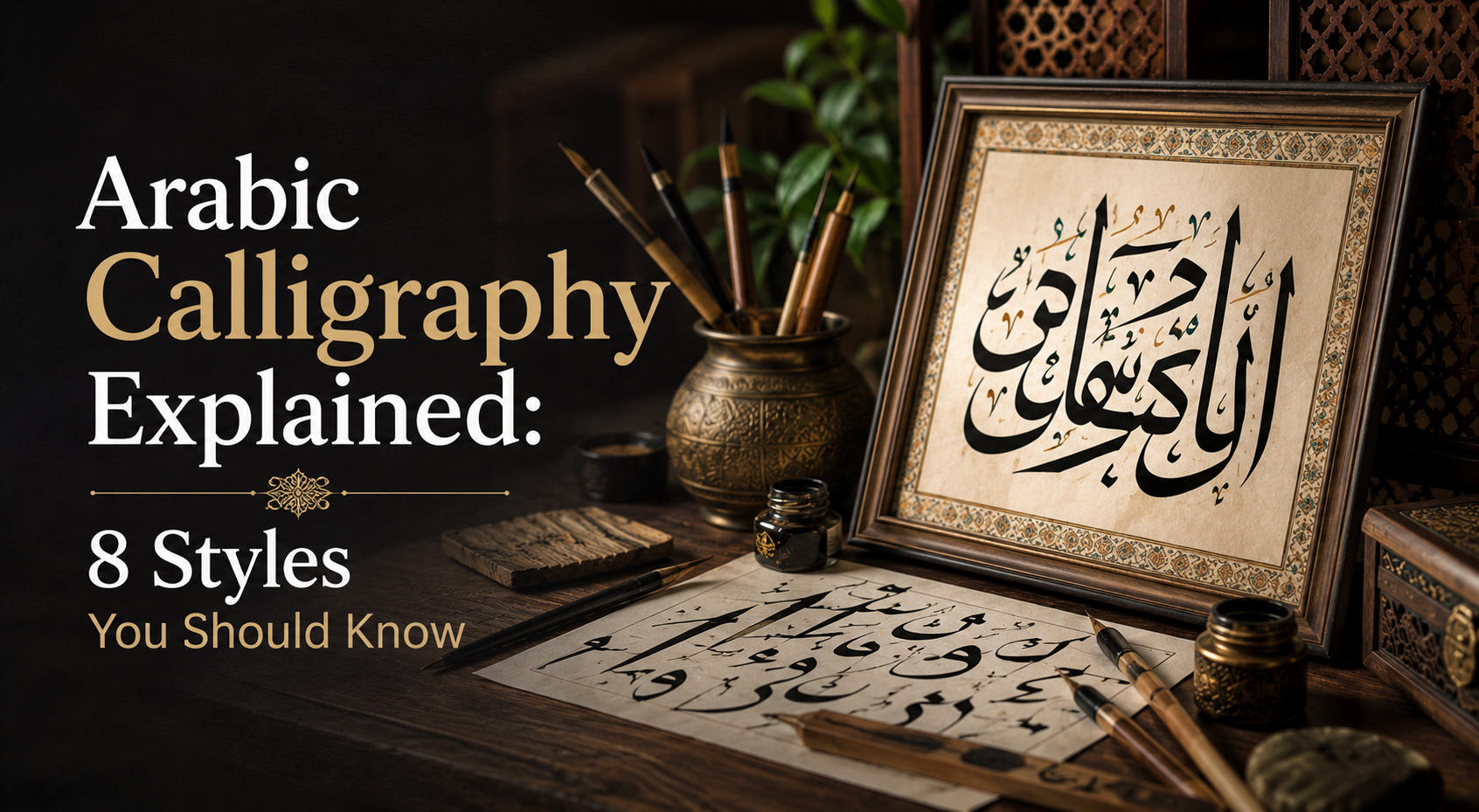
Arabic Calligraphy
is one of the richest visual art traditions in the world, combining language, geometry, rhythm, history, and artistic expression in a single written form. Developed over centuries across the Middle East, North Africa, and regions influenced by Islamic culture, it transforms Arabic letters into carefully balanced visual compositions.
Arabic calligraphy is the artistic practice of writing Arabic letters and words in carefully developed scripts, each with its own proportions, shapes, rules, and visual character. The seven major styles include Kufic, Naskh, Thuluth, Diwani, Muhaqqaq, Riq'a, and Maghrebi.
These styles are more than different handwriting techniques. Each one reflects a particular historical period, cultural setting, practical purpose, and artistic philosophy. Some are highly geometric and architectural, while others are fluid, decorative, or designed for everyday writing.
For audiences in the USA, learning the differences between these styles offers a valuable introduction to a global art form that appears in museums, architecture, interior design, wedding artwork, digital media, branding, and contemporary fine art. Whether you are exploring Arabic script for cultural knowledge, collecting artwork, planning a custom design, or studying visual typography, understanding the major styles provides the foundation for appreciating this enduring tradition.
What Is Arabic Calligraphy? A Quick Overview
Arabic calligraphy is the artistic discipline of shaping Arabic letters into visually harmonious compositions according to established rules of proportion, line, spacing, and movement. Unlike ordinary handwriting, traditional calligraphy is created through deliberate control of every stroke, curve, angle, and connection between letters.
The Arabic writing system is particularly well suited to visual art because letters connect within words and can be stretched, compressed, curved, layered, and arranged in many different ways. This flexibility has allowed calligraphers to develop numerous scripts with distinct personalities.
The term Arabic calligraphy can refer to both traditional scripts and contemporary artistic interpretations of Arabic writing. Historically, calligraphers worked with reed pens, natural inks, and specially prepared papers. Today, artists may also use brushes, digital tablets, vector software, and other modern tools while preserving principles inherited from classical traditions.
The major scripts discussed in this guide are Kufic, Naskh, Thuluth, Diwani, Muhaqqaq, Riq'a, and Maghrebi
. Together, they represent the remarkable range of Arabic writing styles developed across different regions and historical periods.
A Brief History of Arabic Calligraphy
The history of Arabic calligraphy is closely connected to the development and spread of the Arabic writing system. Early Arabic scripts evolved from earlier writing traditions in the Arabian Peninsula and surrounding regions. As Arabic became increasingly important for administration, literature, scholarship, and religious texts, the need for consistent and refined written forms encouraged the development of more structured scripts.
The early centuries of Islam played a particularly important role in the growth of Arabic calligraphy. The writing of the Quran created a strong cultural emphasis on accurate, beautiful, and respectful presentation of Arabic text. Early manuscripts often used bold, angular forms that later became associated with early Kufic traditions.
As Islamic civilization expanded from the Arabian Peninsula into the Middle East, North Africa, Central Asia, and parts of Europe, different regions developed their own approaches to writing. Calligraphers refined letter proportions and established rules that helped distinguish one script from another. Scripts suited to manuscripts differed from those used for monumental architecture, official documents, or everyday communication.
By the medieval period, calligraphy had become one of the most respected artistic disciplines in many Islamic societies. Calligraphers were not simply copying text; they were studying geometry, balance, rhythm, and the visual relationships between letters. In many traditions, mastery required years of disciplined practice under an experienced teacher.
The Ottoman era produced especially influential developments in scripts such as Thuluth and Diwani. Meanwhile, North African and Andalusian traditions developed distinctive forms that are now commonly associated with Maghrebi calligraphy.
Over time, Arabic calligraphy spread through architecture, manuscripts, coins, textiles, ceramics, metalwork, and decorative objects. Its influence continues today. Contemporary artists and designers combine traditional principles with modern composition, digital tools, abstract forms, and new materials.
This long history explains why Arabic calligraphy is not a single visual style. It is a broad family of traditions shaped by geography, purpose, technology, and artistic innovation.
8 Major Styles of Arabic Calligraphy You Should Know
Kufic — The Oldest Angular Script
Kufic is widely regarded as one of the oldest major styles of Arabic calligraphy and is named after Kufa, an important historical city in present-day Iraq. Early forms of the script became especially important for writing early Quranic manuscripts and formal inscriptions.
The most recognizable feature of Kufic is its strong geometric character
. Letters often appear angular, structured, and carefully aligned. Horizontal strokes may be extended, while vertical elements create a sense of architectural order. Depending on the historical period and regional variation, Kufic can appear highly rigid or more decorative and complex.
One reason Kufic became so influential is its visual strength. The script can create powerful compositions even when viewers cannot read Arabic. Its lines, angles, and repeating structures make it especially suitable for monumental design.
Historically, Kufic appeared in manuscripts, architectural inscriptions, coins, and decorative objects. Today, it remains popular in interior design, wall art, logos, typography, jewelry, and contemporary visual art.
Modern artists may use traditional Kufic principles or reinterpret the script in minimalist and geometric ways. Square Kufic, for example, has become particularly popular in contemporary design because letters can be arranged into grid-based compositions.
For designers and collectors, Kufic represents the architectural side of Arabic calligraphy. Its visual identity is structured, bold, historic, and highly adaptable to modern compositions.
Naskh — Clear, Readable, and Widely Used
Naskh is one of the most recognizable and readable Arabic calligraphy styles. Its name is associated with copying or transcription, reflecting its historical importance in manuscripts and written texts.
Compared with the angular appearance of Kufic, Naskh is generally more rounded, flowing, and compact. The letters are carefully proportioned, and the script is designed to support clear reading. This balance between beauty and legibility made it highly practical for books, manuscripts, and educational texts.
Naskh developed and evolved over centuries, with important refinements made by skilled calligraphers who established more consistent rules for letter shapes and proportions. Its clarity helped it become one of the most influential scripts in Arabic writing.
Today, Naskh remains widely encountered in printed Arabic text and digital typography. It is also frequently used in artistic calligraphy when the artist wants the words to remain easy to read.
Among the major forms of Arabic calligraphy, Naskh is often considered one of the most accessible for beginners and general audiences because its letterforms are relatively clear and familiar. It demonstrates how calligraphy can be both visually refined and functionally readable.
For artwork, educational material, manuscripts, and text-based designs, Naskh offers a strong combination of elegance, clarity, and historical importance.
Thuluth — Decorative and Used in Mosque Architecture
Thuluth is one of the most celebrated decorative scripts in the history of Arabic calligraphy. The name is commonly associated with the Arabic word for “one-third,” traditionally connected to the proportions of the pen or the structural characteristics of the script.
Thuluth is known for its large, sweeping, and highly expressive letterforms
. Long vertical strokes, broad curves, dramatic extensions, and complex connections give the script a strong sense of movement. Unlike highly compact writing styles, Thuluth often allows letters to expand across a composition.
The script became particularly important in religious architecture and monumental inscriptions. It can be seen in mosques, religious buildings, historical monuments, and decorative panels across the Islamic world. Its visual grandeur makes it well suited to large-scale applications.
Thuluth is also used for Quranic verses, titles, ceremonial artwork, and decorative compositions. Because of its complexity, creating balanced Thuluth requires significant technical skill. Small changes in spacing or proportion can affect the entire visual rhythm of a composition.
In contemporary design, Thuluth continues to appear in wall art, custom commissions, architectural decoration, wedding artwork, and cultural exhibitions. Its dramatic appearance makes it particularly effective when the goal is to create a sense of elegance, tradition, and visual importance.
Among the major Arabic calligraphy styles, Thuluth is often recognized for its theatrical presence and sophisticated ornamental quality.
Diwani — Ornamental Script Used in Ottoman Courts
Diwani developed during the Ottoman period and is strongly associated with official documents, royal administration, and court culture. Its purpose and appearance were shaped by the need to create a distinctive, elegant, and sometimes difficult-to-read script for formal communications.
The script is characterized by curved letterforms, dense composition, flowing connections, and decorative complexity. Letters may be arranged closely together, creating an ornamental texture across the page. The overall effect can be highly fluid and visually intricate.
Diwani was used for official correspondence and documents connected to Ottoman government institutions. Its complex appearance also helped distinguish important administrative writing from ordinary text.
A related form, often known as Jali Diwani, is even more decorative and may include additional dots, ornaments, and carefully arranged details. This version is particularly suited to artistic compositions.
Today, Diwani is frequently used for decorative artwork, wedding invitations, certificates, logos, wall designs, and special occasion pieces. Because of its flowing and luxurious appearance, it is especially popular for designs intended to communicate elegance.
For modern viewers, Diwani demonstrates how Arabic calligraphy can function almost like a visual pattern. Even when the words are readable, the overall composition often has a strong decorative impact.
Muhaqqaq — A Refined Script for Quranic Manuscripts
Muhaqqaq is a highly refined classical script historically associated with important manuscripts, particularly Quranic texts. Its name is often connected with ideas of precision, correctness, or careful execution, reflecting the disciplined nature of the script.
The style is known for its large scale, elegant proportions, elongated horizontal strokes, and carefully controlled curves
. Compared with some compact scripts, Muhaqqaq can appear open and spacious, giving individual letters a strong visual presence.
During important periods of manuscript production, Muhaqqaq was valued for presenting significant religious and literary texts in a formal and dignified manner. Its refined structure required considerable control from the calligrapher.
Although it is less common in everyday writing today, Muhaqqaq remains important to the study of classical Arabic calligraphy. Artists and specialists continue to practice and preserve its traditional characteristics.
Contemporary uses may include fine art, manuscript-inspired artwork, exhibitions, educational demonstrations, and carefully researched recreations of historical styles. Its visual character makes it especially appealing to people interested in the relationship between writing, scholarship, and cultural heritage.
Muhaqqaq illustrates the highly disciplined side of calligraphy. Its beauty comes not from casual spontaneity but from proportion, precision, and the careful relationship between every letter and the surrounding space.
Riq'a — A Simplified Everyday Script
Riq'a is a practical and simplified Arabic script developed for everyday handwriting. Compared with highly formal styles such as Thuluth or Muhaqqaq, Riq'a is more compact, direct, and efficient.
Its letterforms are generally designed to be written quickly and comfortably. The script uses simplified shapes and reduced complexity, making it suitable for notes, personal writing, informal communication, and daily use.
Riq'a became particularly popular in the modern period as a practical handwriting style. Its development reflects an important principle in the history of Arabic writing: not every script was created for monumental art or religious manuscripts. Some were developed to make communication faster and more accessible.
For beginners, Riq'a can provide an interesting introduction to the relationship between handwriting and formal calligraphic traditions. It shows how Arabic letterforms can be adapted for speed while maintaining their fundamental identity.
In modern visual culture, Riq'a may appear in informal branding, editorial design, handwriting-inspired artwork, signage, and contemporary illustrations. Designers may also draw inspiration from its compact forms when creating modern Arabic typography.
Among the major styles of Arabic calligraphy, Riq'a represents practicality and everyday communication. Its simplicity is not a lack of artistic value; instead, it reflects a different purpose from highly ornamental scripts.
Maghrebi — A North African and Andalusian Tradition
Maghrebi calligraphy developed in North Africa and was also associated with the broader cultural world of Islamic Spain, or Al-Andalus. It includes regional variations that reflect the artistic and historical development of western Islamic societies.
The script is known for its rounded, distinctive, and often highly expressive forms. Certain letter shapes and proportions can differ noticeably from eastern Arabic calligraphic traditions. The writing may appear more relaxed, curved, and visually distinctive.
Maghrebi traditions were important in manuscripts, religious texts, scholarly works, and regional documentation. Different areas developed their own variations, making the term Maghrebi represent a family of related styles rather than a single completely uniform form.
Today, Maghrebi calligraphy is valued for its cultural identity and historical importance. It appears in exhibitions, manuscript studies, contemporary artwork, cultural projects, and designs inspired by North African heritage.
For audiences unfamiliar with the diversity of Arabic writing, Maghrebi is especially valuable because it demonstrates that Arabic calligraphy developed differently across regions. The visual language of a manuscript from North Africa may look substantially different from a script associated with Ottoman Turkey or the Middle East.
Modern artists may preserve traditional forms or combine Maghrebi influences with contemporary composition. This makes the style relevant not only to historical study but also to modern cultural and artistic expression.
Ta’liq — A Flowing Persian-Influenced Calligraphic Tradition
Ta’liq is a distinctive calligraphic style that developed in Persia and became particularly important for writing Persian and other languages using the Arabic script. Its name is commonly associated with a hanging or suspended quality, reflecting the script’s flowing appearance and distinctive arrangement of letters.
Unlike the strong geometric structure of Kufic or the highly formal appearance of Muhaqqaq, Ta’liq is known for its fluid, sloping, and graceful letterforms. Letters often appear to hang from an implied line, creating a sense of movement and visual rhythm. The script can have an elegant, slightly informal character while still requiring considerable technical control.
Historically, Ta’liq was used for correspondence, literary works, official documents, and Persian manuscript traditions. It played an important role in the development of later Persian calligraphic styles, including Nastaliq, which became especially famous for its expressive and flowing composition.
Today, Ta’liq continues to influence contemporary artwork, Persian-inspired calligraphy, cultural exhibitions, typography, and decorative designs. Its inclusion in the wider study of Arabic-script calligraphic traditions highlights the broader cultural world in which Arabic letters have been adapted and developed.
For modern audiences, Ta’liq is especially interesting because it demonstrates how the Arabic script can take on different visual identities across languages and regions. Its flowing structure and elegant movement make it a distinctive addition to the history of calligraphy.
How These Styles Are Used in Modern Arabic Calligraphy
Modern Arabic calligraphy extends far beyond traditional manuscripts and religious architecture. Artists, designers, architects, and creative professionals continue to adapt classical scripts for contemporary audiences while preserving their cultural and visual foundations.
In home decor, calligraphic artwork is used for framed pieces, wall panels, canvas prints, and custom interior installations. Different scripts create different atmospheres. Kufic may suit minimalist or geometric interiors, while Thuluth can create a more traditional and dramatic visual statement.
Weddings and special events are another important area. Names, dates, blessings, and meaningful phrases can be arranged into personalized compositions. Diwani and flowing decorative styles are often attractive for formal invitations and ceremonial artwork.
Digital art has also expanded the possibilities of Arabic calligraphy. Artists can create compositions for social media, websites, digital exhibitions, motion graphics, and multimedia projects. Traditional letterforms may be combined with abstract shapes, photography, animation, or contemporary typography.
Branding is another growing application. Businesses may use custom Arabic lettering to create a distinctive identity, especially when communicating heritage, craftsmanship, luxury, or cultural connection. However, effective branding requires more than simply selecting an attractive script. Letterforms must remain appropriate to the intended audience and purpose.
Modern Arabic calligraphy therefore exists between tradition and innovation. Its strongest contemporary examples respect the structural principles of classical scripts while exploring new materials, technologies, layouts, and artistic ideas.
Tools and Techniques Behind Arabic Calligraphy
Traditional Arabic calligraphy depends on specialized tools and disciplined technique. The most iconic tool is the qalam, a pen traditionally made from a carefully prepared reed. The angle, cut, and flexibility of the pen influence the thickness and character of each stroke.
Ink is another essential element. Traditional calligraphers have used different types of inks and pigments, often selected for their color, consistency, and interaction with the writing surface. Black ink remains widely associated with classical manuscript writing, while colored and metallic inks may be used for decorative artwork.
Paper also matters. Calligraphers may prepare or select surfaces with specific textures and absorbency. Smooth paper allows the pen to move cleanly and helps preserve fine details.
Technique involves more than simply copying letter shapes. Calligraphers study proportions, pen angles, spacing, rhythm, line placement, and the relationship between positive and negative space. Repeated practice is essential for developing consistency.
Modern artists may combine traditional tools with brushes, markers, digital tablets, vector software, and graphic design programs. Digital tools allow compositions to be scaled, edited, animated, and adapted for different formats.
However, technology does not automatically replace traditional skill. A digital design can reproduce shapes, but understanding the structure and visual logic of classical Arabic calligraphy remains essential for creating work that feels balanced and authentic.
Frequently Asked Questions
What is Arabic calligraphy?
Arabic calligraphy is the artistic practice of writing Arabic letters in visually balanced and carefully structured forms. It includes numerous historical scripts, each with unique proportions, stroke patterns, and uses. The tradition has been applied to manuscripts, architecture, decorative art, personal names, typography, and contemporary digital design.
What are the main styles of Arabic calligraphy?
The seven major styles commonly discussed are Kufic, Naskh, Thuluth, Diwani, Muhaqqaq, Riq'a, and Maghrebi. Each developed in different historical or regional contexts. Some are primarily associated with manuscripts, some with architecture or official documents, and others with everyday handwriting.
Which Arabic calligraphy style is easiest to read?
Naskh is generally considered one of the easiest classical styles to read because its letters are clearly formed and proportioned for legibility. Riq'a is also practical and familiar as an everyday handwriting style. Readability can vary depending on the specific artist, composition, and level of stylization.
What is the oldest style of Arabic calligraphy?
Kufic is widely recognized as one of the oldest major Arabic calligraphy styles. Early forms were used in important manuscripts and inscriptions. Its angular, geometric appearance reflects the early development of formal Arabic writing and remains influential in both historical and contemporary design.
What's the difference between Kufic and Naskh?
Kufic is generally angular, geometric, and structured, while Naskh is more rounded, flowing, and focused on readability. Kufic is often associated with inscriptions, architectural design, and historical manuscripts. Naskh became especially important for books, manuscripts, printed text, and clear written communication.
Is Arabic calligraphy the same as Islamic calligraphy?
Not exactly. Arabic calligraphy refers to artistic writing using the Arabic script, while Islamic calligraphy is a broader cultural category that may include calligraphic traditions used in Islamic art. Islamic calligraphy can involve Arabic and, in some historical contexts, other languages written in Arabic-derived scripts.
What tools are used to create Arabic calligraphy?
Traditional tools include the qalam, ink, and carefully prepared paper. Calligraphers may also use rulers, ink containers, brushes, and other materials depending on the style. Contemporary artists increasingly use digital tablets and design software alongside traditional tools.
Can Arabic calligraphy be customized with names or quotes?
Yes. Custom calligraphic artwork can be created using names, meaningful phrases, poetry, quotations, dates, and other text. The appropriate style depends on the desired appearance, readability, cultural context, and intended use. A skilled artist can adapt the composition to create a balanced and personalized design.
How has Arabic calligraphy evolved with digital design?
Digital design has expanded the ways Arabic calligraphy can be created, edited, animated, and distributed. Artists can combine classical scripts with typography, illustration, motion graphics, and digital media. However, strong digital work still benefits from an understanding of traditional letter proportions and calligraphic principles.
Conclusion
The diversity of Arabic calligraphy reflects centuries of artistic development across different cultures, regions, and historical periods. From the geometric strength of Kufic and the readability of Naskh to the grandeur of Thuluth, the ornamentation of Diwani, the refinement of Muhaqqaq, the practicality of Riq'a, and the regional character of Maghrebi, each style offers a distinct visual language.
Understanding these seven traditions makes it easier to appreciate how writing can become architecture, decoration, cultural memory, and fine art. Today, Arabic calligraphy continues to evolve through contemporary artwork, interior design, branding, weddings, digital media, and custom creative projects while remaining connected to its historical foundations.
Explore custom Arabic calligraphy artwork crafted by Nihad Dukhan in any of these timeless styles.