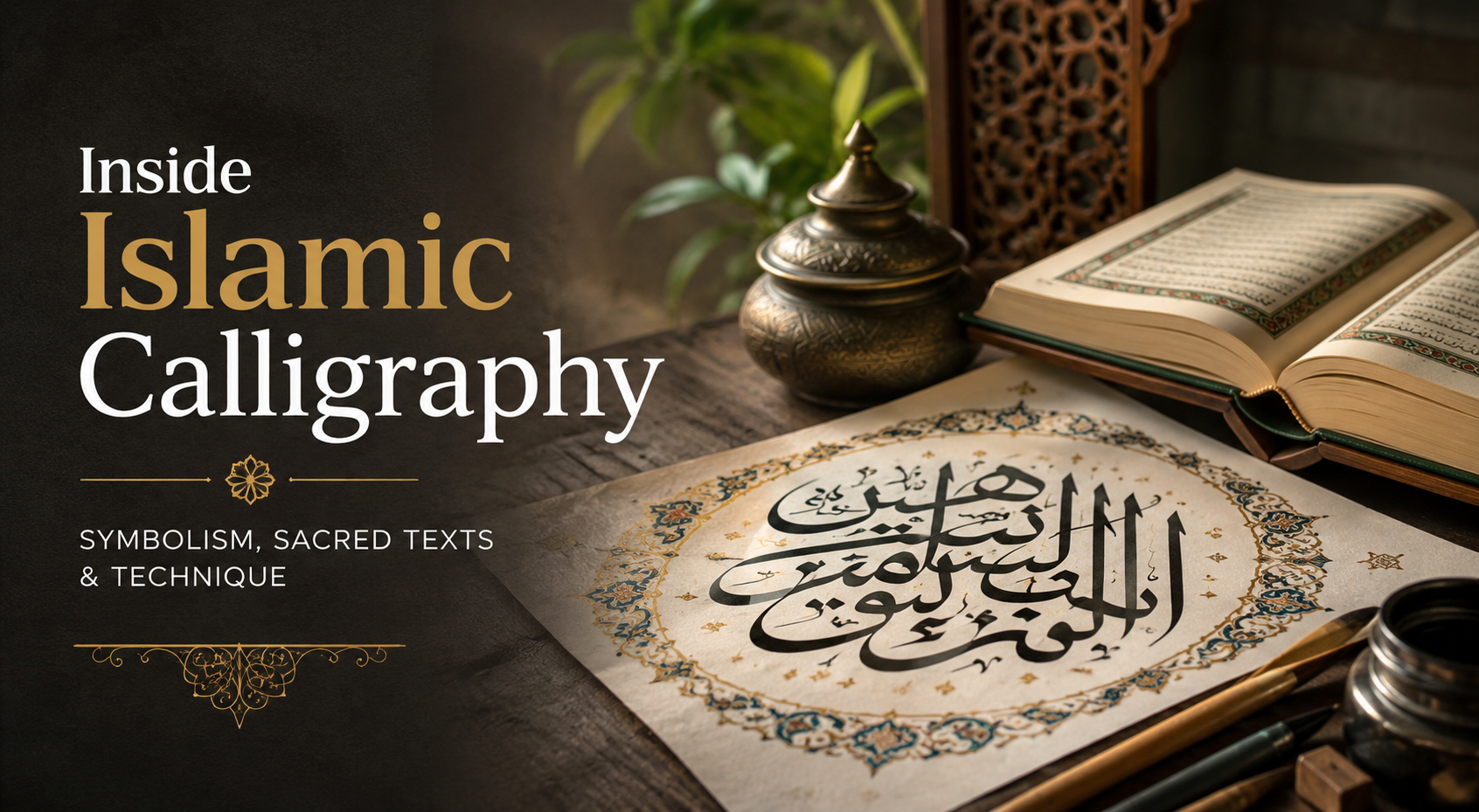
Islamic Calligraphy
is far more than beautifully arranged lettering. It is a spiritual, cultural, and artistic tradition in which written language becomes a visual expression of faith, history, identity, and devotion. For centuries, calligraphers have transformed sacred words, poetry, and meaningful expressions into works of art that communicate both visually and intellectually.
Islamic calligraphy is the artistic practice of writing Arabic and other languages associated with Islamic culture in carefully developed scripts and compositions. It is especially known for presenting Quranic verses, religious expressions, and meaningful texts through disciplined lettering, proportion, rhythm, and design.
Unlike ordinary handwriting, the tradition combines technique with symbolism. Every curve, proportion, spacing decision, and composition can contribute to the overall meaning of a piece. From ancient manuscripts to contemporary wall art in American homes, Islamic calligraphy continues to connect written language with artistic expression.
For modern audiences in the USA, studying Islamic calligraphy offers a fascinating way to understand the relationship between art, spirituality, language, and cultural heritage. Its enduring appeal lies not only in its visual beauty but also in the depth of meaning contained within the written word.
What Is Islamic Calligraphy? A Brief Definition
Islamic Calligraphy is the artistic discipline of creating visually refined written compositions using Arabic and other scripts connected with Islamic cultures. It is commonly associated with Quranic text, religious phrases, the Names of Allah, poetry, and expressions that carry spiritual or cultural significance.
Unlike standard writing, calligraphy follows carefully developed rules concerning letter proportions, stroke weight, spacing, alignment, and composition. A skilled calligrapher does not simply write words; they construct a balanced visual system in which letters become part of an artistic design.
Although Arabic is the language most strongly associated with Islamic calligraphic traditions, Islamic art has developed across many regions, including the Middle East, North Africa, Persia, Central Asia, South Asia, and the Ottoman world. As a result, different cultures developed distinct scripts, materials, decorative methods, and artistic approaches.
At its core, Islamic calligraphy brings together language, visual harmony,
cultural history, and spiritual reflection
. It can appear in manuscripts, mosque architecture, ceramics, textiles, metalwork, wood, paintings, and contemporary digital art.
The Origins and History of Islamic Calligraphy
The history of Islamic calligraphy
is closely connected to the development and preservation of the Arabic written word. In the early Islamic period, writing became especially significant because of the importance of recording, preserving, and transmitting the Quran. As the Muslim world expanded, the need for accurate and beautiful writing encouraged the development of increasingly refined scripts.
Early Arabic writing was not yet standardized into the many recognizable styles known today. Over time, calligraphers and scholars worked to improve letter forms, proportions, readability, and consistency. The growth of Islamic civilization created new centers of learning and artistic production, allowing calligraphy to develop across different regions.
The Quran played a central role in this evolution. As copies of the sacred text were produced, calligraphers developed techniques that balanced legibility with visual beauty. The written page became an important artistic space, with carefully arranged text, decorative illumination, and precise manuscript production.
One of the earliest influential styles was Kufic, associated with the city of Kufa and known for its strong, angular forms. It was used in early Quranic manuscripts and architectural decoration. As writing needs changed, more fluid scripts developed for faster writing and improved readability.
The Abbasid period was particularly important for the formal development of Arabic scripts. Calligraphers and scholars contributed to systems of proportion that helped establish consistent relationships between letters. This encouraged calligraphy to become a recognized discipline rather than simply a practical method of writing.
The tradition then spread and evolved across a vast geographical area. Persian calligraphers developed elegant styles suited to Persian literature and poetry. Ottoman artists refined monumental scripts for architecture and religious decoration. In South Asia, calligraphy became closely connected with Mughal art, manuscript culture, architecture, and decorative arts.
North Africa and Andalusia also developed their own regional approaches. Each cultural environment contributed new visual characteristics while maintaining a connection to the broader tradition.
This history explains why Islamic calligraphy cannot be reduced to one script or one visual style. It is a family of artistic traditions shaped by language, religion, geography, technology, and generations of artistic practice.
The Symbolism Behind Islamic Calligraphy
The power of Islamic calligraphy comes partly from the fact that its visual beauty is closely connected to the meaning of the written word. A composition may be admired for its balance and design, but its deeper significance often comes from the text it presents.
Why Calligraphy Replaced Figurative Art in Islamic Tradition
It is important to avoid oversimplifying Islamic artistic history. Islamic cultures have produced many forms of figurative art, including illustrated manuscripts, architectural decoration, textiles, and paintings. However, in many religious contexts, particularly those connected with the decoration of mosques and Quranic manuscripts, calligraphy became the dominant visual language.
This prominence was influenced by the special status of the written word in Islam. Religious texts, especially the Quran, were not simply ordinary literature. The words themselves carried profound spiritual importance. Presenting them beautifully offered artists a way to create meaningful decoration without relying on representations of prophets or divine figures.
As a result, writing became a central artistic medium. Walls, domes, manuscripts, tiles, ceramics, and objects could be decorated with carefully composed text. Calligraphy offered both visual beauty and intellectual meaning.
The tradition also encouraged artists to explore abstraction, geometry, rhythm, and ornament. Letters could be stretched, balanced, repeated, layered, or arranged into complex compositions while remaining connected to language.
Connection Between the Written Word and the Divine
The written word holds an especially important place in Islamic culture because revelation is fundamentally connected with language and recitation. The Quran is experienced through reading, recitation, memorization, and reflection. Its written form therefore carries both textual and visual significance.
This relationship gives calligraphy a distinctive character. A Quranic composition is not merely decorative text. For many viewers, it represents a reminder of faith, spiritual guidance, remembrance, and reflection.
The act of writing can also be viewed as a disciplined practice requiring patience and concentration. A calligrapher must repeat forms, control the hand, maintain proportions, and work carefully. This process can create a connection between artistic discipline and personal reflection.
The visual composition may therefore operate on multiple levels. A viewer may first notice the balance of the letters, then recognize the text, and finally reflect on its deeper meaning.
Symbolic Meaning of Specific Letters and Forms
Individual letters and forms can carry symbolic associations within Islamic artistic and cultural traditions. However, meanings should be approached carefully because interpretations can vary according to religious scholarship, historical context, regional tradition, and the specific text being used.
The Arabic alphabet itself is visually distinctive. Its connected forms create opportunities for rhythm, repetition, extension, and balance. Horizontal strokes may create a sense of stability, while vertical forms can introduce height and emphasis. Curves and rounded shapes can soften a composition.
Some calligraphic compositions emphasize symmetry and geometric order. Others use flowing movement to create a sense of rhythm. A circular composition may suggest unity or completeness in an artistic sense, while a vertical arrangement can draw attention upward within an architectural setting.
The dot, used traditionally as a measurement unit in many calligraphic systems, is especially important technically. It helps establish the proportions of letters and demonstrates how mathematical discipline supports artistic expression.
In this way, symbolism in Islamic calligraphy is not limited to hidden meanings assigned to individual letters. It also emerges through the relationship between text, composition, proportion, repetition, space, and cultural understanding.
Sacred Texts in Islamic Calligraphy
Sacred and meaningful texts are among the most important subjects in Islamic calligraphy. The Quran, Hadith, and the Names of Allah are frequently represented in artistic compositions, although the choice of text and its presentation require respect and careful attention to accuracy.
Quranic Verses
Quranic verses are among the most recognizable forms of calligraphic art. They may appear in manuscripts, mosque interiors, architectural panels, framed artwork, ceramics, and contemporary home decor.
Artists often select verses according to the purpose of the piece. A composition for a home may focus on themes such as peace, gratitude, guidance, protection, patience, or remembrance. Architectural calligraphy may use text that complements the spiritual purpose of a mosque or religious space.
Accuracy is essential when presenting Quranic text. A calligrapher must carefully reproduce the wording, spelling, diacritical marks, and intended script. Artistic creativity should never compromise the integrity of the sacred text.
Hadith and Religious Expressions
Hadith, which refers to reports concerning the sayings, actions, and teachings of the Prophet Muhammad, may also appear in calligraphic art. Short religious expressions and traditional phrases are also commonly used.
These works may serve as reminders of ethical values, spiritual principles, or important aspects of Islamic belief. The artistic presentation can make the words visually prominent while encouraging viewers to reflect on their meaning.
The Names of Allah: Asma-ul-Husna
The Asma-ul-Husna, or the Beautiful Names of Allah, are another important subject in Islamic artistic traditions. Individual names or collections of names may be arranged in decorative compositions.
Artists may explore the visual qualities of Arabic letters to create balanced layouts. The names can be presented individually, in circular compositions, or as part of larger decorative arrangements.
Because these texts are sacred or religiously meaningful, context matters. A professional calligrapher should understand the importance of accuracy, respectful presentation, and appropriate placement.
Major Styles and Techniques of Islamic Calligraphy
The history of Islamic calligraphy includes numerous scripts, each with its own visual character, historical background, and technical requirements. Some styles are associated with manuscripts, others with monumental architecture, official documents, poetry, or decorative art.
Kufic
Kufic is one of the earliest and most recognizable Arabic calligraphic styles. It is known for its angular, geometric, and structured appearance.
Early forms of Kufic were particularly important in Quranic manuscripts and architectural decoration. Its strong horizontal and vertical elements make it suitable for inscriptions carved into stone, displayed on tiles, or incorporated into geometric designs.
Over time, many variations developed. Some versions became highly decorative, while others remained relatively simple and monumental.
Today, Kufic continues to influence modern graphic design, logos, wall art, typography, and architectural decoration.
Naskh
Naskh is known for its clarity, readability, and balanced proportions. It became especially important for manuscripts and the writing of books.
Compared with the angular appearance of early Kufic, Naskh generally has a more rounded and fluid character. Its readability made it highly suitable for extended texts, including religious manuscripts.
Many modern Arabic typefaces are influenced by the principles of Naskh. Its continued importance demonstrates how traditional calligraphic forms can influence contemporary digital typography.
Thuluth
Thuluth is often recognized for its elegant, flowing, and monumental appearance. It features elongated vertical strokes, large sweeping curves, and complex compositions.
The style has been widely used in mosque architecture, monumental inscriptions, Quranic decoration, and formal artistic compositions. Its visual presence makes it particularly effective when text must be seen from a distance.
Thuluth requires significant technical skill. Letter proportions, spacing, overlapping forms, and extended strokes must work together to create harmony.
Diwani
Diwani developed during the Ottoman period and is associated with flowing, decorative, and sometimes highly intricate writing.
The script is characterized by curved forms and closely connected letters. Historically, it was used in official documents and courtly contexts. Its ornamental qualities later made it popular in artistic compositions.
Because of its complexity, Diwani can appear mysterious to viewers unfamiliar with Arabic writing. Its beauty often comes from the balance between legibility and decorative movement.
Muhaqqaq
Muhaqqaq is a refined script historically used for important manuscripts, including Quranic texts. It is known for its clear, elongated forms and elegant proportions.
The script can create a sense of dignity and spaciousness on the page. Although less commonly seen in everyday modern writing, it remains important in the history of manuscript calligraphy.
Together, these styles demonstrate the diversity of the tradition. Islamic calligraphy is not one uniform visual language. It is a broad artistic field in which different scripts developed for different purposes, regions, and aesthetic preferences.
Tools and Techniques Used by Islamic Calligraphers
Traditional Islamic calligraphy depends on specialized tools and careful preparation. The most famous instrument is the qalam, a pen traditionally made from a reed.
A calligrapher carefully cuts and shapes the reed to create the correct nib angle. The shape of the nib affects the width, direction, and character of every stroke. Even small changes can significantly alter the appearance of a script.
Ink is another important element. Traditional inks may be prepared using materials such as soot, pigments, binders, and water. Different colors can be used for decorative purposes, although black ink remains strongly associated with manuscript writing.
Paper preparation also has a long history. Traditional papers may be treated, polished, and prepared to create a smooth surface that allows the pen to move consistently. Burnishing can help produce a refined finish.
Calligraphers also use rulers, guides, measuring systems, and specialized tools to maintain proportion. In many traditional systems, the dot serves as a basic unit for measuring letter dimensions.
Modern artists may combine traditional techniques with contemporary materials. Acrylic paint, watercolor, canvas, wood, metal, glass, and specialized papers are now widely used.
Digital techniques have also expanded creative possibilities. Artists can use digital tablets, vector software, and typography tools to experiment with composition, scale, and color. However, digital design does not automatically replace traditional expertise. Understanding letter structure, proportion, script rules, and cultural context remains essential.
The Role of Islamic Calligraphy in Modern Art and Design
Today, Islamic calligraphy continues to evolve while maintaining a connection to centuries of tradition. In the USA, it can be found in homes, galleries, cultural exhibitions, mosques, restaurants, studios, and private collections.
Home decor is one of the most visible modern applications. Framed calligraphy may be used as a meaningful focal point in living rooms, entryways, prayer spaces, and offices. Many people value these works not only for their visual appearance but also for the personal or spiritual meaning of the text.
Mosque architecture remains another important setting. Calligraphy may be incorporated into walls, domes, mihrabs, tiles, and architectural panels.
The tradition is also increasingly visible in wedding and event design. Meaningful Arabic phrases, names, and decorative compositions can be used in invitations, signage, seating displays, and personalized artwork.
Gifting culture has further expanded interest. A custom calligraphic piece may commemorate a wedding, birth, anniversary, religious occasion, or family milestone.
Modern artists are also experimenting with mixed media, abstract compositions, contemporary color palettes, digital illustration, and large-scale installations. These developments show that tradition and innovation can coexist.
For American audiences interested in art and culture, contemporary calligraphy provides a way to engage with Islamic heritage through a visual language that is both historically rooted and creatively adaptable.
Frequently Asked Questions About Islamic Calligraphy
What is Islamic calligraphy?
Islamic calligraphy is the artistic practice of creating visually refined written compositions using Arabic and other scripts connected with Islamic cultures. It often includes Quranic verses, religious expressions, the Names of Allah, poetry, and culturally meaningful text. The art focuses on proportion, structure, rhythm, spacing, and visual harmony.
Why is calligraphy so important in Islamic art?
Calligraphy became especially important because written language, particularly Quranic text, holds profound significance in Islamic culture. It provided a way to create beautiful religious art centered on the written word. Over centuries, calligraphers developed sophisticated scripts that became central to manuscripts, architecture, decoration, and visual culture.
What are the main styles of Islamic calligraphy?
Major styles include Kufic, Naskh, Thuluth, Diwani, and Muhaqqaq. Other regional and historical scripts also exist. Each style has distinct characteristics. Kufic is often geometric and angular, Naskh is highly readable, Thuluth is monumental and flowing, Diwani is decorative, and Muhaqqaq is refined and associated with manuscript traditions.
What tools are used in Islamic calligraphy?
Traditional tools include the qalam, usually a carefully prepared reed pen, along with ink, prepared paper, rulers, and measuring tools. Calligraphers may also use specialized surfaces and pigments. Modern practitioners sometimes work with canvas, wood, glass, metal, acrylics, digital tablets, and design software.
Is Islamic calligraphy only religious in nature?
No. Although religious texts are extremely important, Islamic calligraphic traditions have also been used for poetry, literature, architecture, cultural expressions, names, proverbs, and decorative designs. The term broadly relates to calligraphic traditions associated with Islamic cultures and is not limited exclusively to sacred text.
What is the difference between Islamic and Arabic calligraphy?
Arabic calligraphy refers specifically to artistic writing using the Arabic script or Arabic language, while Islamic calligraphy is a broader cultural category associated with Islamic artistic traditions. The two overlap significantly, especially because Arabic calligraphy has historically been central to Islamic art, but Islamic calligraphy may also reflect Persian, Ottoman, South Asian, and other regional traditions.
Can non-Arabic speakers learn Islamic calligraphy?
Yes. Non-Arabic speakers can learn the techniques of Islamic calligraphy. However, learning the script, understanding letter forms, and developing proper technique are important. When working with Quranic or other sacred text, learners should also take extra care to verify accuracy and understand the meaning and respectful context of the words.
What materials are Islamic calligraphy pieces usually made on?
Traditional pieces may be created on prepared paper, parchment, manuscripts, and architectural surfaces. Contemporary artworks may use canvas, wood, glass, ceramics, metal, textiles, and digital media. The choice depends on the artistic purpose, the script, the environment, and the desired visual effect.
How has Islamic calligraphy evolved in modern times?
Modern artists combine traditional scripts with contemporary media, abstract compositions, graphic design, new materials, and digital technology. While some artists preserve classical methods, others reinterpret traditional letterforms for modern interiors, exhibitions, branding, architecture, and personal art collections.
Conclusion
Islamic calligraphy represents one of the world's most sophisticated relationships between written language and visual art. Its history reflects the development of scripts, manuscripts, architecture, scholarship, and cultural exchange across centuries and regions.
Its significance comes from more than beautiful lettering. The discipline combines technical precision with spiritual reflection, cultural identity, symbolism, and artistic creativity. From the geometric strength of Kufic to the flowing elegance of Thuluth and the readability of Naskh, each style contributes to a rich visual heritage.
For contemporary audiences in the USA, Islamic calligraphy offers an opportunity to appreciate art that connects history with modern creativity. Whether found in a sacred space, museum, home, or contemporary gallery, its enduring power lies in the ability to transform meaningful words into visual experiences that invite both appreciation and reflection.
Discover the beauty of authentic Islamic calligraphy — explore custom pieces crafted by Nihad Dukhan.