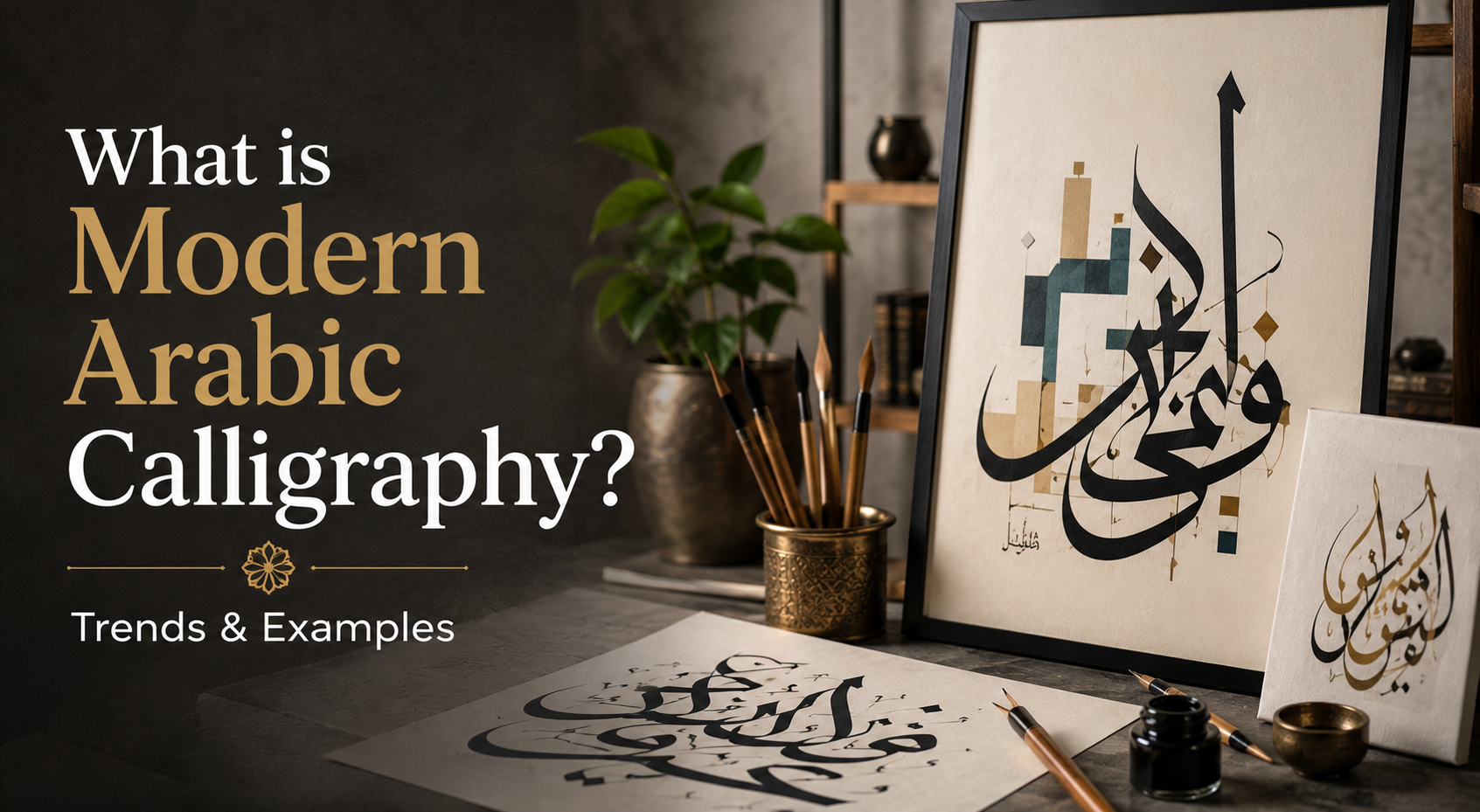
Arabic calligraphy has evolved far beyond its traditional roots. Once primarily associated with religious manuscripts, mosques, and classical artistic traditions, it is now influencing contemporary branding, fashion, interiors, murals, digital art, and global visual culture. Arabic Calligraphy continues to preserve centuries of cultural heritage while adapting to new creative environments.
Modern Arabic Calligraphy is the contemporary interpretation of Arabic lettering through experimental forms, digital tools, abstract compositions, graffiti, typography, and mixed media. Unlike traditional styles, it allows artists to reinterpret letterforms and compositions while maintaining a connection to the visual identity of the Arabic script.
This evolution has made modern Arabic calligraphy increasingly relevant to designers, collectors, homeowners, brands, and art enthusiasts across the USA. From minimalist wall art to expressive calligraffiti and personalized name designs, the art form demonstrates how heritage can remain meaningful while embracing innovation. Understanding its origins, techniques, trends, and everyday applications provides a clearer picture of why this creative movement continues to grow globally.
What is Modern Arabic Calligraphy? A Clear Definition
Modern Arabic Calligraphy is the contemporary practice of creating artistic compositions with Arabic letters and script while using experimental styles, modern design principles, unconventional materials, and digital technologies. It may preserve recognizable Arabic letterforms, but it is not limited to the strict rules, tools, and compositions associated with classical calligraphic schools.
Traditional Arabic calligraphy generally emphasizes established scripts, disciplined proportions, formal techniques, and historical rules passed down through generations. Modern Arabic Calligraphy, by contrast, gives artists greater freedom to manipulate scale, spacing, texture, color, composition, and visual form.
A contemporary artist may combine Arabic letters with abstract painting, graffiti, geometric design, photography, animation, or Western typography. The writing may remain readable, become partially abstract, or function primarily as a visual structure.
The key distinction is not that modern work abandons tradition. Rather, it reinterprets tradition for a contemporary audience. Artists may still draw inspiration from classical scripts such as Kufic, Thuluth, Naskh, or Diwani while adapting their visual qualities for modern creative environments.
As a result, Modern Arabic Calligraphy can appear as a painting, digital illustration, logo, mural, fashion graphic, installation, or personalized artwork. Its defining characteristic is the creative dialogue between the heritage of Arabic script and the visual language of contemporary design.
How Modern Arabic Calligraphy Differs from Traditional Styles
The relationship between contemporary and traditional practice is best understood as an evolution rather than a complete separation. Traditional Arabic calligraphy is built around established systems of proportion, letter construction, rhythm, and discipline. Historically, the calligrapher's mastery depended on precise control of the pen, ink, paper, and script rules.
Modern Arabic Calligraphy often begins with that foundation but expands the creative possibilities. Artists may preserve the essential identity of Arabic letters while changing how those letters are arranged, interpreted, or presented. This creates a broader visual vocabulary suitable for modern art and design.
One of the most visible differences is the influence of graffiti and street art. Calligraffiti combines the expressive energy of urban lettering with Arabic script. Large-scale murals may use sweeping strokes, layered colors, dramatic textures, and bold compositions that would not typically appear in formal manuscript traditions.
Abstract art has also influenced contemporary approaches. In some works, the viewer may recognize individual letters, while in others the script becomes an almost architectural arrangement of lines and curves. The emotional impact may be more important than immediate readability.
Typography represents another major difference. Traditional calligraphy generally focuses on writing and artistic script production. Contemporary designers may treat Arabic letters as flexible visual forms that can be adjusted for logos, packaging, editorial layouts, websites, and advertising campaigns.
Digital tools have further expanded the possibilities. Tablets, vector software, animation programs, and generative design systems allow artists to experiment with forms that would be difficult to create manually. A single calligraphic composition can be resized, animated, layered, or adapted for multiple formats.
However, modern experimentation does not automatically make a piece culturally meaningful or artistically successful. Strong contemporary work usually demonstrates an understanding of the structure and character of Arabic script. The most compelling artists often combine technical knowledge of traditional forms with the freedom to experiment.
This balance is important. If the connection to the script is completely lost, the result may become generic abstraction. If experimentation is too limited, the work may simply reproduce historical styles without offering a contemporary perspective.
The strength of Modern Arabic Calligraphy lies in this space between preservation and innovation. It allows artists to respect the identity of Arabic writing while exploring how it can function within a global design environment.
Key Trends Shaping Modern Arabic Calligraphy Today
The contemporary movement is developing across multiple creative industries. Artists are working on canvas, walls, screens, clothing, architecture, packaging, and public installations. Several important trends are shaping how audiences experience Arabic script today.
Calligraffiti: Where Calligraphy Meets Street Art
Calligraffiti is one of the most recognizable developments in contemporary Arabic lettering. The term combines calligraphy and graffiti, describing artwork that uses the visual qualities of calligraphic writing within the expressive environment of street art.
Large-scale murals may feature dramatic brushwork, layered backgrounds, spray-paint textures, and energetic compositions. Unlike traditional calligraphy, which is often created for close and focused viewing, calligraffiti is designed to communicate across public spaces.
The style can also create cultural dialogue. Arabic script may appear on urban walls in cities where different languages, communities, and artistic traditions meet. In the USA, this makes calligraffiti particularly relevant to multicultural neighborhoods, public art programs, galleries, and contemporary design projects.
Some calligraffiti artists prioritize readability, while others create compositions where letters become symbolic shapes. Both approaches demonstrate how Arabic writing can function as language and visual art at the same time.
Minimalist and Abstract Interpretations
Minimalism has become another important trend. Instead of using complex compositions or many colors, contemporary artists may focus on a single word, phrase, or letterform.
A minimalist piece may use black ink on a neutral background, a small number of geometric shapes, or carefully balanced negative space. The simplicity allows the structure of the script to become the central visual element.
Abstract interpretations take the idea further. Letters may be stretched, repeated, rotated, layered, or partially concealed. In some cases, the viewer first experiences the artwork as an abstract composition and only later notices the underlying Arabic script.
This approach has strong connections to contemporary interior design. Minimalist artwork can complement modern homes, offices, restaurants, galleries, and hospitality spaces without appearing visually overwhelming.
The trend also reflects a broader interest in visual storytelling. A single Arabic word can carry emotional, spiritual, cultural, or personal meaning while remaining visually elegant.
Digital and AI-Assisted Design Tools
Digital technology has transformed how artists create, test, and distribute contemporary Arabic lettering. Digital tablets allow artists to draw with pressure-sensitive tools that can replicate aspects of traditional brush and pen movement.
Vector software makes it possible to refine shapes, adjust proportions, experiment with color, and prepare artwork for different applications. A composition created for a canvas may later be adapted for a website, social media graphic, product package, or large-scale mural.
Animation has introduced another dimension. Arabic letters can appear gradually, transform into patterns, or move across a screen. This has created opportunities for motion graphics, film titles, digital campaigns, and interactive installations.
AI-assisted design tools are also influencing the creative process. They can help generate visual directions, explore compositions, and support experimentation. However, technology does not replace the artistic understanding required to create culturally appropriate and visually coherent work.
The most effective digital workflows usually combine human creativity with technology. The artist remains responsible for meaning, composition, cultural context, and refinement. Digital tools simply provide additional ways to explore and execute an idea.
Fusion with Western Typography and Branding
Contemporary designers increasingly explore how Arabic script can interact with Latin typography. This is particularly important for global brands serving multilingual audiences.
A brand identity may place Arabic and English lettering side by side, creating a visual relationship between different writing systems. Designers must consider differences in direction, letter structure, spacing, rhythm, and visual weight.
When handled carefully, the result can be both functional and culturally distinctive. Arabic lettering may become an important part of a brand's identity rather than simply a translated version of English text.
This fusion is visible in logos, packaging, advertising campaigns, editorial design, fashion labels, restaurants, cultural institutions, and technology products.
The trend also demonstrates that Arabic script has a place within global design systems. It can be modern, sophisticated, playful, minimal, luxurious, or experimental depending on the creative direction.
Use in Fashion, Murals, and Interior Design
Fashion has embraced Arabic lettering through clothing graphics, accessories, runway visuals, and textile patterns. A single word or phrase may be transformed into a repeating pattern or placed prominently as a statement graphic.
Murals offer another major opportunity. Artists can create large-scale work for community spaces, galleries, restaurants, offices, and cultural events. The scale allows the movement and structure of the script to become part of the architecture.
Interior design has also helped expand the audience for contemporary calligraphic art. Homeowners and designers may use framed artwork, canvas pieces, sculptural lettering, and custom wall installations to introduce cultural meaning into modern spaces.
These applications show that Arabic Calligraphy is no longer limited to books, religious institutions, or specialist exhibitions. It now exists within the everyday visual environment.
Examples of Modern Arabic Calligraphy in Everyday Use
One reason contemporary Arabic lettering continues to grow is its versatility. It can function as fine art, personal expression, cultural decoration, and commercial design.
Home Decor
In homes, contemporary Arabic artwork may appear as framed prints, canvas paintings, metal wall pieces, wooden installations, or digital art. Popular subjects include meaningful words, names, poetry, blessings, and short quotations.
The design can be adapted to different interior styles. A minimalist black-and-white composition may suit a modern apartment, while textured or colorful artwork may work better in an eclectic or artistic space.
Weddings and Special Events
Personalized calligraphic artwork is increasingly used for weddings, engagement celebrations, anniversaries, and cultural events. Names, dates, initials, and meaningful phrases can become part of invitations, welcome signs, seating displays, backdrops, and keepsake artwork.
Because the script has a strong visual identity, even a short phrase can create a memorable design element.
Corporate Branding
Businesses may incorporate Arabic lettering into logos, packaging, signage, campaigns, and brand storytelling. This is especially relevant for organizations that want to communicate cultural heritage or reach Arabic-speaking audiences.
A professionally designed Arabic wordmark can help create a distinctive identity while supporting bilingual communication.
Wall Art and Public Murals
Large-scale wall art allows artists to experiment with size, texture, and visual impact. A mural may use a recognizable phrase or transform letters into an abstract composition that interacts with the surrounding architecture.
Public artwork can also create a sense of cultural visibility and community connection.
Personalized Name Art
Personalized name artwork remains one of the most popular applications. An individual's name can be designed in a traditional-inspired script, a modern abstract style, a geometric composition, or a bold calligraffiti approach.
The artwork may be created for a home, office, gift, celebration, or personal collection. This demonstrates how Modern Arabic Calligraphy can connect cultural identity with individual expression.
Tools and Mediums Used in Modern Arabic Calligraphy
Contemporary artists use a combination of traditional materials and modern technology. The choice of tools often depends on the desired style, scale, and final application.
Digital Tablets
Digital tablets are widely used for creating and refining artwork. Pressure sensitivity allows artists to control line weight and movement, while digital layers make experimentation easier.
Design Software
Vector and illustration software can help artists create scalable artwork for logos, websites, packaging, murals, and print products. Digital tools also make it easier to test different layouts and color combinations.
Canvas and Paint
Canvas remains a popular medium for physical artwork. Artists may use acrylic, watercolor, ink, oil, spray paint, or mixed-media techniques to create texture and depth.
Traditional Qalam
The traditional qalam, or reed pen, remains important for artists who want to preserve the physical experience of classical calligraphy. Some contemporary artists begin with a qalam composition and then digitize, enlarge, manipulate, or combine it with modern materials.
Mixed Media
Mixed-media artwork may combine ink, paint, collage, wood, metal, photography, textiles, and digital printing. This approach allows Arabic lettering to become part of a larger visual environment.
The most interesting contemporary work often combines old and new. A traditional stroke may become the foundation for a digitally edited composition, while a digital design may be recreated by hand on canvas. This exchange between methods reinforces the idea that Modern Arabic Calligraphy is an evolving practice rather than a fixed category.
Frequently Asked Questions About Modern Arabic Calligraphy
What is modern Arabic calligraphy?
Modern Arabic Calligraphy is the contemporary interpretation of Arabic script through experimental lettering, abstract art, graffiti, typography, digital tools, and mixed media. It may draw inspiration from traditional scripts while using modern compositions, materials, and creative techniques for art and design.
How is modern Arabic calligraphy different from traditional Arabic calligraphy?
Traditional Arabic calligraphy generally follows established scripts, proportions, tools, and artistic rules. Modern approaches are more experimental and may incorporate abstract forms, graffiti, digital technology, Western typography, unusual materials, and unconventional compositions while still drawing inspiration from the structure of Arabic lettering.
What are the latest trends in modern Arabic calligraphy?
Major trends include calligraffiti, minimalist compositions, abstract lettering, digital and AI-assisted design, bilingual branding, fashion graphics, large-scale murals, personalized name art, and contemporary interior decoration. These trends show how Arabic script is increasingly being used across both fine art and commercial design.
Is modern Arabic calligraphy still considered authentic art?
Yes. Artistic authenticity does not require an artwork to copy historical styles exactly. Contemporary Arabic calligraphy can remain culturally meaningful when artists understand the script, respect its heritage, and use experimentation thoughtfully. Modern interpretation expands the visual possibilities of the art form rather than automatically rejecting its traditions.
What is calligraffiti?
Calligraffiti is a creative style that combines the techniques and visual qualities of calligraphy with graffiti and street art. Arabic calligraffiti may use large-scale lettering, expressive brushwork, spray-paint textures, bold colors, and public murals to create highly visual contemporary compositions.
Can modern Arabic calligraphy include names or personal quotes?
Yes. Names, short quotations, poetry, meaningful words, and personal messages are frequently used in contemporary Arabic calligraphic artwork. The text can be designed in minimalist, abstract, geometric, traditional-inspired, or highly expressive styles depending on the artist's approach and the purpose of the piece.
What materials are used in modern Arabic calligraphy?
Common materials include reed pens, ink, brushes, acrylic paint, watercolor, canvas, wood, metal, spray paint, digital tablets, and design software. Many artists combine traditional tools such as the qalam with modern digital techniques and mixed-media materials.
Is modern Arabic calligraphy popular in home decor?
Yes. Contemporary Arabic artwork is used in homes as framed prints, canvas paintings, wall installations, personalized name art, and decorative pieces. Its combination of cultural meaning and visual design allows it to complement minimalist, modern, traditional, and eclectic interior styles.
How has digital design influenced modern Arabic calligraphy?
Digital design has made experimentation, editing, animation, scaling, and distribution easier. Artists can create lettering on tablets, refine compositions digitally, adapt designs for different formats, and combine hand-drawn work with software-based techniques. AI-assisted tools are also being explored for creative ideation, although human artistic judgment remains essential.
Conclusion: The Future of Modern Arabic Calligraphy
Modern Arabic Calligraphy demonstrates how a historic artistic tradition can continue to evolve without losing its cultural significance. By combining the structure and heritage of Arabic script with graffiti, abstraction, digital technology, typography, fashion, branding, and interior design, contemporary artists are introducing Arabic lettering to new audiences around the world.
The movement is not simply about making traditional forms look modern. It is about exploring new ways for language, identity, design, and visual culture to interact. From personal name artwork to large-scale public murals, Arabic Calligraphy now exists across a broad creative landscape.
For audiences in the USA and beyond, this evolution offers an opportunity to experience Arabic script as both cultural heritage and contemporary art. Its future will likely continue to be shaped by artists who understand the past while confidently exploring new creative possibilities.
Bring the elegance of modern Arabic calligraphy into your space with custom artwork by Nihad Dukhan.